  |
 |

|
  Composers
Allen, George Benjamin (1822-1897)
Balfe, Michael William (1808 - 1870)
Barnett, John (1802-1890)
à Beckett, Mary Ann (née Glossop) (1815 - 1863)
Benedict, Julius, (1804 - 1885)
Biletta, Emanuele (1825 - 1890)Biletta was born in Italy and first studied piano with his father. His first appearance in England seems to have been conducting at Madame Forestier's Soiree on May 31, 1847. By early 1848, he had been taken on by Covent Garden to provide ballet music. However, his first effort, La Reine des Feux-Follets, raised little enthusiasm in the Morning Post (Mar. 10, 1848) that could not "say much for the beauty or originality of Signor Biletta's music". By the time he composed White Magic to a libretto by Henry Chorley that was performed at the Haymarket in 1852, The Examiner (Mar. 20, 1852) referred to him being "favourably known by his light and graceful compositions". He then went back to Italy before going to Paris in 1854 to create an opera for the Paris Opera [1]. The result was La Rose de Florence for in 1854 but it took around two years to come to the stage in November, 1856 [2]. He returned to England in 1858 and early in 1859 joined the Operetta Company as conductor. He created an operetta for them, Caught and Caged [3]. Sometime after 1865 he returned to Turin where he composed a cantata for the wedding of Prince Humbert in 1868 [4]. He seems to have stayed there and, at some point, became the honorary British Vice Consul [5]. He composed a wide range of music in addition to ballet and opera as well as being a pianist, accompanist and singing teacher throughout much of his career. The scores of several of his songs and of the Italian version of La Rose de Florence can be found in the British Library. [1] The Era (Apr. 2, 1854) [2] Morning Post (Nov. 17, 1856).
The Italian libretto when it was revived in Florence in 1875 at
https://catalog.hathitrust.org/Record/ [3] The Times (Nov. 29, 1858). Northern Mail (Jan.19, 1859) advertised it at Newcastle on January 28 and 29, 1859. Libretto at https://catalog.hathitrust.org/Record/102694775 [4] Daily News (Aug. 20, 1868) [5] Daily News (Sept. 9, 1890)
Clay, Frederic Ernes (1838-1889)
De Pinna, Joseph, (1799(?) - 1885)
Duggan, Joseph Francis (1817- ?) [1]
Ellerton, John Lodge (1801 - 1873)Born John Lodge, he later
added the Ellerton. "This admirable English amateur"[1] was very prolific in all types of music despite an
almost
complete lack of success. He wrote several operas but only one
was staged, Domenica, on June 7, 1838, at Drury Lane
and that only once. His oratorio, Paradise Lost, was
rather better received. Jerome Mitchell. More Scott Operas,
(Lanham, Maryland: University Press of America, 1996), pp.
28-45, discusses Ellerton's unperformed opera The Bridal of
Triermain (based on Scott) at some length. Ellerton also wrote poetry. An example,
The Bridal of Salerno, can be found at
https://www.google.co.uk/books/edition/The_Bridal_of_Salerno/CvUDAAAAQAAJ?hl=en&gbpv=1&dq= [1] Obituary in The Musical World (Mar. 22, 1873), p.181.
Fitzwilliam, Edward Francis (1824 - 1857)Fitzwilliam was from an acting family. His musical education included studying with Henry Bishop and John Barnett. He took up the position of Musical Director at the Lyceum Theatre for two years in October 1847. In 1851, he wrote the music for an English opera, Queen of a Day, to a libretto adapted from French sources by John Buckstone. He seemed to have had a strong connection to Liverpool and conducted opera there occasionally including his The Queen of a Day in 1852 and 1853. When Buckstone took over the management of the Haymarket at Easter 1853, Fitwilliam became his Musical Director and stayed there until his death. Fitzwilliam wrote a further English opera to a Buckstone libretto, Love's Alarms (1853), which premiered in Liverpool, as well as an operetta, A Summer Night's Love, in 1844 at the Surrey and music for plays, pantomimes, songs and religious works. Forbes, Henry (1804 - 1859)Henry Forbes was an organist, pianist, teacher, composer and conductor of Societé Armonica from 1827 - 1850. The latter started as an amateur band which then graduated to employing professionals and hosting public concerts at a cheaper rate than the Philharmonic, although with a lower orchestral standard, according to The Spectator (March 13, 1835). Forbes wrote mainly smaller scale works, such as songs and psalm tunes but did create an opera, The Fairy Oak (1845) and an oratorio, Ruth.
Glover, William Howard (1819-1875)
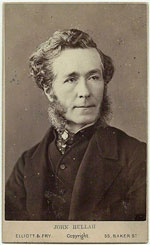
Hullah, John Pyke (1812-1884)
Jolly, John Marks (1790-1864)John Marks was professionally connected with music for nearly 60 years [1]. When he was young he toured in the provinces, acting as well as playing in the orchestra. For 20 years he led the Surrey Theatre orchestra and while there was taken to court for debt. He led and played in several other orchestras. He eventually ended up arranging music for the Oxford Music Hall. He composed some songs and an opera, Mabel (1840), but it only managed one performance at Covent Garden. As was so common, he left his widow in straitened circumstances and a benefit for her was proposed. Kurt Gänzl's blog [2], which is mainly about Jolly's daughters, Elizabeth and Cecilia, includes an anonymous, vituperative, letter listing Jolly's failings to Ben Webster at the Haymarket and warning him against employing Jolly. [1] Obituary in The Era (July 10, 1864) [2] https://kurtofgerolstein.blogspot.com/2018/06/the-jollys-from-buck-house-to-workhouse.html
Lanza, Gesualdo (1879-1859)Signor Lanza, as he was invariably titled, was born in Naples. He came to England around the end of the 18th century. He was primarily a singing teacher with several well known pupils to his credit and a lecturer and writer on singing. He was also a conductor, impresario, and composer of songs, religious works and opera, including Hamet and Zelena that premiered at the Theatre Royal, Dublin, on February 1, 1855.
Laurent, Henri Joseph (1827-1861)Laurent was born in France, the son of Emile Laurent, the director of Promenade Concerts at the English Opera House. It was there where Henri gave his first concert as a pianist in December 1841. Despite some success as a pianist, his leaning was towards composing and, on January 15, 1844, a movement from his new Grand Symphony was given at the Royal Adelaide Gallery, which was managed by his father. In 1846, his father remodeled the gallery as Laurent's Casino and opened it on September 28, 1846 with a concert at which Henri conducted. On March 7, 1847, The Era announced that Henri would compose an opera, Quentin Durward, to a libretto by Edward Fitzball and based on Sir Walter Scott's novel. The opera did not appear until the end of 1848 and was not a success. Henri does not seem to have tried another. He was the musical director at Drury Lane for a season starting at Christmas, 1850. However, his main focus was on conducting at the Argyll Subscription Rooms as well as composing dances and other short works. The Argyll was the new manifestation of the Casino, which had to close after some legal problems. It initially advertised dancing lessons but in time also staged dances.
Lavenu, Lewis Henry (1817-1859)
Levey, William Charles
Linley, George (1797 - 1865) [1]
Leodiensis (Worthies of Leeds) (London: Simpkin, Marshall & Co., 1865), pp. 606-608, and the Oxford Dictionary of National Biography. He does not appear to have been immediately related to the 18th century musical Linleys of Bath. [1] The Newcastle Weekly Chronicle (Sept. 12, 1896) claimed he was born in 1795 but baptism records on Ancestry.co.uk have December 27, 1797) [2] The Queen (Oct. 15, 1864)
Loder, Edward James (1809-1865)
Loder, George (1816-1868) George Loder was one of the musical Loder family of Bath, cousin to Edward Loder, composer of Raymond and Agnes, whose London premiere he conducted in 1859. In 1836, he went to the USA where he stayed for around twenty years, working as teacher, instrumentalist and conductor with various orchestras and institutions. In 1855, he went to Australia with Anna Bishop, where he conducted Lyster's opera troupe. By 1859, he was back in London making a living as conductor, composer and organist. He returned to Australia in 1862 with his second wife, Emma Neville, and died there in 1868 after a long illness. Nicholas Temperley (ed.), Musicians of Bath and Beyond: Edward Loder (1809-1865) and his Family. (Woodbridge: Boydell Press, 2016) includes a detailed account of his life in Andrew Clarke's, "Loder & Sons, Bath: A Band of Musicians", (pp. 97-103) and of his time in Australia in Julia Szuster's "George Loder's Contribution to Musical Life in Colonial Australia" (pp. 149-166). Graeme Skinner's Austral Harmony website, also has details of his life including many reviews.
Lutz, Wilhelm Meyer (1829-1903)
The Era (Aug. 12, 1899) carried a profile of him and the Daily Telegraph (Feb. 2, 1903) a lengthy obituary. Jennifer Carnell, Mary Elizabeth Braddon and the Victorian Theatre, (Hastings: Sensation Press, 2016), p. 23 has a section on him. His composition, Pas de Quatre, is available on youtube
Macfarren, George Alexander (1813 - 1887)
Mallandaine, John Elliot (1838 - 1886)Mallandaine was the nephew of the tenor and theatre manager, Elliot Galer. His first composition, The Haunted Mill, was staged in 1863. In early 1866, he composed Love's Limit to a libretto by Robert Reece and Sylvia, the Forest Maiden, to a text by his uncle, Elliot Galer, both performed at the New Royalty Theatre where he was musical director. More details of his life can be found at the Mallandain Family History web site.
Melon, Alfred (1820-1867)
Mitchell, Alexander (1825 - ) [1]Mitchell was born in London. He did not appear to have a musical background, his father being a solicitor, and was largely self taught, although he was said to have been a pupil of George Alexander Macfarren, himself nearly blind by this time.[2] There are differing reports as to whether Mitchell had been born blind or became completely blind in the late 1830s.[3] He worked out a way of enabling his mother to write down his compositions.[3] As well as composing, he conducted and played the violin, piano and concertina. His only opera was The Last Crusade, which appeared publicly in 1850. He organised many concerts over the years, his focus being on supporting the Milton Society for Improving the Social Standing of the Blind, whose honorary secretary he was. The last mention of him that has been found is in Hertford on March 19, 186 [4]. It is interesting that he always seemed to have been tagged as blind in any reference whereas Macfarren, who was also blind for much of his career, was not. [1] The Observer (Feb.22, 1846) reported him as being in his 21st year. [2] Railway Bell (Oct. 17, 1850) [3] Hertford Mercury (Mar. 21, 1863). The Era (Nov. 10, 1850) stated that he was "self-educated" and, quoting some other unnamed source, that he was "was born blind". [4] The Observer (Feb.22, 1846).
Mori, Frank (1820 - 1873)Mori was from a musical family, his father Nicholas being a well known violinist and the composer, Lewis Lavenu, his half brother. Mori was best known as a teacher, conductor, accompanist and composer of songs. He composed one English opera, The River Sprite, to a libretto by George Linley that was staged at Covent Garden in February 1865. More detail on Mori and his father can be found at the Abraham Adcock blog.
Packer, Charles Sandys (1810-1883) [1]
[1] Biography at E. J. Lea-Scarlett, "Packer, Charles Sandys (Stuart Shipley) (1810 - 1883)", Australian Dictionary of Biography, ( National Centre of Biography, Australian National University, 1974) http://adb.anu.edu.au/biography/packer-charles-sandys-stuart-shipley-4353/text7071 [2] Maree-rose Jones, "Musical Activities at the Royal Victoria Theatre, Hobart", Tasmanian Historical Research Association, No. 54, Vol. 3, December 2007, in particular pp.149-151. [3] A performance of the oratorio was given
in Tasmania in April 2021, see
https://www.abc.net.au/listen/programs/hobart-your-afternoon/charles-s-packer-oratorio/13446444
&
https://www.abc.net.au/news/2021-07-28/choral-recovery-charles-s-packer-masterpiece/ [4] Graeme Skinner, Towards a general theory of Australian Musical composition. (University of Sydney: PhD thesis, 2011), p.284-291.
Phillips, Henry (1801 - 1876)Better known as a singer, see here
Reece, George Benjamin
Rodwell, George Herbert Bonaparte (1800 - 1852)
He wrote three English operas: The Lord of the Isles (1834) and The Sexton of Cologne (1836), both to librettos by Edward Fitzball and The Spirit of the Bell (1835) with James Kenney. Fitzball said of him "Rodwell, though not a great composer, was a first rate melodist"[1]. Retrospect Opera have released a version of the melodrama Jack Sheppard with music by George Rodwell. [1] The Observer (Apr. 1, 1838) [2] Edward Fitzball, Thirty Five Years of a Dramatic Author's Life. (London: T.C.Newby, 1859), p.36
Romer, Francis (Frank) (1810-1889)Frank Romer was brother of the well know singer Emma Romer and brother in law of Mark Lemon, one of the founders of Punch magazine. His first appearance in the press was as a composer in 1833 when he was mentioned as having rescored a version of Bellini's La sonnambula for a benefit performance by Emma at the Royal Victoria. Later he arranged the music of Marschner's Des Falkners Braut to a new libretto by Lemon in the opera Rob of the Fen in 1838 at the Lyceum. 1836 saw the staging of his opera The Pacha's Bridal and 1841 that of Fridolin, (originally titled The Seneschal) both to librettos by Lemon. Fridolin's failure appears to have ended his opera career although he continued to compose songs often to words by Lemon but also including a setting of some Longfellow poems. As well as some teaching, eventually becoming a professor at Trinity College, London[1], he wrote a treatise on singing and became a publisher with James Cock and Charles Lane Hutchings. That partnership was dissolved in 1865 (Perry's Bankrupt Gazette, Jan. 7, 1865) but he must have then become a partner with Hutchings as their partnership was dissolved in 1884 (The London Gazette, May 2 1884). He died in 1889. His son, Robert, became an M.P. and later a Lord Justice of Appeal. [1] Patricia de Montfort, Louise Jopling ( Abingdon, UK: Routledge, 2017)
Rooke, William Michael (1794 - 1847)
Schira, Francesco (1809-1883)
[1] Lloyd's Weekly Newspaper (May 4, 1845) Maddox was awarded £200. [2] Signor Schira by Camille Silvy, albumen print, 29 October 1861. NPG Ax56205
Smart, Henry Thomas (1813-1879)
[1] This can be found at https://dn790003.ca.archive.org/0/items/cu31924022193456/cu31924022193456.pdf
Tully, James Howard (1814-1868)
Wallace, William Vincent (1812 - 1865) |


 |
 |
 |
  |
|
|