  |
 |

|
  (William) Howard Glover1819-1875Glover's Life and Work
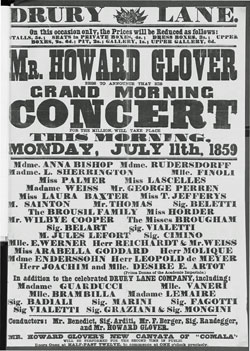
son of Julia Glover one of the best known actresses of the first half of the 19th century. His father was probably John Howard Payne, American actor, playwright and author, including the words of Home Sweet Home. Glover, who always used Howard in preference to William as a first name, had a good musical education on the continent. In 1842 he was reported as having an opera Attila staged in Frankfurt but by the next year he was back in Britain. A rather patchy career followed including teacher, singer, violinist, pianist, conductor, critic (Morning Post), impresario, librettist and composer but he never made a solid success of any of them despite his obvious abilities. Partly this was due to his poor financial skills, ending up bankrupt at least three times, but also to a certain volatility of temperament. It was said of him that he stood in his own light. In 1868 to try to revive his fortunes, his friends paid for him and his family to go to the United States where he took up a position as conductor at Niblo’s Garden in New York. However, as Joseph Bennett [1] wrote “the habits of years could not be shaken off, and the only change was a change of place”. In 1874 a benefit concert was promoted in New York to relieve the family’s hardship. A year later he died leaving his wife and 12 children destitute. Ruy Blas (1861) was his only published serious opera. A further opera, Attila (1842) had been staged in Frankfurt but only a few excerpts were ever sung in London. His best known cantata was Tam O’Shanter (1855), Others included Hero and Leander (1850), which was originally planned as an opera, one for the marriage of the Princess Royal to Prince Frederick William of Prussia (1858) and Comala (1859). His comic opera, Aminta, the Coquette, was given in London in 1852, although earlier versions had been giving in the provinces. His operettas included Once too often (1862) and Palomita (1875). Glover’s friend and early librettist, Archer Gurney, "had for him a sincere affection as well as admiration, and grieved not lightly over his premature death and comparative failure in life". Gurney summed up Glover’s life that "He was witty and agreeable with a dash of bitterness" and that he "possessed several qualities of a great composer, a strong vein of melody, imagination, grace, power, knowledge and dramatic fire - but was wanting in perseverance, being unable or unwilling to face severe and continuous application". He did soften this with the thought that "Let his trying nightwork [as musical critic of the Morning Post] be borne in mind" [2]. A more detailed description of his life and career can be found at Howard_Glover_Life_and_Career.pdf . [1] Joseph Bennett. Forty Years of Music. (London: Methuen & Co., 1908), p.20 [2] Augustus Gurney, A Remarkable Clerical Career. ed. David Gurney (Market Harborough: Troubadour, 2025), ebook - https://troubador.co.uk/bookshop/biography/a-remarkable-clerical-career , p. 413. This was a memoir of his brother Archer Gurney. Archer Gurney did not include Glover in his list of neglected English composers in his letter to the Musical Times (1 June 1881) |
 |
 |
 |
  |
|
|