London theatres premiering English
Romantic Opera
The following outlines the history, during
the English Romantic Opera era, of London theatres that premiered
the major English operas. Five
are still in use as theatres. Only one opera of note, Loder's Raymond and Agnes, was premiered outside London, at
the Theatre Royal, Manchester in 1855. There are many books on
London theatres, both city wide and individual, the classic ones
are The Theatres Of London and The Lost
Theatres of London by Raymond Mander and Joe Mitchenson. http://www.arthurlloyd.co.uk/
has
extensive histories and old photographs of many UK music halls and
theatres. Unfortunately, the
Theatres Trust
has taken down its archive of old theatres, although it offers
to help with questions on particular theatres.
https://victorianweb.org/victorian/mt/theaters/pva234.html
has short histories of many London theatres.
Benjamin Vincent,
ed.,
Haydn’s Dictionary of Dates. 12th edition (London:
Edward Moxon and Co., 1866), pp. 710-713, has lists of
managers and major incidents at the main London theatres up to
1866. Edward Wedlake Brayley's,
Historical and Descriptive Accounts of the Theatres of
London. (London: J. Taylor, 1826) covers the period
immediately before the advent of English Romantic Opera.
The Society
for Theatre Research has a list of
Theatre and Music Hall Licensees taken from Diana Howard, London
Theatres & Music Halls: 1850-1950. (London: The Library
Association, 1970)
The website
https://logicmgmt.com/1876/Victorian_theatre/victorian_theatre.htm
looks at various aspects of Victorian theatre.
|
Sometimes
called the Little Theatre, Haymarket, it was founded in
1702. At that time, Drury Lane
and Covent Garden were the only London theatres that were licenced to stage spoken drama. However,
in 1766, the Haymarket was licenced to stage spoken drama in the summer. It was
rebuilt to designs by John Nash and reopened in 1821;
the Nash facade is essentially unchanged.
The prices, in 1830, were:- Boxes-5s, Pit-3s., Lower
Gallery-2s., Upper Gallery-1s. Performances began
at 7pm [1]. Benjamin Webster managed the theatre from
1837 until 1853 after which John Buckstone took over
until 1877.
It was in
November 1861 that Taylor's Our American Cousin
was first performed there. It ran for 400 performances and was
said to mark the start of the "long run", where one
play, when successful, was performed continuously while
audience number held up, as opposed to the earlier
practice of changing and alternating productions.[2]
|
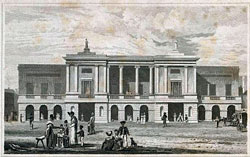
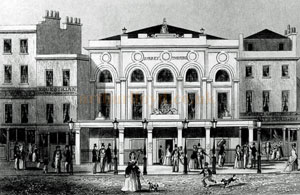
Haymarket Theatre ( circa1830) |
The
theatre played
little part in English opera, being more focused on
spoken drama, until 1851, when it staged Edward
Fitzwilliam's The Queen of a Day and
revived Macfarren's King Charles the Second.
The following year it staged Howard Glover's Aminta
the Coquette and Emanuele Billetta's White
Magic and, in 1855, Henry Smart's Berta.
Books on the theatre include-
William J. Burling,
Summer Theatre in London 1661-1820, and the
Rise of the Haymarket Theatre (London: Associated University
Presses, Inc., 2000)
Online resources-
https://trh.co.uk/theatre-history/
http://www.arthurlloyd.co.uk/TheatreRoyalHaymarket.htm
|
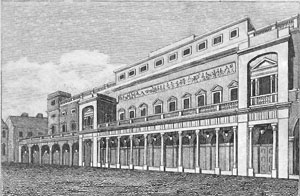
The
theatre was rebuilt after burning down in 1790
with the exterior design by John Nash added in 1818. It became Her Majesty's Theatre on the
accession of Queen Victoria in 1837; there already was a
Queen's Theatre. There were five tiers of boxes, all of
which were private property or let for the season. The
boxes accommodated about 800 persons, the pit 800 and
the gallery 800. There was also a grand concert room.
The prices, in 1830, were:- Pit-10s.6d., Stalls-14s.6d.,
Gallery-5s. Performances began at 7pm.[1]
Edward Smith and
his manager, James Mapleson, produced three seasons of
English opera there between 1858 and 1861, including Macfarren's Robin Hood
(1860) and Wallace's The Amber Witch (1861).
Mapleson took over the theatre in 1862 until it burnt down in 1867.
It was mainly devoted to Italian opera
|
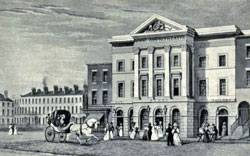
Kings' Theatre (circa 1830)
|
but there were some English operettas,
such as William Levey's Fanchette (1864) and
Punchinello (1864). On rebuilding, it continued to stage
important operatic work for much of the rest of the century including several
Carl Rosa seasons and the first performance in England of
Wagner's
Der Ring.
The theatre also had a concert room,
which was known as the Bijou theatre, where, from around 1860,
small scale operettas, such as Clay's Out of Sight
(1861), were sometimes performed. This should not be confused
with the Victoria Hall, Bayswater, which was sometimes called
the Bijou Theatre, Bayswater.
Books on the theatre include-
Daniel Nalbach, The King's Theatre. (London: The Society for Theatre Research, 1972)
Online
information on the theatre includes -
http://www.arthurlloyd.co.uk/HerMajestysTheatre.htm
Pip Clayton wrote a series of articles on the theatre's
history in the
Donizetti Society Newsletters
no.112 (February 2011),
no.114 (October 2011),
no.115 (February 2012),
no.116 (June 2012),
no. 117 (October 2012) and
no. 118 (February 2013). Nos. 116 and 117 cover the
English Romantic Opera era
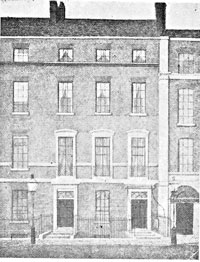
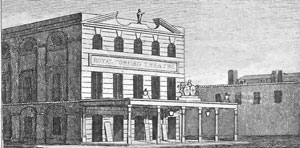
The theatre was opened in 1840 by actress and singer, Fanny Kelly, who ran
it in tandem with her Theatre and Dramatic School. The
theatre was designed by Samuel Beazley and, initially,
held only around 200 customers. Its horse powered scene
changing machinery proved a fiasco on the opening night
and, overall, the theatre had little success. Kelly
eventually had to sell up to cover debts in 1849.
It
was taken over by Charles Gilbert who advertised it for
rent claiming that it held 700 people and was lit by
gas[1]. A cooperative under the leadership of John Gregg [2] hired it and it reopened on November 5, 1850 as the New English Opera
House. It premiered Alexander Mitchell’s The Last
Crusade, which possibly lasted just one night and
was its only offering. The theatre became
the Royal Soho and continued to be hired out. On January 23,
1855, Mary Pyne Galton, one of the Pyne sisters, hired
it for her "first benefit", which included a performance
of Wallace's Maritana.
It
was enlarged, refurbished and reopened in 1861 under the name
of the New Royalty Theatre. It offered mainly comedies,
burlesques and the occasional operetta but it could not
sustain a regular programme and was periodically up for
rent or for use by amateur companies.
|
Miss Kelly's Theatre (1840) - Mander
and Mitchenson, The Lost Theatres of London |
In
1865-1866, it did see a brief period of new English
opera, although on nothing like the scale or seriousness
of Pyne and Harrison's earlier efforts. Elliot Galer and
Fanny Reeves too it over in June 1865 and revived George
Allen's Castle Grim that had premiered in the
May at the Victoria Hall, Bayswater. On October 23, 1865,
they
staged the premiere of Meyer Lutz's Felix or
the Festival of Flowers and early in 1866 the
premieres of John Mallandaine's Love's Limits and Sylvia, the Forest Flower. It
later dropped "New" from the title. Gilbert and
Sullivan's Trial by Jury was premiered there in
1875.
Books on the theatre include:-
Raymond Mander and Joe
Mitchenson, The Lost Theatres of London. (London:
Rupert Hart-Davis, 1968), pp. 402 - 429.
Online information on the theatre includes -
http://www.arthurlloyd.co.uk/Royalty.htm
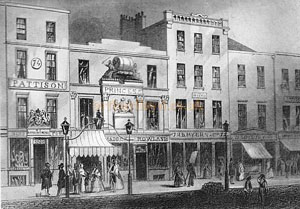
This was another theatre opened in 1840. John Maddox presented
drama and continental opera in English there from 1843-50. He also produced a number of
Balfe operas as well as the premieres of Loder's The Night Dancers in 1846,
George Linley's Francesca Doria, Macfarren's King Charles
the Second and Francesco Schira's Mina in 1849
and Schira's The Orphan of Geneva in 1850.
With
Maddox's departure in May 1850, it became devoted mainly to spoken drama,
notably when managed by Charles Kean in the 1850s. Carl Rosa used it for
his first London season
in 1875. The theatre was demolished in 1880 but rebuilt, being demolished
finally in 1931.
|
http://www.arthurlloyd.co.uk/Princess.htm |
Books on the theatre
include:-
Raymond Mander and Joe
Mitchenson, The Lost Theatres of London. (London:
Rupert Hart-Davis, 1968), pp. 335 - 357. Online information on the theatre
includes-
http://www.arthurlloyd.co.uk/Princess.htm
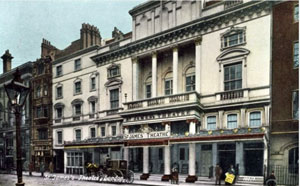
The
theatre was built in 1835 to a design by Samuel Beazley and owned by the tenor John Braham. However, it had little success
and by 1838 Braham was ruined and ownership moved elsewhere. During Braham's management, it saw two premieres:-
à Beckett's Agnes
Sorel (1835) and Hullah's The Village Coquettes (1836). In
November 1839, Alfred Bunn was, briefly, the manager and changed
the theatre's
name to the Prince's Theatre, in honour of Prince Albert,
then just engaged to Queen Victoria. A year later John
Barnett and Morris Barnett took over the theatre, "which
they [purposed] devoting, exclusively, to the production
of English Operas and Musical Afterpieces" and to the
employment of "British operatic artists" (see
here).
However, they had to give up after less than two weeks,
but did manage to stage the |
Theatres
Trust |
premiere of Frank Romer and Mark Lemon's Fridolin
on November 26, 1840. The theatre reverted to the St James's
name in 1842. The theatre never staged any more premieres of
English opera, although there was at least one, very
short, attempt to mount an English opera season there in 1853,
which had planned to include Barnett's Mountain Sylph.[1]
The theatre was on King Street and was
demolished in 1957. The current St James's Theatre is unrelated.
Books on the theatre include-
A Chronicle of the St. James's Theatre, (c1900?) at
https://archive.org/details/chronicleofstjam00londuoft
Barry Duncan, The St James's Theatre, it's Strange & Complete History. ( London: Barrie & Rockcliff, 1964)
Raymond Mander and Joe
Mitchenson, The Lost Theatres of London. (London:
Rupert Hart-Davis, 1968), pp. 451 - 484.
Online information on the theatre includes-
http://www.arthurlloyd.co.uk/StJamesTheatre.htm
https://www.british-history.ac.uk/old-new-london/vol4/pp191-206
Built in 1782 as the Royal Circus it
had burned down twice by 1805. From then on, it mainly specialised
in popular entertainment becoming a byword for
melodrama. During his stint between 1827 and 1831,
Robert Elliston produced a number of Shakespeare plays,
adding music to circumvent the regulations. He also put
on some continental operas in English.
Its most successful period was under
the Davidges, George having the lease from 1834 until
his death in 1842, when his wife, Frances, took it on
until 1848. She sometimes employed or sublet to a
manager to run things, including Alfred Bunn from
September 1847 to February 1848, shortly after which she gave up the lease. The Davidges
put on continental operas |
http://www.arthurlloyd.co.uk/surrey.htm |
in English and some older, established English operas but rarely new English opera.
However, they did premiere Rodwell's Lord of the Isles (1834)
and
à Beckett's
Little Red Riding Hood (1842). The Davidges were
unusual in making alot of money from their time running the
Surrey theatre.
After Frances Davidge's departure, the
new lessees, Richard Shepherd and William Creswick continued its previous opera policy with Emma Romer as
director from 1852-55. The only English opera premiered was
Balfe's The Devil's
in it (1852). In June 1856, Shepherd and Creswick tried giving Italian
opera in Italian but that collapsed within a month. The next
attempt at opera was in June 1857 when they hosted a three month
season of the
National English Opera Company with James Tully as musical
director. No new English operas were given. The theatre caught fire again during 1865 and
after its rebuilding it concentrated mainly on pantomimes and
drama. It was demolished in 1934.
Also known as The Royal Surrey Theatre.
Books on the theatre include-
William G. Knight, A Major London 'Minor', The Surrey Theatre, 1805-1865.
(London: The Society for Theatre Research, 1997)
Jim Davis and Victor Emeljanow,
Reflecting the Audience. (Hatfield: University of
Hertfordshire, 2001), pp. 3 - 40 has a chapter on the
repertoires and audiences of the Surrey and the Victoria (Old
Vic) theatres
Online information on the theatre includes-
http://www.arthurlloyd.co.uk/surrey.htm
According to the Arthur Lloyd website,
the Victoria Hall was built in 1863 by John Burgoyne, part of a
small complex in Bayswater. The website claims that it was
renamed the Bijou theatre in 1866, but when George Allen's comic
opera, Castle Grim, was premiered there on May 23,
1865, the advertisement in the Bayswater Chronicle (May
20, 1865) listed it as the Bayswater Bijou Theatre. It was the
only English opera premiered (or possibly ever performed) there.
It seems to have closed around 1873 and then refurbished and
reopened in 1893. It later served a number of uses becoming the
Twentieth Century Theatre in 1936 but eventually fell into
disuse and turned into part of an antiques warehouse in the
1960s. Its most notable claim to fame was in staging the UK
premiere of Oscar Wilde's Salome in May 1905. It was
given as a private club performance as the play had been refused
a licence by the Examiner.
Online information on the theatre includes-
http://www.arthurlloyd.co.uk/TwentiethCenturyTheatre.htm
Theatres outside London premiering
English Romantic Opera
Online information on the theatre includes-
http://www.arthurlloyd.co.uk/Dublin/TheatreRoyalDublin/TheatreRoyalDublin.htm
Royal Amphitheatre
(Cooke's Royal Amphitheatre of Arts), Liverpool
https://www.facebook.com/groups/billysliverpoolofyesterday/posts/438013917054359/
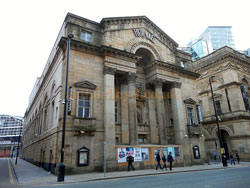
The theatre was built in 1845
and re-modelled in 1875 and then closed in 1921. It saw
the premiere of Loder's Raymond and Agnes in
August 1855. It was later taken over by a nightclub that
closed in 2009. It is currently empty.
Online information on the theatre includes-
http://www.arthurlloyd.co.uk/ManchesterTheatres/
TheatreRoyalManchester.htm
Liz Cooper, "The Theatre Royal, Manchester, in
Edward Loder's Time" in Nicholas Temperley (ed.), Musicians of Bath and Beyond: Edward Loder (1809-1865)
and his Family, (Woodbridge: The Boydell Press,
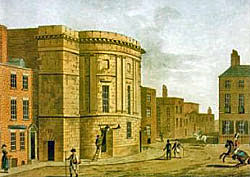
2016), pp. 42-57. |
Arthur Lloyd |
Other London theatres that sometimes feature
Eastern Opera House
This
was essentially more an aspirational label than an institution.
It did stage some opera in English, including some
English opera, but in the end failed to establish opera
permanently in the east end of London. The City of
London Theatre first used the title during the 1855-1856
season when they staged several operas conducted by
Frederick Kingsbury. After a gap of
around four
years, it was then used by the Pavilion Theatre in
Whitechapel.
In February, 1856, the
Pavilion Theatre had burnt down. It was rebuilt as the
New Royal Pavilion Theatre and opened on October
30,1858, staging mainly light and comic drama. However,
in April 1860, James Tully brought an English Opera
company there and the lessee, John Douglass, decided to
resurrect the Eastern Opera House (sometimes Eastern
English Opera House) label. Tully's season only lasted
until mid May but in August Douglass announced that
alterations would be made to convert "this Colossal
Theatre into a permanent
|
New Royal Pavilion Theatre
Wikipedia |
English and Italian opera House"[1]. He opened his
opera season on August 25, 1860, the Daily News (Aug. 27, 1860)
noting that "There might be more noisiness and somewhat more
freedom of attire than are characteristic of our west-end
audiences; but certainly in earnestness and determination to
enjoy, the easterns far outshone the westerns". In October, he
took on Meyer Lutz as conductor, but unfortunately the
initiative petered out before the end of the year. Even though
the theatre continued to use the title for about a decade, it
did not put on any more opera. Presumably, as so often,
Douglass was unable to make it pay.
More information on the City of London theatre - http://www.arthurlloyd.co.uk/CityOfLondonTheatre.htm
More information on the Pavilion Theatre - http://www.arthurlloyd.co.uk/PavilionTheatreAndWonderland
WhitechapelRoad.htm
Opened
in 1806, it was managed between 1830 and 1838 by Lucy
Vestris, a singer and dancer who offered a variety of
musical shows, mainly burlesques often on classical
themes, but with an occasional adapted continental
opera, such as Auber's Le Philtre (The Love
Spell) in 1831 and The Black Domino
(1838). It never
staged an English opera. Vestris instigated several
innovations, including more historically correct
costumes, better scenery, and introducing the box set. Not least
she insisted on proper rehearsal time.
After 1838, the theatre
never achieved any consistent success offering mainly comic
works and melodrama. It again burnt down in 1849 but was
rebuilt only to be |
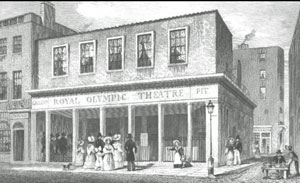
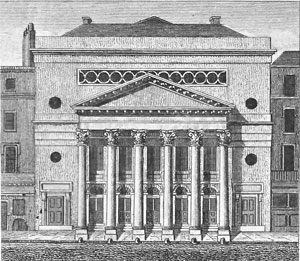
Olympic Theatre (1830) - Wikipedia |
demolished in 1889.
Although again rebuilt, it lasted
only a decade or so more. Books on
the theatre include:-
Raymond Mander and Joe
Mitchenson, The Lost Theatres of London. (London:
Rupert Hart-Davis, 1968), pp. 253 - 287. Online information on the theatre includes -
http://www.arthurlloyd.co.uk/Olympic.htm
|
Originally
opened in 1818 by Joseph Glossop, it changed its name to
the Royal Victoria Theatre in 1833, after Queen Victoria's mother.
It became known as the Old Vic towards the end of the
century.
Its early
days were mainly taken up with "burlettas" of various
types, i.e. plays with music to get round the
prohibition on spoken drama other than in the patent
theatres. No English opera seems to have been staged
although there was a company calling itself the English
Opera Company for a short while.[1]
Books on
the theatre include-
|
Royal Coburg Theatre ( circa1830)
|
Peter Roberts, The Old Vic
Story,, (London: W.H.Allen, 1967) Jim Davis and Victor Emeljanow,
Reflecting the Audience. (Hatfield: University of
Hertfordshire, 2001), pp. 3 - 40 has a chapter on the
repertoires and audiences of the Surrey and the Victoria (Old
Vic) theatres
Raymond Mander and Joe
Mitchenson, The Theatres of London. (London:
New English Library, 1975), pp. 260-266.
Online information on the theatre includes-
http://www.arthurlloyd.co.uk/OldVicTheatre.htm
|