  |
 |

|
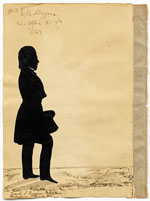
  Joseph Francis Duggan1817 - ?Duggan was born in Dublin probably in 1817 [1]. There seems nothing on his early life and training but he went to the US at some point, possibly with the Seguins in August 1838 as in May, 1839, the Seguin company in New York sang some of his music. Initially, he acted as opera accompanist and conductor and as part of the orchestra for a short opera season at the National Theatre, Washington, at the end of 1839 [2]. In 1841, he became Principal of the Philadelphia Musical Institute and he was described in the silhouette as Professor of Music, Philadelphia, November 7, 1843. He then went to Paris in 1844-1845 before coming back to the UK. He became chorus master and possibly musical director of the Princess's Theatre [3] or, at least the latter was how he was described in the Charleston Daily Courier (Sep.21,1847) on his return to New York from London on the Victoria, along with the Manvers, Miss Brienti and Augustus Giubilei and his wife. In early 1847, while at the Princess's, he had composed incidental music and songs for at least two dramas: King of the Brigands and The King and the Piper.
As well as composing further songs, he also taught and conducted. In 1857, St George started a tour of her one woman show with music by Duggan. Duggan continued to work with the Draytons providing music for their Operatic Proverbs in 1858. In 1865, he was an unsuccessful candidate for Professor of Music at Edinburgh University [6], although he did eventually become a professor at the Guildhall School of Music in 1881. In 1868, he finished a three act opera, The Brides of Venice or Leonora, with a libretto by John Brougham but it was not performed. The score is in the British Library, donated by Julia St. George in 1895 [7]. Composition, teaching and conducting occupied him for the rest of his career. He also published a few books including a translation of one by Albrechtsberger. Other than occasional performances of his songs, there are no mentions of him after 1883 when he was named as a Professor at the Guildhall School of Music [8] unless the Ralph F. Duggan in the 1891 census is him. [1] There is a parish register (ancestry.com) showing a Joseph Francis Duggan baptised in Dublin on July 27, 1817. This would fit with the Musical Courier (July 10, 1907), p.20, naming him, Francis Joseph Duggan, listing his birth as in July 1817. No death date was given. The 1851 census listed Duggan as 31 and the 1881 as 63. The 1881 census had Duggan as a boarder in Julia St George's house. The 1891 census showed a "Ralph F Duggan", music composer aged 76 born in Dublin, living next door to St George. It is not clear why Joseph would have changed his name and birth year so this may have been an older brother or relation implying that Joseph Duggan had died prior to 1891. On the other hand there is no other trace of Ralph Duggan. The Smithsonian portrait has Duggan's dates as 1817-1879 but he was still alive at the time of the 1881 census. Brian C. Thompson, "Henri Drayton, English Opera and Anglo-American Relations, 1850 - 72" , Journal of the Royal Musical Association (Volume 136, No. 2, 2011, p. 250, gave his death as 1900 but one would have thought that he had died before 1894 when his friend and, possibly, wife, Julia St George donated his testimonials for the Edinburgh University professorship to the British Museum. Thompson lists some of Duggan's work with the Draytons. [2] James D. Brown and Stephen S. Stratton, British Musical Biography (Birmingham: S.S. Stratton, 1897), p.130. Daily National Intelligencer (Dec. 9, 1839) [3] The Morning Advertiser (Dec. 15, 1846) said that Duggan was chorus master for Loder's The Night Dancers in October 1846. It was around that time that Loder was appointed musical director at the Princess's - Nicholas Temperley (ed.), Musicians of Bath and Beyond: Edward Loder (1809-1865) and his Family (Boydell Press: Woodbridge, 2016), p.137. Grove Dictionary (1900), p.760, says that Charles Horn was appointed musical director in 1845 following Francesco Schira's move to Drury Lane. The Standard (May 27, 1847) thought that Duggan was a member of the orchestra. [4] Taunton Courier (July 9, 1851) [5] Brown and Stratton, Loc.Cit. [6] The Examiner (Oct 21, 1865) advertised that he was a candidate. The British Library, Add MS 34710 I, has testimonials in support of his candidature, including from Berlioz ("est un musicien fort distingué et très savant"), David, Mellon, Auber, Fétis, Mellon, Benedict and a two page printed statement of his qualities from 16 "members of the musical profession in Edinburgh". Interestingly also the singer Charlotte Sainton, as one might have thought such testimonials would have been a male preserve. Despite such a distinguished set of musical supporters he did not get the job, possibly because they were almost all practicing musicians rather than academics. The original bequest to the British Museum was described as being by Madame St. George, widow of J.F. Duggan, although no trace of a marriage has been found. Both the 1891 census and when she was admitted briefly to the St Pancras Workhouse shortly before her death in November 1903 listed her status as single. In the 1881 census it said widow. [7} Return for the British Museum, 1896 [8] Illustrated Sporting and Dramatic News (May 12, 1883) |
 |
 |
 |
  |
|
|