  |
 |

|
  Sadak
and Kalasrade
|
|
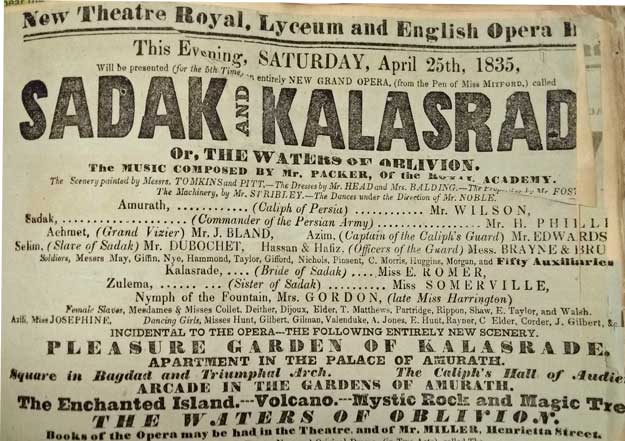
Amurath (the Caliph) Sadak Achmet (Vizier) Azim Selim Hassan Hafiz
Kalasrade Zulema (her attendant) Nymph of the Fountain |
- Mr Edwards / (Mr Edmonds) [1]
|
History
Mary Mitford and Charles Packer had had success with a dramatic scene at a Royal Academy concert in 1832 [1] and perhaps that encouraged them to try a full blown opera. The opera opened Arnold's 1835 season but proved a complete failure and was withdrawn after just a week. Following Packer's transportation to Australia for forgery and his subsequent musical career there, the overture and, on at least one occasion, a trio found their way into several concerts in Hobart in the mid-late 1840's, e.g. on February 7, 1848 [3]. The News (Apr. 5, 1835) stated that on March 31, i.e. 3 weeks before the opening night, the opera was read before a full company at the opera house, which shows how tight a schedule was allowed for a production. The Public Ledger (Apr. 13, 1835) reported that the opera was ready, just two weeks after the reading.
Plot
The plot is based on James Ridley's Tales of the Genii, which was originally published in 1764 under the claimed authorship of Sir Charles Morell, a device to mask the fact that Ridley was a clergyman. It had been used as a basis for various works since then.
Sadak, who has been away fighting in the service of the Caliph of Persia, Amurath, returns to find his palace burnt down and his wife, Kalasrade, abducted by the Caliph, who is besotted with her. When Sadak arrives at the Caliph’s palace he decides against taking revenge but instead implores the Caliph to let her go. The Caliph says that he will provided Sadak brings him a cup of the waters of oblivion within a month, Kalasrade having made that the condition of her yielding to the Caliph. Overcoming various obstacles with the help of the Nymph of the Fountain, Sadak returns with the water just in time. The Caliph then drinks the water believing an old prophecy that it will be good for Persia and for love but immediately falls dead and Sadak and Kalasrade are reunited.
Reception
The reception was very lukewarm. The Supplement to the Musical Library (May 1835, p.48), commented on Mitford's lack of dramatic experience and that "Situations that would have been perceived by a practised dramatist have been neglected" while her strength, her poetry, could not be appreciated because the text had not been printed beforehand and, in a comment reminiscent of today, " few singers take the trouble to pronounce a single syllable distinctly".
The Literary Gazette (April 25, 1835, p.269) found it "monotonous, both in construction and music" and advised "the substitution of some other opera, as soon as may be". The Morning Chronicle (April 21, 1835) was of the same opinion although the performance led it "to expect a great deal from the young composer's more matured efforts" and thought the staging was good and that the performers tried their best. It claimed that "so much disapprobation was expressed" that it was not announced for repetition. However, The Times (April 21, 1835) claimed that it was announced for repetition, although it found little memorable about the opera and while it had "some tolerably good airs and some pretty poetry, it went off but heavily" . The Supplement (loc.cit) did not want "the young composer to be discouraged" but to learn his lesson from it, "Let him hereafter reflect well before he appeals to the public, and submit his next essay to a sensible friend, ere he suffers it to be put in a manager's hand.
Comment
It was very unusual to name the librettist on a playbill. Presumably, as Mitford was a well known novelist it was thought that this would encourage audiences to come.
Scores and libretto
The manuscript submitted to the Examiner can be found in the British Library at Add MS 42930 ff.162-184b. The covering letter was dated April 1, 1835 and it was signed off on April 4. The printed libretto (London: S.G. Fairbrother, 1835) is available in the British Library [1] and at the Library of Congress. The manuscript and printed versions are mainly identical but the printed libretto has some extra songs: for Kalasrade in Act 1, Scene 5 (p.13), for Sadak in Act 1 Scene 6 (p.17) and for Amurath in Act 2, scene 1 (p.21). There was no surviving evidence of official approval of these additions.
[1] This scan has temporarily been included here as the original link no longer works as a result of the British Library cyber incident.
Recordings
There are no known recordings of any of the opera.
Books, Articles, Online
There are no known articles or books on the opera. The Astralharmony website carries extensive quotes from newspaper reviews of the day. See https://www.sydney.edu.au/paradisec/australharmony/packer-family.php#sadak-and-kalasrade
[1] The advertisement in the Morning Post up to and including the first night on April 20 announced that it was the first appearance of Mr Edmonds. Edmonds was almost certainly Mr Edmund Edmunds, as several newspapers misspelt his name and no other Mr Edmonds has been found listed in theatre advertisements around this time.. In fact, the poster for the 5th performance and the libretto named Mr Edwards. Bell's New Weekly Messenger (Apr. 26, 1835) wrote that "A Mr Edwards, from the Bath Theatre, made his first appearance ... The part he played was one of little prominence" and most reviews ignored him. However, it is not clear whether the paper was reviewing the opening night. The Morning Herald (Apr. 21, 1835) claimed that that night's performance was Edmonds' 2nd appearance. Thus it is possible that he sang the first two performances and that Edwards, for some reason, then took over the rest. Edwards was still in Bath on April 16 singing at a concert so he might have been a last minute replacement. He had been singing with Emma Romer in Barnett's The Mountain Sylph earlier in the month, so she would have been in a position to recommend him if the need had arisen. As neither singer was probably known to London audiences, it would have been easy to get confused.
[2] The Morning Post (Apr. 16, 1832)
[3] Colonial Times (Hobart, February 4, 1848)
 |
 |
 |
  |
|
|