  |
 |

|
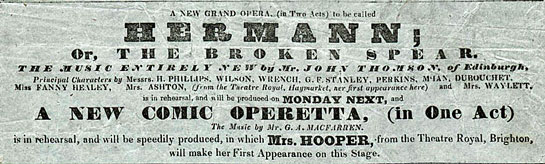
  Hermann or The Broken SpearMusic by John ThomsonLibretto by Reverend Richard Harris Barham?
English Opera House,
London
|
|
Hermann Conrad Giamar Duke of Austria Prosenburg Griffinclaw Wolfgang Leopold
Isabella Margaret Maralda |
- ?
- Miss Somerville (replacing Harriet Waylett) |
History
Notwithstanding the continuing success of The Mountain Sylph, Arnold launched yet another new opera, Hermann, the first by John Thomson. Although Hermann gained some approval, its final performance was on November 10, 1834 just before the close of the season giving a total of 9 performances. In November, Fanny Horsley [1] wrote to her sister Lucy that "Poor John Thomson is in excessively low spirits at the bad success of his opera Hermann". The failure clearly still smarted nearly six years later in 1840, when Thomson wrote : "Having once experienced the miseries of dramatic authorship in the shabby production, reckless mutilation, and foul murder of an unfortunate opera of mine, called Herrmann"[2]. The opera does not seem to have been revived or given outside London. The inclusion of a dumb heroine was not unknown in early 19th century drama and its most recent example was the very successful La Muette de Portici (Masaniello), as both an opera (Auber) and as a ballet, over the previous year or so. The authorship of the libretto was not divulged, the Standard (Oct. 28, 1834) dismissing the idea that Thomson might have written it himself. However, there are reasons to believe that it was the Reverend Richard Harris Barham (see comments below). Occasionally, the opera was called Herman or Herrmann, as John Thomson does in the quote above. |
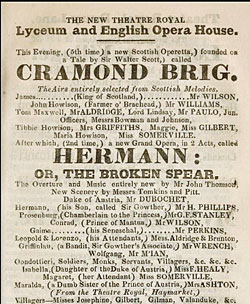 Theatrical Observer (Oct. 28, 1834) - Archive.org |
Plot
According to the Caledonian Mercury (November 1, 1834) the story was based on one of the stories associated with the medieval legend of Robert the Devil. The Morning Chronicle (October 28, 1834) described the plot as follows:-
Hermann, the profligate son of the Duke of Austria, after running through a career of vice, has put himself at the head of a band of condottieri, as Sir Gowther of the Blood-red Hand. While in the midst of his revels with his banditti he hears of the nuptials of a young couple at a neighbouring convent, and determines to carry off the bride at the altar. To effect his purpose he disguises himself and his band as monks and, having surprised the party and torn the bride from her lover, he is horror-stricken at finding that she is his own sister, Isabella, who is about to be married to Conrad, Prince of Mantua. He commands his followers to forbear, and the intended nuptials are suffered to proceed, and the profligate flies to the desert in despair at the sense of his crimes to which the incident has awakened him.
We next come to the Court of the Mantuan Prince, where Giamar, his Seneschal, is plotting to subvert his throne by an insurrection, aided by the condottieri. A miserable mendicant appears at the Palace, and is scoffed at and mocked by the retinue of the Prince and Princess, by whom he is delivered from their persecution. Here Maralda, a dumb sister of Conrad, who has been flitting about very mysteriously through the story, comes to the relief of the poor stranger just as he is sinking from exhaustion, and by her attentions recovers him in time to supply him with arms, and inspire him with energy to repel the attack of the insurgents on the Palace. After the battle the unknown knight is not to be found, but his prowess and services induce the Prince to offer his dumb sister in marriage as his reward if he will make himself known. A spear has been broken in the battle, leaving the head in the wounded shoulder of the knight, and the handle is in the possession of Conrad. The traitor Seneschal here comes forward, pretends to be wounded in the shoulder, produces a broken spear-head, and claims the merit of having won the victory in which he had been the actual leader of the enemy. His plot is on the point of success, when the dumb Princess shows her brother that the handle of the broken spear does not fit to the head which Giamar has produced, and then brings forward the true knight, who is the repentant and reformed Hermann, and who had formerly been indifferent to her affection, though it had survived all his vicissitudes of fortune.
There is also a comic subplot involving Prosenberg, Isabella's Chamberlain, and Margaret, Isabella's attendant.
One point of interest is that the first line of the second verse of Hermann's Air in Act 2, Scene 1, "I shudder at my past career", is "Father of life! Behold me bending". In both the Full Score and in the later published song score, it is "Virgin Holy! Hear my prayer". The most likely explanation for the change of "Virgin Holy" to "Father of Life" and "Father" in the libretto is that it reflected concern at the possible reaction of the Examiner of Plays (the censor), George Colman, who was known to be very sensitive to religious words or phrases.
Reception
The Times (October 28, 1834) considered that:
As a drama, this production may be dispatched in a few words. The serious part is much too stilted, the songs are not remarkable either for harmony of versification or beauty of idea... and the attempt at point and drollery... are miserably poor. There were some pretty passages in the music, but there is a paucity of those melodies which when once heard do not lightly pass away from memory. There was a great deal too much noise, and when the strains were of a more quiet and placid description, they were for the greater part cold and jejune. Still, however, the opera contains not a few morceaux which deserve especial praise.
It thought all the performers acquitted themselves well but complained that although only two acts, the opera took three and a quarter hours.
The Caledonian Mercury (November 1, 1834), perhaps not unexpectedly given Thomson's nationality, was more supportive and held that the music was "clear, simple and melodious". In contrast to The Times, it thought that "the orchestral parts are written... in the pure and chaste style of the olden masters ... and the ear is not stunned by the unremitting tempest of sound which proceeds from our modern orchestras". However, they also criticised the libretto finding that, apart from the strongly drawn Hermann, the rest of the characters were "feeble and sketchy". They also felt that the opera did not receive the performance it deserved and, Phillips apart, were unimpressed by the performers, "Miss Healey [sic] seemed frightened out of her wits".
The Observer (November 2, 1834) was also very positive, "As a drama, the piece has considerable merit. The dialogue is spirited and lively, and the lyrical part is pleasing, and even poetical; but there is a want of skill in the working out of the plot, which occasions some obscurity. The music of a high order". It noted that "The piece was extremely well received by a full house, and announced for repetition amid much applause", although it also remarked that "the performance generally betrayed hasty preparation" and on Miss Healy's nervousness.
The Morning Chronicle (October 28, 1834) and the Morning Post (October 28, 1834) both carried the same review which thought that " if one half of [the opera] had been cut out and music equal to the remaining moiety supplied it would have been a different affair". Phillips aside, both soloists and chorus were felt lacking and the review ended with the lukewarm "It was quite successful".
By the third performance, The Supplement to the Musical Library (March to December, 1834, p.108) while 'Disposed to think most highly" of the music recorded the sad fact that "the chorus had migrated to the winter theatres", as had some members of the orchestra and that the singers, except for Philips, "were unequal to the parts assigned to them". A further visit was even worse with the piece having been hacked about so much (presumably in response to criticisms of its length) that "the performers were at a loss how to proceed ... the public very naturally expressed some resentment, and the piece was withdrawn".
Comments
The librettist's identity was not publicised. The Morning Chronicle (July 29, 1834) talking of the forthcoming opera said that the dialogue had been provided by "a gentleman who is author of several successful pieces and who is well known in the musical world as an excellent adapter of words, both serious and comic to popular airs". No subsequent reports or documents named the librettist but two possibilities are considered below.
One possibility is Richard Brinsley Peake,who was well known as an author of (usually) comic pieces, which would invariably include songs because of licencing restrictions. He also wrote some musical romances. In 1834, he was the stage manager (or deputy manager) of the Lyceum and, in that capacity, he sent the libretto to the censor. However, given Thomson was pretty much an unknown quantity to audiences, one would think that Samuel J. Arnold, the manager, would have wanted to name as well known a librettist as Peake in order to bolster the opera's appeal.
The most likely candidate is the Rev. Richard Harris Barham. He wrote quite a lot of comic verse and articles before and after this time, some of which were put to music. He does not fit the Morning Chronicle description particularly well but then one does not know if that description was a line someone spun to the Chronicle or an accurate description of which they had first-hand knowledge. Barham wrote a verse synopsis of the Hermann plot that was included with The Ingoldsby Legends, a set of comic poems that was published some years later. Given that the opera only played for nine nights and that there does not appear to be any printed material on it other than newspaper synopses (although there may have been printed librettos produced for sale to customers that have not survived), it does seem a bit of an odd choice on his part and not something that he appears to have done for any other opera. However, if he had actually written the libretto then a comic poem synopsis would clearly have been feasible and might well have appealed to him. Secondly, he used the word "fane" - an archaic word for a temple or shrine - in the libretto and in the Legends. It is not a word that was in wide use by the 1830's.
As a priest in the Anglican Church, it would not have gone down well to be known as the librettist. Even The Ingoldsby Legends were written under a pseudonym, Thomas Ingoldsby, so one can see why the libretto would have been anonymous and remained so. Perhaps the poem was a veiled pointer to ownership.
Scores and libretto
The Full Score (FS) was completed in August 1834 and is held at Edinburgh University.
The following are available from the British Library:-
The libretto that was submitted to the Examiner for the necessary licence on October 18, 1834 and signed off on October 27, 1834, the day of the première, is held at Add MS 42928, ff.374-411. .
The Vocal Score (VS) for Act 1 and tenor parts for choruses in both Act 1 and 2 are held in Add 33816. The Vocal Score follows the Full Score closely except where noted in the end notes.
The parts other than string parts are included in Add 33817. The string parts are included in Add 33818.
Scores (with piano) for three of the opera's songs were published by W. Hawes in London. Isabella's "The Grateful Heart" is held at H.1860.dd.(5.), Margaret's "Oh dear! What a terrible eye" at H. 2832.o.(69.)and Hermann's "I shudder at my past career" at H.2832.k (38.).
The Supplement to the Musical Library, May 1835, p.45 also advertised three other songs from Hawes:- Hermann's "Oh! 'tis a cheering sight to view", Conrad's "Oh, calm thy bosom's anxious beating" (which appeared in the full score but not in the libretto) and Hermann's "Let me pass" but they no longer seem to extant.
A transcription of the libretto from the British Library manuscript can be found here .
Recordings
The overture to the opera Hermann together with three of his Lieder were included on NYOS 003. They can be heard on https://open.spotify.com/artist/7qP8kiKxcpRKPG02AiKGXI.
Books and Articles
No specific articles or books on the opera are known.
[1] Rosamund Brunel Gotch, ed., Mendelssohn and his friends in Kensington, Letters from Fanny and Sophy Horsley written 1833-36. London: Oxford University Press, Humphrey Milford, 1934, p.170.
[2] "Correspondence", The Musical World, Volume 14 (July 2, 1840), p.9.
 |
 |
 |
  |
|
|