  |
 |

|
  The Pacha's BridalMusic by Frank RomerLibretto by Mark Lemon
English Opera House,
London
|
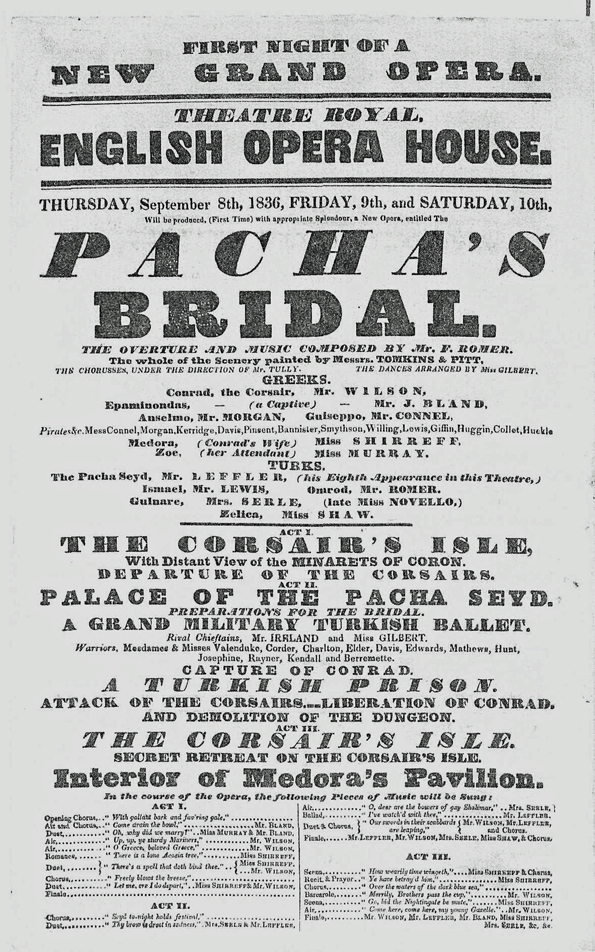
|
Initial cast |
Later cast |
|
|
Conrad, the Corsair Anselmo, his lieutenant Giuseppo,Second lieutenant Epaminondas, a Captive The Pacha Seyd Ismael Omrod, Chief Eunuch
Medora, Conrad's wife Zoe, her attendant Gulnare, a favourite of Zelica |
|
Mrs Serle |
Conductor - Frank Romer ? [1]
[1] The usual practice would have been for the composer to conduct the first performances, which would have been particularly welcomed given that the cooperative mounting the opera must have been very short of funds. Another possibility would have been James Tully , but he is listed as chorus master
History
On January 19, 1836, the Morning Post announced that the English Opera House (Lyceum) was to be let with immediate possession. Arnold had decided that he could no longer sustain the losses. The Morning Post (March 7, 1836, p.6) announced that Arnold's company had decided to take the theatre on as a "Commonwealth" and to open on Easter Monday, April 4, 1836. However, Alfred Bunn soon got in the act and approached the committee in July 1836 with a view to taking on the management, which he seemed to have done from November. However, it might be due to him and his interest in English opera that the theatre revived De Pinna's The Rose of the Alhambra on July 16, 1836 and, on September 8, 1836, premiered Romer and Lemon's The Pacha's Bridal. Abigail Betts took over from Jane Sherriff on October 3 and John Frazer from John Wilson on October 5. It was still being staged on November 9 but by November 11 only the first scene of Act 2 was advertised.
When Frazer took over as operatic director of the Royal Grecian Saloon [1], he mounted a production of the opera with himself as Conrad that ran for much of April 1849. No other London performances have been found but it was advertised for performance in Leeds on October 6, 1841 (Leeds Times, October 2, 1841).
It had some overseas performances. Thomas Allston Brown [2] recorded its premiere under the name Conrad and Medora at the National Theatre, New York on February 28, 1839, with Jane Sherriff and John Wilson who were then touring the US. It only seems to have had two performances [3]. More intriguingly it was scheduled to have Australian performances but although the libretto arrived the music did not causing George F. Duly to hastily compose new music and in the process the first Tasmanian opera. John Howson had to do a similar rescue two years later in Sydney [4]. It does not appear that Romer's version was ever performed.
Plot
The plot is based on George Gordon Byron's The Corsair, although The Athenaeum (1836, p.677) commented that "As a drama, it bears about the same proportion to its original, as Lord Byron dead does to Lord Byron living. The skeleton is there, but the soul and fire which animated it are gone". Conrad is altogether a jollier and more moral pirate while his attack is prompted by patriotism. Gulnare does not kill her master Seyd and Medora does not die but goes mad until restored to sanity by a song from Conrad. Lemon did not retain any of Byron's dialogue or songs except for a single stanza, perhaps wisely because it would have shown up his rather pedestrian efforts.
The subject might have been chosen as there was a certain vogue for "Turkish" subjects at that time although one might wonder at quite what this idea of "Turkish" consisted of. The Morning Chronicle (Mar 4, 1839) quoting the Morning Post, spoke of this [5] and a later opera, Hullah's The Barbers of Bassora, as possessing "the recommendation of being in strict conformity to the mental, moral and material costume of the diversified population of the Ottoman empire".
Conrad plans an
attack on the Pasha Seyd in
retaliation for the attacks on his
home country of Greece rather than for gold,
which his men are expressly
forbidden to steal. He takes his
leave of his wife Medora. Meanwhile,
the Pacha, Seyd, is planning to
marry his favourite slave, Gulnare,
who is not keen on the idea.
In order to
spy out the land, Conrad enters Seyd's
palace in the
guise of a holy "Dervise" who has
escaped from the pirates. However, his men attack
prematurely and Conrad is captured
but not before rescuing Gulnare from
the mayhem. As a result, she falls
in love with him and tries to free
him but their escape is foiled by Seyd.
Some of Conrad's men turn up
just in time and rescue them. They all return to
Conrad's base with the captured Seyd.
During this time Medora has sat waiting for Conrad's
return. Some men from the abortive
first attack return
without him for which she roundly
castigates them.
Conrad returns with his
rescuers to the camp to find Medora
has gone mad but a song from him restores her
sanity. Gulnare, disappointed that
Conrad is married, by way of reward
asks for Seyd to be spared. The
press descriptions implied that she
was reconciled with Seyd, perhaps in
a stage action, although, as some
pointed out, her wholesale betrayal
would hardly have provided the best
of starts to married life.
Two couples, Zoe
and Epaminondas in the pirates camp
and Zelmira and Omrod in the
Turkish, are included to provide
some comic moments.
Reception
Generally the press thought this opera a good first effort. This verdict is borne out by it being staged for much of the next two months and justifying a change of cast in early October. While being rather lukewarm about the overall drama, The Athenaeum thought that "The words of the songs, &c. are, however, rather above average". Further "although there is nothing whatever attractive, either in the construction of the opera, or the development of the characters, there is yet nothing so repulsive as to make the audience uneasy while they sit and listen to Mr. F. Romer's very pleasing music". The Morning Advertiser (September 9, 1836, p.3) was also positive. It found the verse "graceful and polished" and the melodies "sweet, and alternately playful, pathetic and gay". The Caledonian (September 12, 1836, p.3) thought that "The merits of the music...are higher than those of the drama".
One dissenting voice came from Bell's New Weekly Messenger (September 11, 1836, p.583): "The dialogue is feeble and the words of the songs &c are perfectly innocent of anything like poetry. The defects of the drama are by no means compensated by the merits of the music". However, they were a little more complimentary about the music: "The airs and concerted movements are regularly constructed, the harmony is smooth and correct, and good effects are sometimes produced by the management of the instruments. But the piece is not illumined by a single ray of genius".
Generally the performers were praised."Miss Sherriff never appeared to greater advantage: her acting and singing were all that could be wished. Mr Leffler...has a good voice, but his manner is painfully stiff and ungraceful... The applause was tumultuous at the fall of the curtain." (Bells Weekly Messenger *, September 11, 1836, p. 294). The Examiner (September 25, 1836, p.615) was more critical spending several sentences on Leffler's shortcomings in his efforts to imitate the well known baritone Henry Phillips. Wilson was criticised for a lack of energy in his acting. The paper goes on to give a glimpse of current performance practice writing of Shirreff going through "the ordinary routine of motions assigned to operatic lunacy; at the conclusion, after waiting with attention, and a due regard to Mr Wilson's feeling, to ascertain that the applause given by the audience did not amount to an encore of the song (in which case, of course, she would have continued very mad until it had been repeated), Miss Shirreff completely cured by a long cadence and shake, uttered a terrific scream, and rushed, with all her intellects restored, into her fond husband's arms".
As so often, staging and costumes were praised."This opera has been got up in the best manner; the dress, scenery, &c., are all admirable, as are the stage arrangements. The result was perfect success" (The Standard, September 9, 1836, p.2)
* not to be confused with the entirely different Bell's New Weekly Messenger
Scores and libretto
The manuscript of the libretto (British Library, Add MS 42937, ff. 710-722) sent to the Examiner, George Colman, was dated August 27, 1836 and was signed off on September 2nd, 1836. A printed version published by Miller, probably in 1836 can be found at Google books. A transcript of the libretto can be found here. There are unusually large discrepancies between the printed and manuscript versions with several songs apparently added after the libretto submission, for which it is not obvious that permission was granted.
Eight songs with scores were published by J. Duff & Co in 1836 and described in the Belle Assemblée (December 1836, p. 327) as:-
Of the general character of the music of this Opera we spoke in favourable terms in our Theatrical Review (September, pp. 213-214). We now proceed to consider the Songs &c. separately. The first solo of any consequence is "Greece! Beloved Greece!" It is in the natural key, the second verse modulating into G, which serves to give variety to the air. "There is a lone retama tree!" so exquisitely sung by Miss Sherriff, possesses much originality, and changes in its character admirably, according with the sense of the poetry, expressing the different sentiments the words convey with the utmost fidelity. It is in the key of A flat. The two Duetts "There's a spell" and "Let me, ere I do depart" are also charming compositions. "I've watched with thee" the ballad in which Mr Leffler established himself as a baritone of the first class, deserves particular notice". The subject is flowing and graceful, while the accompaniment sustains the harmonies sufficiently without overwhelming the vocal part - a fault too prevalent with modern composers. Its key is B flat, and is set, for the convenience of amateurs in the treble cleff. "O, dear are the bowers of gay Shalimar!" was by no means done justice to by Mrs Serle, but is notwithstanding a pleasing rondo. "Merrily, brothers, pass the cup" is a barcarolle full of life and spirit and well adapted to the votaries of Bacchus, The other compositions in the piece are "Ye have betrayed him" recitative and air for Medora, and the youthful ballad, "Come here, come here, my young gazelle" in both of which there is much effective and clever writing.
Of these only "I’ve watch’d with thee" is available at the British Library (System number 004619539). The National Library of Australia (https://trove.nla.gov.au ) has that song plus "There's a spell" and "Greece! Beloved Greece!". It has two further ones not mentioned by Belle Assemblée: "Thy Brow is Drest in Sadness" and "Up, up Ye (My) Sturdy Mariners".
The text for "Greece! Beloved Greece!" and "I’ve watch’d with thee" were published in The National Melodist, p.24 and pp. 95-96.
Recordings
No recordings of either the opera or particular numbers are known.
Books, Articles, Online
No books or articles on the opera are known although there is a short reference to it in Frederick Burwick and Manushag N. Powell 's British Pirates in Print and Performance (New York: Palgrave Macmillan, 2015), pp. 66-67, in the chapter on The Corsair. The plot synopsis included there was based on the playbill scene listing and thus differs slightly from the libretto.
[1] Frazer had had previous engagements at the Grecian in 1842 and 1847, (Kurt Ganzl, Victorian Vocalists. London: Routledge, 2018, p. 245-255.
[2] Thomas Allston Brown, A History of the New York Stage. Vol. 1 (1903 ), pp. 250-251.
[3] Katherine K Preston, Opera on the Road. (Urbana: University of Illinois, 1993) p.71.
[4] http://sydney.edu.au/paradisec/australharmony/duly-family.php#Conrad
[5] The article actually referred to The Pacha's Daughter but there does not seem to be any work with that title around that time so it almost certainly referred to this opera.
 |
 |
 |
  |
|
|