
|
 
Edward
James Loder
1809-1865
Loder's
Life
(Most of this section has kindly been provided by
Dr. Andrew Lamb)
|
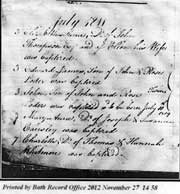
Edward James Loder was born
into a family of Bath
musicians. Although his year
of birth has generally been
cited as 1813, recent
research suggests that it
was four years earlier. He
gave such early promise of
musical talent that his
parents sent him to Germany
to study under Beethoven's
pupil Ferdinand Ries
(1784-1838), whom Edward's
father had known during
Ries's years in London from
1813 to 1824. Back in
England, in 1831 he married
Eliza Watson, daughter of
the choral conductor at
Covent Garden Theatre. As Mrs Edward Loder she sang in
Bath throughout the 1830s.
However, the marriage having
soon broken down, she
emigrated in 1840 with her
siblings, among them the
future publisher, music
critic and lyricist, Henry
Cood Watson, to America.
Having moved from Bath to
London, Loder gained
significant note with the
opera Nourjahad,
which initiated a new phase
in English opera when
produced at Samuel J.
Arnold's English Opera House
at London's Lyceum Theatre
in July 1834. The Widow
Queen (October 1834),
The Covenanters (August
1835) and The Dice of
Death (August 1835)
followed at the same
theatre.
|
|
The failure of
Arnold's venture, combined with
Loder's need to earn a living,
increasingly tied him to the
composition of popular songs and
ballads. Of these "The Brave Old
Oak" (1834), with words by Henry
Chorley, enjoyed especial currency
on both sides of the Atlantic. The
fluctuating fortunes of English
opera and
the financial instability
of its promoters, meanwhile,
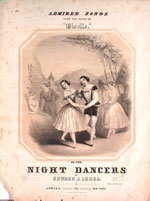
restricted Loder's operatic work. However, in October 1846, his opera
The Night Dancers,
based on the Giselle story, was
produced with significant success at
the Princess's Theatre, London,
where Loder was musical director. Productions
in New York and Sydney as well as
other British and Irish cities
followed during 1847 and during Loder's lifetime this opera
continued to be considered the
high-point of his output. However,
it was followed at the Princess's
Theatre only by works of lesser
pretension such as the operetta
The Andalusian: or The
Young Guard and the ballad
opera Robin Goodfellow
(both 1848).
Altogether, what G. A. Macfarren described as Loder's
"foible of unpunctuality" appears
to have hindered his ability to make
the most of his talents. The opera
that finally achieved production as
Raymond and Agnes in
1855 at Manchester's Theatre Royal
(where Loder was by then musical
director) had been announced for the
Princess's Theatre as early as 1848.
Its success in 1855 was limited, and
in 1856 illness forced Loder to
withdraw from further public engagements. The London production
of |
 |
Raymond and Agnes in
1859 had no more success, so that a
revival of The Night Dancers
by the Pyne-Harrison company at
Covent Garden Theatre in 1860
confirmed the latter as the
high-point of Loder's success during
his lifetime. After several years of
illness, including four years of
paralysis, he died in London in
April 1865. A further article by Dr
Lamb can be found at
https://www.musicweb-international.com/classrev/2013/mar13/loder_article.htm
Loder's Works
Loder only wrote three
indisputable English operas:- Nourjahad
(1834),
The Night Dancers (1846) and
Raymond and Agnes (1855). Three
others:-
The Covenanters (1835),
Francis the First (1838) and
Robin
 |
Goodfellow (1848) have
been included with the operas
although their status is
considerably more debatable either
because of their format or because
much of the music has been taken
from other sources rather than
original music especially composed
for the libretto. The Dice of Death
(1835), The Foresters (1838) and
The
Deer Stalkers (1841) are sometimes
referred to as operas but are even
further from the format and so have
been included in the
non-opera page.
He wrote music for a number of
operettas, masques, burlesques and
plays including Black-eyed Susan
(1830), The Widow Queen (1834), The
Sultana (1848), The Andalusian, or
the Young Guard (1848), The Island
of Calypso (1852), Dick Whittington
and his Cat (1852), Balcony
Courtship (1853), and Never Judge by
Appearances (1859). He also composed
music for innumerable songs and it
has been stated that
he had a contract with D'Almaine &
Co to produce a song a week for some years. Possibly more
likely is the
|
Morning Post's (November
7, 1838) account that he was paid a weekly sum by
a publisher
(presumably D'Almaine), which would
probably have covered a variety of
musical assistance including editing
and as well as composing some songs
"from time to time".
Recordings of
Loder's Works
Commercial Opera Recordings
Retrospect Opera have released
a recording of
Raymond and Agnes, the first complete
recording of any of Loder's operas.
Private Opera Recordings
A CD of the 1995 BBC broadcast of
excerpts from Raymond and Agnes
was available from
Oriel Music Trust, but the Trust no
longer seems in operation.
Ballads, opera excerpts and other works
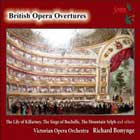 |
His overture to The
Night Dancers is included in the Victorian
Opera Northwest recording of a number
of Victorian English opera
overtures on SOMM
CD 0123 : British Opera Overtures.
More detail on the content
can be found here.
|
A CD of
Loder's piano music played by Ian
Hobson is available on Toccato
Classics (TOCC0322
) . The booklet with an
excellent introductory article by
Nicholas Temperley is available
here.
Short pieces can also be found on
An Album Of Victorian Song
on Symposium 1074 and
King David and His Harp on
Globe 5204.
Books and articles on Loder
 |
There are no books dedicated to Loder.
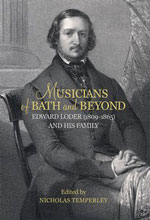
However, he is the focus of Nicholas Temperley,ed. Musicians
of Bath and beyond: Edward Loder (1809-1865) and his Family
(Woodbridge, UK: Boydell and Brewer, 2016),
particularly Andrew Lamb's
chapter, "Edward James Loder(1809-1865):
A Life in Music". pp.
125-148.
There is a chapter in
George Biddlecombe, English
opera from 1834 to 1864 with
particular reference to the
works of Michael Balfe.
((New York: Garland
Publishing, 1994), pp. 87-98,
and he is mentioned in many
of the standard works such
as Grove and general
histories of the era, as
listed on the
Books
page. Andrew Lamb drew up an
extensive project document
as part of the preparations
for marking the 150th
anniversary of Loder's
death. See
here.
|
Scores and librettos
References to scores and
librettos for particular operas will
be found on the relevant opera page
and on the
librettos
page.
Loder's Albums of English Song,
Volume V can be downloaded from the
University of Rochester and from
IMSLP, where his song, Sigh no
longer, can also be found. Texts of
some songs are available from lieder.net.
A list of scores of Loder's
instrumental works can be found
here, some of which can be found
on
hhttp://imslp.org/wiki/Category:Loder,_Edward_James
.
Web pages
There are
currently no websites devoted to
Loder.
|


