
 |
 |

|

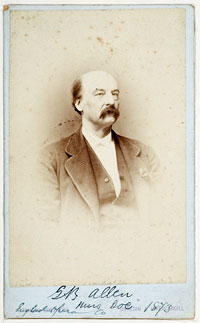
 George Benjamin Allen1822-1897
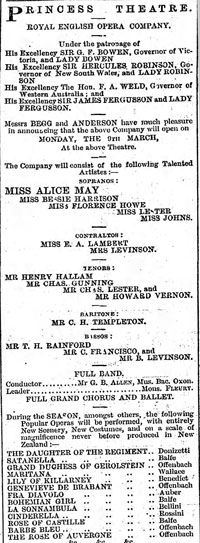
In August 1869, the Australian opera manager, William S. Lyster, came to England with the express purpose of recruiting artistes for his Australian companies [6] and either hired Allen and May or at least gave them the idea of going to Australia. The Argus (Mar. 19, 1870) carried an advertisement from Allen that he expected to be in Melbourne by the middle of May, 1870, and would be available to teach singing. He claimed the move was "for the benefit of his wife's health". Alice May, a former pupil, and he were not married and it is not clear that she had a health problem either [7]. By the middle of June, he was conducting a concert in Melbourne and they stayed organising concerts and teaching in the Victoria area for well over a year. By July 1871, May had become the Lyster company prima donna and Allen had become its conductor [8], first in a tour of Victoria and then to South Australia and Tasmania before returning to Melbourne. September 1872 saw the company in Sydney for several months during which time he provided the music for a burlesque by Grosvenor Bunster starring Alice May called The Belle of Woolloomooloo and staged at Alice May's Gallery of Illustration. The Allens then fitted in a short tour of Victoria by Miss Alice May's English Opera, Concert and Burlesque Company before the start of the 1873 Lyster Company season. However, on November 1, The Argus advertised her farewell concert before the Allens set off for New Zealand.
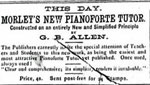
More information on his Australian career can be found at the Australian Variety Theatre Archive and the New South Wales State Library as well as the sources cited in the footnotes. Adrienne Simpson, Alice May: Gilbert & Sullivan's First Prima Donna. (Routledge, New York and London, 2003) and the website Great Singers of the Past - Alice May detail May's career and cover her and Allen's time together. A video posted by a great great great grand daughter of Allen's about his time as organist at All Saints, Notting Hill, can be found at https://www.youtube.com/watch?v=vP1pu3t7Ocw . It includes a performance of one of his anthems. [1] His marriage to Ann Carter on October 2, 1843, described him as a lay-vicar [2] According to Simpson (p.8), he did not have to attend the university but just submit some compositions. She sees his regular citing of the degree as evidence of his pride as someone from an artisan background graduating from Oxford given the class ridden constraints of 19th century Britain. [3] The Belfast Newsletter (Oct 14, 1862) announced an auction of his furniture in Belfast including four pianos and pianinos. [4] It was little more than a concert party without staging and essentially a family affair with Louisa and Susan Pyne, their nieces Blanche and Susan Galton and Blanche's husband to be, Thomas Whiffen. [5] Divorce petition on Ancestry.com. Ann Allen listed herself on the 1871 census as "Wife of Professor of Music". Although later, for example on the 1881 census, Allen and Alice May claimed to be married they were not, presumably because he was still married. He later married Maritza Finsone on August 10, 1886, around three months after his first wife's death. Allen had started the relationship with Maritza Finsone by 1878 as a son was born in December although the 1881 census showed him still with May. Finsome's 1881 entry had "Costume maker. Husband away". Simpson (p.15) does not seem to have been aware of the divorce petition and incorrect in surmising that Ann died in 1869. She (p.139) also doubted that Allen and Finsome were legally married so cannot have been aware of their marriage certificate. [6] The Era (Aug, 8, 1869), The Era (Aug. 15, 1869), Simpson (p.14) [7] Simpson (p.15) [8]The Australasian (July 15, 1871), The Bendigo Advertiser (July 17, 1871). Simpson (p. 15) sees his move to Australia as giving him opportunities for stage work that would have been difficult to get in Britain, where he was looked on primarily as a teacher and church musician. [9] The Otago Daily Times (Jan 27, 1874) announced their appearance in Dunedin in early March 1874. The Wanganui Chronicle (Mar. 3, 1875) announced that they would shortly be leaving for Melbourne. Adrienne Simpson, Opera's Farthest Frontier: A History of Professional Opera in New Zealand. (Auckland: Reed, 1996), pp. 37-41 describes their tour. [10] The Era (Oct 1, 1876) announced his return from "his long Operatic Tour in Australia, India, Tasmania and New Zealand". [11] The Era (Jan.6, 1878) had already signalled the intended switch which seemed aimed at giving the newly reopened theatre an attractive start (Simpson,p.95). However, some, such as the Sydney Mail ( Mar. 23, 1878), suspected skullduggery in the "very abrupt affair". [12] Truth (Jan.28, 1898). Later, Allen got embroiled in a fruitless court case with D'Oyly Carte's company over shares he had bought in the company, (Simpson, pp. 116-118). [13] In early 1881, The Australasian (Jan. 29, 1881) had received a letter saying that they would be returning shortly to Australia, but that never materialised. [14] Simpson (p.30) [15] The New York Daily Tribune (May 10, 1883) [16] G.B. Allen, Morley's New Pianoforte Tutor, (London: W. Morley & Co., 1882). The Musical World (Jan. 14, 1882), p. 20 congratulated Messrs W. Morley, jun. & Co for issuing its Pianoforte Tutor written by Allen, as it was "a Common-sense book because the learner is not confused and disheartened at the outset by a lot of introductory matter having no special relation to the instrument". [17] Daily News (Jan. 15, 1898) |
 |
 |
 |

 |
|
|