  |
 |

|
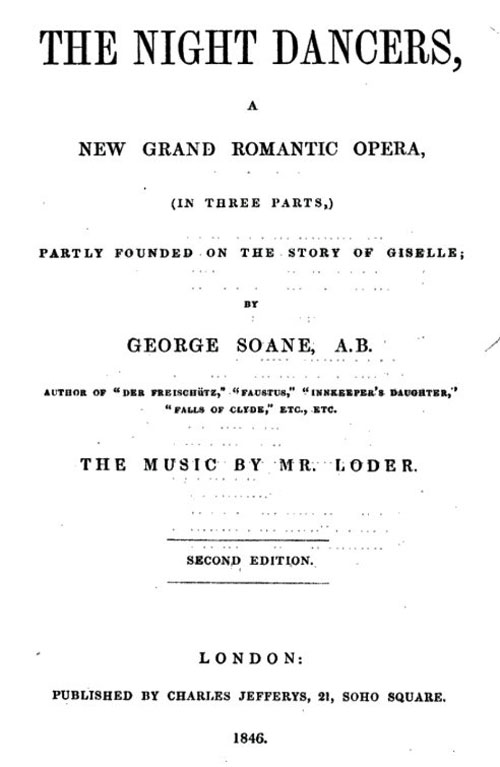
  The Night DancersMusic by Edward James LoderLibretto by George Soane
Princess's Theatre,
London
|
| 1846 cast | 1860 cast | |
|
Albert Godfrey The Duke of Silesia Fridolin Max (a peasant) Peterkin (a peasant boy) Wilfred (Head Ranger)
Giselle Mary Gretchen Myrtha (Queen of the Wilis) Bertha (Daughter of the Duke) Corella Astra Unda |
- Tom Hill
- Miss Day |
- Grattan Kelly - Henry Corri * * - C. Lyall
- Madame Palmieri - Miss Thirlwall * * - Miss C. Albertazzi - Miss Leng - Mary Huddart |
Conductor - Edward Loder
* - Max,
Peterkin, Gretchen and Myrtha are all very minor
characters
who were not identified in the 1860
libretto
History
|
Loder became musical director of the Princess's Theatre, London in 1846 and later that year saw the staging of his new opera, The Night Dancers, to open the new season. It was his first fully original English opera since Nourjahad in 1834, although he had written music for several other stage works in between including Francis the First with much of its music cobbled together from existing works. The opera ran from October 29 through to May 22, 1847, a run of 43 nights. Shortly afterwards it toured other cities including Manchester, Dublin, Leeds and Hull. It was also performed in New York and Sydney in the same year. The Night Dancers was revived at the Princess's Theatre on February 22, 1850, when the prologue, titled here as the "induction", was combined with the first act thus removing one of the intervals. George Alexander Macfarren's wife, Natalia (Clarina), sang the small part of Bertha in the revival. The opera ran through until May, although sometimes only the second act was given. There was then possibly a performance or two at the Theatre Royal, Manchester in November 1851, presumably the result of Loder's move to be its musical director. It was proposed to include a large selection from the opera as part of a benefit in 1857 for Loder, who was by then stricken with illness, but lack of rehearsal time prevented it. |
|
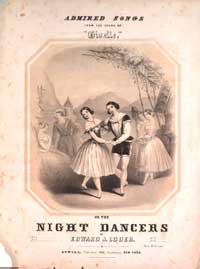
Its final London theatre run came with performances by the Royal English Opera at Covent Garden on November 10, 1860 but by February 1861 only the second act was being given. 1861 and 1862 saw companies including it in their tours: The London Grand Opera Company (including Derby, Huddersfield and Leicester), the English Opera Company (Wolverhampton), the Grand English Opera Company (Belfast). Apart from excerpts at concerts and occasionally in music halls, there do not appear to have been any full performances until George Perren's benefit at the Crystal Palace in August 24, 1871 (Perren was running a season of opera there) followed by performances until at least the end of November. No evidence of any further performances has been found until a revival by the J.W.Turner Opera Company in Spring 1906 at the Standard Theatre, Shoreditch [2] and then none since.
The plot has much in common with the ballet Giselle, which premiered in 1841 with music by Adolphe Adam. It seems from the libretto manuscript that the opera was also to have been entitled Giselle but then a page was added changing it to The Legend of Silesia or the Night Dancers. George Soane, the librettist, stated in his preface to the 1846 printed libretto that the appearance of the ballet triggered his decision to write the libretto. The obligatory happy ending for an English opera was contrived by having the main action with the Wilis and their dance of death revealed as Giselle's dream before her marriage to Albert.
Plot
The plot has kindly been provided by Andrew Lamb
Induction
The scene is laid in Silesia. Giselle the daughter, and Mary the niece, of Godfrey, a Miller, have just finished making their dresses for the wedding of the former, which is to take place on the morrow; deeply imbued with the superstitions of her country, Giselle is filled with romantic notions, and gives way to idle fancies: fond of dancing, and an enthusiast in music, she indulges in both until, wearied by her exertions, she is completely overpowered by sleep. Mary, like a sensible bridesmaid, has retired to rest, and left Giselle to her dancing and—her dream.
Act I
Albert, the intended bridegroom of Giselle, is a young Forester, whose residence in the village has been of short duration. Fridolin, a fussy busybody of a beadle, who had long been endeavouring to find out the history
of this stranger, had spread a
report that the betrothed of Giselle was
of noble birth, and that his hand had
been engaged to a lady of his own rank.
In her dream Giselle fancies all the
particular circumstances which end in
the supposed detection of Albert’s
infidelity; heartbroken at his duplicity
she reproaches him, and falls apparently
lifeless in his arms. Believing that she
has but swooned, Albert endeavours to
recall Giselle to her
senses, when, just as she
appears to be reviving, the
sound of a passing-bell is
heard, followed by a procession of
monks, who are singing
the requiem for a departed sister.
Giselle now seems to be really dead, it
is her own requiem she has heard, and
the voices of all blend in one solemn
train of harmony, with which the Act
closes. |
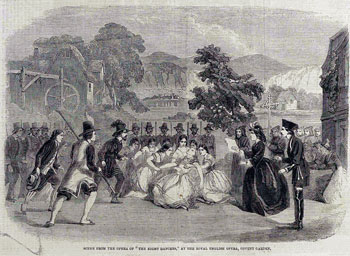
Illustrated London News, (Dec 1, 1860) |
Act II
The greater portion of this Act is occupied by the Wilis, of whom Giselle is now one. According to the most authentic records, the Wilis, or Vilas, are young brides who have the misfortune to die before the wedding-day. They are supposed to have such a passion for dancing that they cannot rest quiet in their graves. Be this as it may, the defunct brides rise from earth at the hour of midnight, and assemble on the high-way, attired in all their bridal finery, with ribbons fluttering in the wind, jewels sparkling on their fingers, and their heads encircled with coronets of flowers. Death has set the whiteness of snow upon their foreheads, but withal has invested them with a mysterious and indescribable beauty, surpassing even the loveliness of life. And woe to the youth who comes within their magic circle; they breathe into him the same wild passion for the dance by which they are themselves possessed, and under its influence he must dance on—on—on—till he falls down dead. (See DER SALON, von H. Heine, Dritter Band, p. 170.) Giselle, it will be remembered, had fallen asleep in the apartment in which the Induction is represented; at the return of daybreak her sleep is broken, her dream is ended, and with the approaching wedding of Albert and Giselle the Opera terminates.
Reception
The Era (Nov. 1846, pp.9-10) thought that Loder and Soane had made a reasonable job of adapting what was seen as essentially ballet material remarking that “Mr Loder has handled the subject with great skill; but there is a lack of distinctive markedness, particularly in the ballads, the character of which would be suitable to any other opera. The treatment of the concerted pieces is replete with consummate knowledge of all the mysteries the art, well-digested intention and faultless and ingenious instrumentation, a free and delicious current of melody". Many but not all of the numbers were commented upon favourably with Albertazzi's indifferent performance of her final aria being put down to the fright from catching fire (see below). Finally it noted that "the curtain fell amid long and loud applause" with both singers and composer being called forward.
The Times (Oct.29, 1846, p.6) considered "The flow of melody, if not always strikingly original, is unrestrained and graceful" and commended Loder's instrumentation. The scenery was "exceedingly picturesque and beautiful", the chorus and band while much improved would have benefited from another week's rehearsal and the singers were generally praised although Madame Albertazzi's voice was thought too heavy for some of the coloratura. Overall though it was very positive verdict.
The Morning Advertiser did three reviews. Its first on October 29, 1846, after the opening night was devoted mainly to outlining the plot and relating Albertazzi's accident (see below) but it did note its success, the excellence of the staging and picked out a few of the numbers and performances for praise. In its November 3 review it described how the opera's "repetitions...are received with unabated delight". "Every detail is admirable, while the whole are woven together with consummate art and charming affect". It also made a rare point of praising the libretto, "A good libretto nowadays is quite a refreshing novelty". In contrast to its initial review it noted the shortcomings of the actual performances which are outlined below. When it went on December 14 to the 32nd performance it remarked that there had not been "any diminution of its attraction" . In contrast to its second review that criticised the female performers, it picked out Miss Smithson, who had taken over the part of Giselle when Albertazzi fell sick, as "a great acquisition". It also praised the effectiveness of the choruses under their chorus master, [Joseph Francis] Duggan.
The 1850 revival at the Princess's Theatre, despite a poor chorus and indifferent orchestra, got much the same audience response according to the Morning Post (February 23, 1850), although there was an air of disappointment that the revival reminded them that Loder had made few strides since the original performance, blamed mainly on the lack of opportunity for English opera.
The 1860 performances at Covent Garden led the Morning Chronicle (November 12, 1860, p.3) to lament that Louisa Pyne and William Harrison, who managed the Royal English Opera, had not taken the main parts themselves but had left the opera to the "second eleven" and that of the principal singers it could not "report much that was highly favourable". However, it praised much of the music, particularly in the second act and foresaw a reasonable run, although The Standard (November 12, 1860, p.3) remarked that the audience was not very numerous. On the other hand, the Morning Post thought "the performance on the whole was highly satisfactory" and that Loder had never been better served. Loder, it seems, was well enough to take a bow.
Comment
Theatre accidents
The opera's première was marked by the sort of accident that was a continuing risk in the theatres of the day. According to the Daily News (October 29, 1846, p.4):
Towards the end of the piece a frightful accident occurred. As Madame Albertazzi was rising through a trapdoor, the skirt of her dress came in contact with a light. It was instantly in a blaze, and, in another second she would have been wrapped in flames, had not Mr. Allen, with great presence of mind and promptitude, torn away the burning part of the dress, and extinguished the flame. The audience, for a moment, were struck with horror… Madame Albertazzi behaved with singular fortitude, and finished the part with little diminution of her usual power.
A conscientious librettist
George Soane seemed to have been a more conscientious librettist than most. He clearly was not happy at having to include a song for the Duke (1846 libretto, p.19) that was "written for the sake of the singer" and thus had been included as a footnote to stop it interfering "with the interest of the scene". The 1860 libretto just included it inline without comment with only two of the three verses. The manuscript had it on a separate page from the main text.
In Act 1, a chorus of Foresters praising ale in the guise of Sir John Barleycorn in the manuscript was replaced by a song from Mary praising wine in the printed librettos. No doubt, Soane realised that a chorus of Silesians singing about English ale was too silly even for an English opera, unlike Edward Fitzball in a similar situation in Balfe's The Siege of Rochelle (1835). The switch to Mary might have been to give her a second song. There is no evidence that this change was signed off by the Examiner.
Poor dramatic skills
In critiquing the opera's performance, particularly the women, the Morning Advertiser (Nov.3, 1846) deeply regretted "the absence of dramatic education... of our English operatic performers. The art of assuming a character, or a passion, with perfect abandon, and of maintaining and delineating its features throughout the part, seems not to enter into their idea of the requisites for a stage vocalist". It contrasted this with the effect made by Malibran, Adelaide Kemble and Thillon.
Scores and Librettos
The libretto manuscript submitted to the Lord Chamberlain can be found at Add MS 42997, ff. 468-517, but only the Induction and Act 1 survive. The covering letter was dated October 17, 1846. The 1846 printed libretto (2nd edition) can be found online at Google Books. The libretto published for the Pyne and Harrison Company 1860 revival can be found online at the Library of Congress. Both librettos were published in London by Charles Jefferys. They are identical apart from a few minor textual differences and close to what was submitted in the manuscript, as far as Act 1 was concerned, but with one change of song as described above. The Examiner, John Kemble, had said that they must omit the lines "You would do just the same as your grandmother did / And take a small bite of the Apple forbid" in Fridolin's song in Act 2 [1] and the printed librettos do not include them. Thus in this case, as opposed, for example, to Balfe's The Devil's in it (1852), the prohibited lines were left out.
Internet Archive has a copy of the vocal score also published by Charles Jefferys in 1846. The Carl Rosa Archive have hand copied orchestral parts.
[1] Lord Chamberlain’s Plays Supplementary Papers. Vol. II from 1843 (London: British Library, Add MS 71565)
Recordings
A commercial recording of the overture can be found on SOMM CD 0123 : British Opera Overtures .
Books, Articles, Online
The 1846 libretto has a preface by its librettist, George Soane, in which he writes of the libretto's origin and expands on the legend of the Wilis.
David Chandler's "Edward Loder and his Librettos" (pp. 225 - 229) and Paul Rodmell's, "Edward Loder's Serious Operas" (pp. 243 - 257) in Nicholas Temperley (ed.), Musicians of Bath and Beyond: Edward Loder (1809-1865) and his Family, (Woodbridge: The Boydell Press, 2016) discuss the opera in some detail.
Nicholas Temperley wrote some notes for a performance of excerpts from the opera given at the University of Illinois on October 10, 2015. See here.
George Biddlecombe, English opera from 1834 to 1864 with particular reference to the works of Michael Balfe. (New York: Garland Publishing, 1994), pp. 88 - 91.
[1] Image thanks to Ray Walker Victorian Opera NorthWest
[2] The Musical Times (April 1, 1906), p. 243. Thanks to Mark Morris for spotting this
 |
 |
 |
  |
|
|