  |
 |

|
  Singers (W)
This section also includes people who were primarily actors but fulfilled either non singing roles, which were sometimes included in English opera of this era, or in roles that did not make great demands on vocal ability. A few have been included because they were namesakes or relatives of English opera performers and so, hopefully, help avoid any confusion that might arise. Kurt Gänzl, Victorian Vocalists, (Abingdon, UK: Routledge, 2017) describes the lives and careers of around 100 Victorian singers from different countries and backgrounds but all of whom have some connection through singing Italian or English opera in London. The singers covered are listed here. Please see the section on the main Singers page for provisos about the material included here. Please email englishromanticopera@gmail.com with any comments and suggestions about errors or further material.
Walton, MrWalton was at the Surrey in early 1842 but moved to the Princess's probably for the 1842-1843 season, where he took over, at least temporarily, from William Oxberry in the revival of Mary à Beckett's Little Red Riding Hood at the Princess's in February 1843. This would imply he was mainly a comic actor. He stayed at the Princess's for at least four years featuring in the premiere of Loder's The Night Dancers on October 28, 1846. The Observer (Jan 1, 1843) described him as "a man of some talent". It is possible that the above was the Mr Walton who appeared in the premiere of Loder's Raymond and Agnes in August 1855. However, another possibility is a Mr Walton, who featured in Manchester concerts from about 1834-1857, or it could be an entirely different person.
Walworth, Thomas Adlington (1824 - 1904)Although usually billed as Mr Walworth, he was born Wallworth. After some initial study, he went to the Royal Academy of Music in 1848 and set up as a singing teacher in his home town of Liverpool in 1849 [1]. Shortly after giving a concert in Liverpool in January 1851, it was announced that he was going to live in London [2]. By 1852, he was starting to establish himself there and increasingly appeared in concerts, for example at St Martin's Hall [3]. He must have gained a good reputation fairly rapidly as he sang in the first performance of Bach's St Matthew Passion to be given in England on April 6, 1854 [3]. Further concerts followed. He joined the Pyne and Harrison opera company for their 1857-1858 season at the Lyceum, where he sang in the premiere of Balfe's The Rose of Castille and in January 1860 in Alfred Mellon's Victorine at Covent Garden. In 1861, he appeared in an operetta, Shakespeare's Dream, at the Surrey and was a last minute replacement in Bellini's La sonnambula at the opening of the New Standard Theatre in December 1867. However, for the most part, he kept to concerts and oratorios, while his main occupation moved towards teaching both privately and at both the Royal Academy and the Guildhall School of Music. In the 1861 census he described himself as vocalist and Professor of Music but in 1871 as singing master and in 1881 as vocal professor. By the 1901 census he was a "retired musical professor". The Era (May 11, 1873) referred to him as "the greatly respected and thoroughly competent singing master of the Royal Academy of Music". [1] Liverpool Mail (July 28, 1849) [2] The Era (Jan. 5, 1851) , The Era (Feb.16, 1851) [3] The Morning Post (Feb 18, 1852) [3] Sheffield Independent (Jan. 25, 1904). Various of the other points above come from this source.
Waylett, Harriet (1798-1851)
Weiss, Willoughby Hunter (1820-1867)
at Covent Garden for several years between 1857 and 1863 and featured in several premieres. After their demise, he joined their successor company, Royal English Opera Company, and sang in the premiere of Mori's The River Sprite at Covent Garden in February, 1865. However, he turned increasingly to concerts becoming best known for his oratorio singing. An online biography is available at https://momh.org.uk/exhibitions/willoughby-hunter-weiss-1820-1867/ . He also composed some songs, the best known being "The Village Blacksmith". [1] Musical World (Mar 11, 1841), p.156. Other information about him can be found in the Oxford Dictionary of National Biography.
Weiss, Mrs (Georgina Ansell Barrett) (Mrs Davis) (1826-1880)
The Examiner (Dec 3, 1864) judged that "Mrs Weiss is not at home on the stage". The Era (Dec. 26, 1847) wrote that: Her voice, which is singularly clear and liquid in the upper notes, is unpleasantly harsh and reedy in some of the lower tones, and detracted from the merit that was due to her for the artistic style in which she rendered several of the passages of the opera. After Willoughby Weiss's death in 1867, she resumed her career early the following year, but there do not seem to be any notices of her after May 1868. According to The Referee (Nov.22, 1880), her career ended when she lost her voice. She married Charles Davis in 1872. [1]The Weekly Dispatch (Feb. 7, 1841). It said that she had been well-taught and acquitted herself excellently despite some nervousness [2] The Morning Post (May 29, 1843) said she "has a voice of great compass, but deficient in its medium or working part". [3] The Sun (Sep. 24, 1844) claimed that there were "critics who assert that her voice in the higher range is without an equal in England". By the time of the Hereford Festival in 1864, she was singing contralto (The Birmingham Daily Post, Sep. 1, 1864).
Welsh, Miss Emily ConstanceWelsh appeared in the premiere of Meyer Lutz's Zaida or the Pearl of Granada staged by Elliot Galer's company at the Royal Amphitheatre, Liverpool, in February, 1859. Galer's company looks to have been her first appearance on the stage. She was not listed in any other performances for Galer's company but might have been a member of the chorus, whose names would not ordinarily be included. In the June, Miss Emily Constance Welsh made her first appearance in London at the St James's Theatre in Augustus Braham's company advertised in the press [1] as singing in the London premiere of Loder's Raymond and Agnes, although she did not appear on the opera playbill. At the end of the year, she was singing in a concert in St Martin's All, London but there is no sign of her after that. She was not the Miss Welsh who married the well known cellist Carlo Piatti. [1] The Era (June 5, 1859)
Weymouth,
Anne (Sarah Ann)
(1822-1875)
|
|
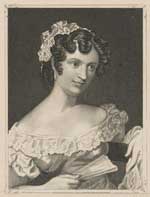
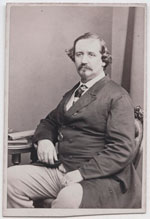
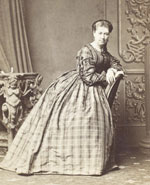
Wilson was born in Edinburgh on December 25, 1800. His operatic debut was in Edinburgh in 1830 and later the same year in London at Covent Garden in Linley's La Duenna. After this he appeared regularly in London becoming part of Arnold's original company at the Lyceum, starring in eight of his premieres from Loder's Nourjahad (1834) to Romer's The Pacha's Bridal (1836) as well as the revival of de Pinna's The Rose of the Alhambra in 1836. Later, he was in the premiere of Barnett's Fair Rosamund (1837) at Drury Lane. He was a popular singer and particularly well known for his singing of Scottish ballads. Nevertheless, The Era (July 29, 1849), in its obituary, claimed that cliques as well as the fashion for foreign singers caused him to give up the London stage. He toured the provinces in 1836 and in 1838 went to the U.S. with Jane Shirreff and the Seguins first appearing in New York before going on an extended tour. On his return, he was part of Balfe's extremely brief management of the English Opera House, appearing in Balfe's Keolanthe (1841) and a revival of Bellini's La sonnambula before going to the Surrey to sing in the latter. |
|

In the
early 1840s, he inaugurated
lecture/recitals of Scottish
song (a new idea at that
time), to which he then
devoted himself full time
with great success. In
1849, he left for another
North American tour, during
which he died in Quebec
City. Rosemary Richards has
written about Wilson's later
career in, "'John Wilson and
Scottish Song" in
Re-visions: proceedings of
the New Zealand
Musicological Society and
the Musicological Society of
Australia Joint Conference.
(Dunedin: University of Otago, December 2-4, 2010
-
https://
ndhadeliver.natlib.govt.nz/delivery/DeliveryManagerServlet?dps_pid=IE17101639. A detailed
account of Jane Shirreff and
John Wilson's U.S. stay can
be found in Katherine K.
Preston, Opera on the
Road. (Urbana and
Chicago: University of
Illinois Press,1993), pp.
44-98.
Woods, Mrs. - Mary Anne Paton (1802 - 1864)
Woodyer, Miss E.
Woodyer was primarily an actress who seems to have had a short career in Dublin from 1852 through to 1858. She appeared in the premiere of Lanza's Hamet and Zelena in the rather ungrateful role of Fatback, "a very fat, diminutive figure". There were also the Misses Woodyer around the same time who were dancers but it is not clear if she was one of them.
Woolgar, William (1802-1885)
Originally from Portsmouth, he described himself as a tailor on the birth entry for his daughter, Sarah Jane Woolgar, who went on to become a well known actress and married the conductor and composer, Alfred Mellon. By 1830, he was one of the managers of the Gosport Theatre.[1] In 1832, he appeared in London at the recently opened Garrick Theatre [2], but his career continued mainly in the provinces for many years.[3] The Era (June 25, 1848) claimed that his appearance as Iago at the Olympic was his first appearance in London.[4] He went to the Haymarket in 1850 and, in 1851, he was in the premiere of Edward Fitzwilliam's The Queen of a Day there. His career did not seemed to have prospered and by the time of the 1861 census, he was describing himself as "tobacconist" but then as "Dramatic" in the 1871 and "Dramatic actor" in the 1881, although there is no trace of him performing. He also seems to have tried setting up a private theatre academy [5] The Morning Post (Dec 7, 1885) wrote of him being "utterly destitute", seemingly along with his daughter. He was dead within two weeks of these reports.
[1] The Hampshire Chronicle (Apr. 5, 1830) noted that he had "sustained the arduous character of the noble Roman" in James Sheridan Knowles' Virginius for his benefit.
[2] Hampshire Advertiser (Mar. 31, 1832)
[3] The Nottinghamshire Guardian (Apr. 5, 1867) described him as "the leading tragedian of the Nottingham Theatre, about 25 years ago", i.e around 1842. The Age (Jan. 6, 1844) noted that he was acting and stage manager of a theatre in Portsmouth.
[4] The Age (Feb. 24, 1844) claimed that his first London appearance was at the Royal Victoria (Old Vic) the following week but that was at a benefit performance.
[5] The Times (July 1, 1861)
Woulds, Elizabeth Windsor
The Woulds were a theatrical family at the Theatre Royal, Bristol and a Miss Woulds, presumably her older sister, Charlotte, appeared in provincial theatres from the early 1840s. There seems no sign of a Miss E. Woulds until the Haymarket in June 1846. [1] Both Miss Woulds and Miss E Woulds were included in the 1847-1848 Haymarket company.[2] Elizabeth continued at the Haymarket until 1855, but there is no sign of her either as Miss E Woulds or Mrs Reynolds after her marriage to a musician, Alfred Reynolds, in May 1855. She was in the premiere of Edward Fitzwilliam's The Queen of a Day (1851) at the Haymarket.
[1] Morning Advertiser ( June 29, 1846)
[2} The Era (Sept. 26, 1847)
Wrench, Mr - Benjamin Wrench (1778 - 1843)
Popular comic actor who appeared in Thomson's Hermann (1834).
Wynn, Mr
There are several theatrical "Mr Wynn's" who appear in this period and it is not clear to what extent they are the same person or family. A Mr Wynn had joined the Princess's Theatre by March 1846. He performed in the premiere of Linley's opera Francesca Doria in March 1849 and in Schira's Mina in December 1849 and The Orphan of Geneva in April 1850. Of his performance in the latter, the Musical World (May 4, 1850), p.274, wrote that he was "by no means devoid of talent as an actor, but he is at times so eager for display that he becomes almost obtrusive. On his singing we cannot compliment him, although the gallery encored him in a buffo song".
He stayed at the Princess's until Charles Kean took over when he went to the Surrey. He was primarily an actor although he sang small parts where required.[1] A Mr Wynn continued to appear in concerts through the 1850s, was managing a touring "Dramatic Company" in the early 1860s and managing the Theatre in Cardiff in 1865 before switching to managing the Amphitheatre Cardiff in 1866 after some contretemps. A Mr W.S. Wynn appeared as a low comedian and comic vocalist in Cardiff in 1865 and was listed as the Amphitheatre manager in 1866.
[1] The Sun (Apr. 22, 1851) called him "a very clever actor"
 |
 |
 |
  |
|
|