  |
 |

|
  Francis the FirstMusic by Edward J. Loder ,Libretto by John Frederick Smith and others (? see below)Theatre Royal, Drury Lane, London
|
|
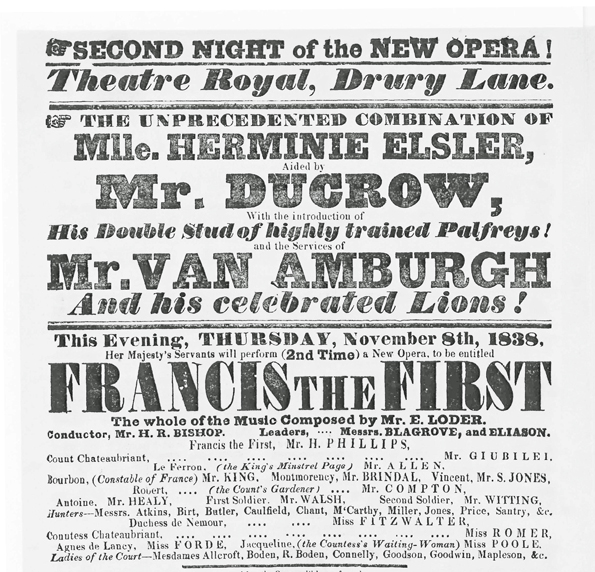
Francis the First Count Chateaubriant Le Ferron Bourbon (Constable of France) Montmorency Vincent Robert (the Count's Gardener)
Duchess of Nemours Agnes de Lancy Countess Chateaubriant Jacqueline |
- Mr King *
- Sally Forde / Mrs Allcroft * - Elizabeth Poole / Sally Forde * |
* It is not clear whether a Mr King, an actor, took this part rather than the singer, Donald King. The former seems seems more likely given that he also played the title
role in Charlemagne, a spectacular that included Van Amburgh's animal act and was part of the same evening's
programme. The Charlemagne bill also showed a Mr G King.
The November 8 playbill has Sally Forde as Agnes de Lancy and Elizabeth
Poole as Jacqueline. However, the Theatrical Observer
(Nov. 13, 1838) was showing Mrs Allcroft instead of Forde with Forde taking over from Poole for the third performance, which was also
repeated for, at least, the fourth. By November 27, Forde and Poole had returned to their original roles.
History
Bunn did not include this in the list of works mounted at Drury Lane prior to 1840 and reported in his early memoirs [1]. Perhaps he wanted to gloss over that the piece had been hurriedly put together, padded out with existing songs and that performances were abandoned before the end of the month. The premiere was scheduled for November 3 but was postponed because Emma Romer was ill (Theatrical Observer,Nov.5, 1838). The Theatrical Observer (November 7, 1838) mentioned that the first night was enlivened by the growling of a lion from another act being clearly heard during the opera.
The librettist(s) are somewhat obscure and were not made public at the time. The Morning Post (Nov. 7, 1838) listed "Haynes Bayly, Charles Jeffrys (sic), Thomas Mackinlay, Rophino Lacy and others". The Court Gazette (Nov. 10, 1838) believed that it had "been furnished by Dalmaine and Co. from various modern poetasters" adding that it was "of the vile Fitzball school". Theatrical Observer (Nov. 7, 1838) claimed it was a maiden effort of a Mr. Mackinlay". Actors by Daylight (Nov. 3,1838) named the librettist as McKinlan [3] but on November 17 changed it to Mackinlay. However, The Observer (Nov. 12, 1838) wrote that "We are enabled to contradict a statement which has appeared to the effect that Mr Mackinlay, of the firm Messrs. D'Almaine and Co., is the author of the libretto of this opera. That gentlemen is not the parent of the work". Loder also wrote to the Morning Post on November 13 denying their account and claiming that it was the work of one person, whom he did not name, that had been submitted, as a musical drama, to D'Almaine & Co. some years previously. He did admit that others had added some songs and made other changes to render it into a libretto (only Act 1 still survives). This history is all to believable given that it ended up a rather slapdash affair with some of its original songs crossed out and replaced with other numbers..
Loder's statement cut little ice with the Post but, on November 23, without any explanation it identified the author as the same as that of the play The Court of Old Fritz, which opened at the Olympic on November 22, viz. John Frederick Smith. The copy sent to the Examiner of Plays, Charles Kemble, for a licence was signed "From Mr Mackinlay, 20 Soho Square". The latter was the address of D'Almaine and Mackinlay probably submitted it as the responsible employee rather than as the author, which could be the root of the confusion. No other evidence has been found to support the idea of Smith as the main author but, at the present, that looks the most likely [4]. Rather unusually considerable portions of the dialogue are in blank verse, the result of its origin as a drama. At least one of the songs, "The old house at home", was by Haynes Bayly, while "The Lady's Page" by W.H. Bellamy seems to have been the basis for another.
It had at least six performances at Drury Lane according to the Theatrical Observer but none are shown after November 27, by which time it had been reduced to two acts and was relegated to being the concluding piece of the evening.
Plot
The Era (Nov. 11, 1838) wrote:-
|
The main part of the plot consists in the attempts of a court pander, to lure the lovely Countess Chateaubriant into the toils of his royal master. He effects this to a certain extent, by gaining possession of a ring from the Count, her husband, the production of which is to be that he wishes the Countess present at court. The King delivers this ring in disguise, but is recognised by a lady belonging to the Countess. He then discovers himself, and uses his influence as a sovereign in vain. The Countess is inflexible. The Count, however, is filled with suspicion, and lends himself to some political intrigue, very clumsily managed, by way of revenge. He is, however, made sensible of the injustice of his suspicions, becomes more attached than ever to his wife, the King is satisfied, and all ends happily. This has many echoes of Domenico Gilardoni's libretto for Donizetti's Francesca di Foix (1831), itself drawn from Jean Nicolas Bouilly and Emmanuel Dupaty's libretto for Henri-Manton Berton's Françoise di Foix (1809). |
|

Reception
The opera was almost universally disparaged both for the text and, less so, the music.
The Morning Post (November 7, 1838) wrote that:- "As an opera, although containing some pleasing chamber music, it was a failure: and indeed looking at the want of connection in its subjects, it might as well have been called a musical melange". However, the blame was not laid at Loder's door but at the last minute creation of the text. "As regards the plot it is indistinct and mysterious, and is, after much attention on our parts, as religiously concealed from us at this present writing as it was before we had the honour of seeking to develop it."
The Morning Chronicle (Nov. 7, 1838) having lambasted the text and reiterated its perennial plea that good opera required a good text then went on:- "There is a good deal of merit in Mr Loder's music; but its merit consists more in ingenious and artist-like construction than in striking and original melody". Actors by Daylight (Nov. 10, 1838) agreed:- "a good theoretical knowledge of composition is displayed, though we look in vain for any manifestation of genius, or even what may be called talent". The Athenaeum (November 10, 1838, p.812) was disappointed in the work in the light of what Loder had achieved with Nourjahad but qualified it by saying "never was composer so unmercifully weighed down with a libretto". The Theatrical Observer (Nov. 7, 1838) thought that neither libretto nor music "rose above mediocrity".
John Bull (Nov. 11, 1838) was not, in the main, amused: "Francis the First,..., considered as a dramatic production, is the vilest trash that ever wearied poor hearers withal. There may be a plot in it, but it is capitally concealed". It went on to level charges of plagiarism in some songs and that "The music is chiefly of a suggestive character, inasmuch as reminiscences of airs and melodies of other days are constantly brought to mind by it; but the instrumentation proves the composer to be master of his craft".
The Observer (Nov.11, 1838) was more positive finding the overture "bold and striking", "several pleasing solos" and the choruses "extremely good". An American journal, The Musical Review, (January 5, 1839, p. 332) reported that: "The music is good and very pleasing ... The encores were many, and the applause that followed the announcement of the repetition of the piece was given with discrimination and judgment. The author of the opera, we are given to understand, is Mackinley [5], and we are happy to say he has done his work well".
Phillips was said to have "sung very beautifully and Miss Romer made every exertion to do justice to her part" Morning Chronicle (Nov. 7, 1838).
The last review may have been misled by the enthusiasm of the claquers, usually ignored in newspaper reports. In London, they do not usually seem to have openly supported certain singers but to have been employed by publishers to get particular songs encored as a way of getting them better known and hence of encouraging sales of scores. In this case they seem to have aimed at getting the opera repeated, at a time when such repeats were often triggered by the strength of public response. The Morning Chronicle review noted that "The claquers were in such force, and so energetic in their plaudits that it was impossible to say what was the opinion of the audience; but our impression is that this opera will not sustain many representations".
Scores and libretto
Only the first act of the libretto lodged with the Examiner of Plays survives (British Library, Add MS 42949, ff. 386 - 410). A transcript is given here. The vocal score in the British Library (System number 004489020), actually consists of only 9 of the numbers and one of those differs from the libretto so may have been added later. There are separate scores of three of those songs. The score of the ballad, "The old house at home", with words by Thomas Haynes Bayly is available at https://www.loc.gov/resource/ihas.100007386.0?st=gallery.
No printed libretto and only a few vocal items' texts [1] have been found but, together with also using the vocal scores, even these few examples show differences between versions and with the manuscript.
[1] For example, the Observer (Nov. 12, 1838) included the words for three songs.
Recordings
There are no known recordings of the opera or parts of it.
Books, Articles, Online
Nicholas Temperley (ed.), Musicians of Bath and Beyond: Edward Loder (1809-1865) and his Family (Boydell Press: Woodbridge, 2016) has a few scattered references together with a more detailed look (pp. 206-207) at Haynes Bayly's ballad "The old house at home".
[1] Alfred Bunn, The Stage, Volume 3 (London:Richard Bentley, 1840), pp.244-246
[2] Theatrical Observer (Nov.5, 1838)
[3] Grove Music Online (www.oxfordmusiconline.com ) names the librettist as Mackinlan .
[4] Nicholas Temperley (ed.), Musicians of Bath and Beyond: Edward Loder (1809-1865) and his Family (Boydell Press: Woodbridge, 2016), p.229 also supports this assumption.
[5] Presumably a misspelling of Mackinlay .
 |
 |
 |
  |
|
|