  |
 |

|
  Singers (D)
This section also includes people who were primarily actors but fulfilled either non singing roles, which were sometimes included in English opera of this era, or in roles that did not make great demands on vocal ability. A few have been included because they were namesakes or relatives of English opera performers and so, hopefully, help avoid any confusion that might arise. Kurt Gänzl, Victorian Vocalists, (Abingdon, UK: Routledge, 2017) describes the lives and careers of around 100 Victorian singers from different countries and backgrounds but all of whom have some connection through singing Italian or English opera in London. The singers covered are listed here. Please see the section on the main Singers page for provisos about the material included here. Please email englishromanticopera@gmail.com with any comments and suggestions about errors or further material.
Day, MissThe only sign of a Miss Day around this time was a young pianist, Miss Ellen Day, who often appeared in concerts with her brother, a violinist. It seems unlikely that she was the Miss Day who had minor roles in Loder's The Night Dancers (1846) and Balfe's The Devil's in it (1852).
D'Este Finlayson, Madame / Miss Emmie A. D'Este (1845 - 1874) [1]Miss D'Este Finlayson was first noted in the London press in 1864 singing in the premiere of Balfe's operetta, The Sleeping Queen at the German Reed's Gallery of Illustration on September 1, 1864. The Morning Post (Aug. 18, 1864) wrote of a "new soprano, Miss Finlayson, of whom we have heard some favourable reports". By the next year she was using Madame rather than Miss as in May 1865, when she sang in the premiere of George Allen's Castle Grim at the Victoria Hall, Bayswater. She appeared at the New Royalty Theatre in early 1866 in John Mallandaine's Love's Limits and Sylvia, the Forest Flower. From then on she was less prominent in London and appeared increasingly in the provinces as well as gravitating towards burlesque and comedy. Initially, she toured with her husband, John Finlay Finlayson, a singer, organist and pianist, who had written an opera di camera, Love wins the way at the Gallery of Illustration in October 1865 [2]. However, in the autumn of 1868, they stopped appearing together and in the Era (Sep. 26, 1869) she announced that she would be known as "Miss Emmie A. D'Este" from then on. She seems to have got married and retired from the stage towards the end of 1873 but then died shortly afterwards in January 1874 of smallpox [3]. It is possible that she was Emma Alice Whitfield, born 1843 in Liverpool. Her first concert was on March 31, 1858, as part of a "Native Juvenile Talent" concert in Liverpool. She then sang in Liverpool, the north and in Dublin. However, in 1863, the Liverpool Daily Post (June 3, 1863) wrote the she had "had a very flattering reception in Capetown" as lead soprano in an opera troupe. The Era (May 8, 1863) noted that she was singing with a Mr J. F. Finlayson [4]. There is no trace of Whitfield after that but Miss/Madame D'Este Finlayson arrived on the London scene in 1864. No trace has been found of their marriage but when Finlayson got married in 1877 to Alice Goodwin, he entered himself as a widower. There is no obvious explanation as to why she added the D'Este to her name other than the supposed status enjoyed by foreign performers. [1] The Era (Jan. 25, 1874) in its obituary said that she was 29 years old. [2] He seems to have begun his professional life as a piano tuner for Broadwood pianos, as was his father - 1861 census [3] Birmingham Evening Mail (Jan. 19, 1874). She was by then Mrs H. Warner. Either that marriage or her previous marriage to Finlayson was a probably a fiction as Finlayson was still alive. [4] The two of them were also listed as singing a selection of numbers from Verdi's Il Trovatore in Capetown in 1863 - https://esat.sun.ac.za/index.php/Il_Trovatore
Distin, Theodore (1823-1893)Theodore was the youngest son of John Distin. John formed a brass quintet from himself and his sons in 1835 and, together with his wife, Ann (one of the Loder family), on the piano became very well known for their concerts and as traders in musical instruments [1]. Theodore played the French horn but in time turned more to singing. In 1845, the Lancaster Gazette (Apr. 5, 1845) wrote of his fine deep voice. Eventually he became part of the Pyne-Harrison company. He appeared in Pyne and Harrison's 1860 revival of Loder's The Night Dancers at Covent Garden. [1] Royal Society of Musicians website . There is a PhD thesis on the Distin Family by Raymond Farr, see here.
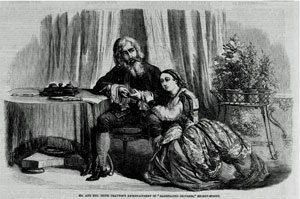
Doria, Clarissa (Clarisse) (1828? - 1854)Doria seemed to first appear in March 1850 at the Marylebone[1], but judging from the comment in The Era (Mar 17, 1850) that the audience was looking forward "with much interest as it was announced in the bills that Miss Clarissa Doria would make her first appearance" she was already quite well known [2]. No clue has been found as to what that earlier reputation might have been. The Morning Advertiser (Aug. 23, 1850) wrote that she was "remarkable for her personal attractions" suggesting possibly that perhaps she was already known from music hall, revues or similar, where physical looks were a premium. A Times (Oct 29, 1851) described her as of "literary reputation" but nothing except her acting has been found. The early 1850s saw the start of the Bloomerism fashion and Doria gave a number of lectures on it and demonstrations of the outfits. That might well might well have led to such anticipation but the dates are too late[3]. Her career developed quickly. She went to the Richmond Theatre, the Olympic and the Theatre Royal, Manchester, before arriving at the Surrey at the start of 1852, where she appeared in Balfe's The Devil's in it. Her final appearance at the Surrey was in April 1853 some time after which she sailed to the US, where, by September 1853, she was appearing at Burton's in New York [4]. Unfortunately that does not seem to have lasted very long as she became ill and died at the end of 1854 [5]. She was primarily an actress and gained considerable praise over her short career. [1] The Weekly Chronicle (Mar. 10, 1850) advertised the Monday, March 11, 1850, show of The Rag Pickers of Paris as her first appearance on any stage. [2] This recognition did not extend to Manchester, where the Manchester Courier (Oct. 5, 1850) noted only that "she seems to be a novice" [3] Kentish Independent (Nov. 15, 1851) advertised one such meeting including that she would appear in a Winter and Summer dress of the new costume. It also referred to her as a lady of literary reputation. [4] New York Daily Herald (Sep. 26, 1853) [5] New York Daily Herald (Jan. 1, 1855) . It named her as Mrs James O'Malley and gave her age as 26. Reynolds's News (May 5, 1850) claimed that she was "under the incognito of Clarissa Doria, the wife of Mons. Soyer". If the latter referred to the celebrated chef Alexis Soyer, this was not correct but might mean that she was using a stage name rather than her married name.
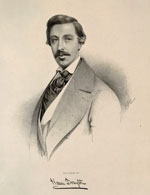
Drayton, Henri (1822? - 1872)
[1] His marriage certificate to Lowe on December 7, 1854, stated that he was a widower. Lowe entered her name as Susanna Sarah Low. Ancestry.com [2] A few details of these operas can be found in Vera Brodsky Lawrence's Strong on Music. Vol. 3 (Chicago: Chicago University Press,1999 ), pp. 313-314. Sometimes they had just a pianist but at other times a conductor so presumably an orchestra, [3] New York Times (Aug. 1, 1872)
Drayton, Mrs Henri - Susanna Lowe
Dubochet, MrDubochet seems only to have been evident over two seasons. In 1834-1835, he was part of the English Opera House company, where his most significant roles were in Thomson's Hermann and Packer's Sadak and Kalasrade . In 1835-1836, he was a member of the Olympic Theatre company.
Durand, Charles (Isaac Charles Bingley) (1827 - 1904)Durand was born Isaac Charles Bingley. [1] He first appeared in concerts in 1850. His first stage appearance according to the Morning Post (Nov. 17, 1851) was in the revival of Macfarren's King Charles the Second at the Haymarket on November 17, 1851, when "although evidently a novice" he "contrived to acquit himself respectably".[2] However, he had appeared in the short lived opera by Alexander Mitchell, The Last Crusade (1850), when he was billed as a pupil of John Barnett. He signed up as part of the Theatre Royal, Dublin company for the 1852-1853 season and stayed there until 1855. While in Dublin at the Theatre Royal, he sang in the premiere of Lanza's Hamet and Zelena on February 1, 1855. After that, he toured for many years with different companies: the National English Opera Company under the management at different times of James Tully and Lucy Escott from 1856-1860, with Henry Haigh - 1862, Henry Melville - 1865 before starting his own in late 1865. He continued to manage companies, though not continuously, until 1886. [1] The Era (Mar. 26, 1904). Supported by the census returns - ancestry.com [2] Morning Post (Nov. 18, 1851)
Dussek, Eugene (Eugene Dussek Corri) (1826-1870)Eugene Dussek was one of the musical Corri family and brother to bass Henry Corri and baritone Haydn Corri. Dussek was also a bass and switched to using Dussek in the mid 1850s, presumably to distinguish himself from the other Corris. His first public appearances seem to have been as part of a church choir in Dublin in 1845 [1]. By 1851, he was singing with an opera company in Leeds and claiming to have sung at both Covent Garden and Her Majesty's [2]. He formed his own company with Frederick Young in 1856 and toured some Northern towns but soon they joined his brother Henry's troupe. In 1858, he joined Manley and Bridgman's English Opera touring company and later Elliot Galer's company until mid 1859 at which point he joined the Pyne-Harrison company. While with Galer's company, he sang in the premiere of Meyer Lutz's Zaida or the Pearl of Granada at the Royal Amphitheatre, Liverpool on February 14, 1859. He also featured in the premieres of Glover's Ruy Blas (1861), Balfe's The Puritan's Daughter (1862) and Benedict's The Lily of Killarney (1862). In 1862, he married another member of the Pyne-Harrison company, the soprano Annie Thirlwall and sang in their short pre 1863 season tour but does not seemed to have stayed with them for their final season. Dussek joined the successor company to Pyne-Harrison, the Royal English Opera Company (Ltd), for the first part of their 1864 -1865 season when he sang in Mori's The River Sprite, in February 1865. He left shortly afterwards to join his brother, Henry and wife, Annie's company, the Grand English Opera Company and toured with them and other companies such as Loveday and Summers until mid 1868. It is not clear what he did then but in October 1869 he was sued, in his position as a stage manager, for an outstanding salary payment. The judgment went against him but he pleaded that he "be allowed to pay the amount in instalments, as he had not been doing anything for some weeks" [1]. Thus he would appear to have been out of work at that time and on February 4, 1870, he had died. [1] Freeman's Journal (Sep. 5, 1846) [2] Leeds Times (Nov. 15, 1851) The Era (Oct. 24, 1869) |
 |
 |
 |
  |
|
|