  |
 |

|
  Nourjahad(Illusion, or The Trances of Nourjahad)Music by Edward J. LoderLibretto by Samuel J. Arnold (after Frances Sheridan)
English Opera House
|
|
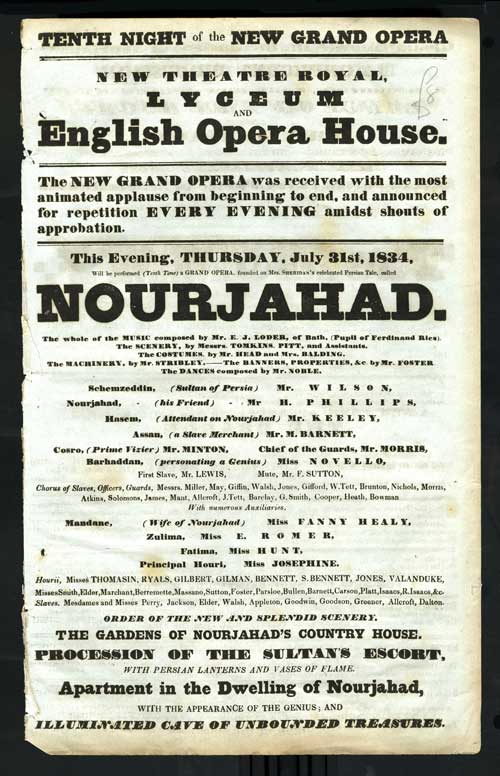
Schemzeddin (Sultan of Persia) Nourjahad (his friend) Hasem (attendant to Nourjahad) Assem (a slave merchant) Cosro (Grand Vizier)
Barhaddan Mandane (wife of Nourjahad) Zulima Fatima Principal Houri
Conductor |
|
History
When Samuel James Arnold reopened the English Opera House on July 21, 1834, after a fire, he advertised it as for "the presentation of English operas and the encouragement of indigenous talent"[1]. The first opera under this new regime was Edward Loder’s Nourjahad, to a libretto by Arnold. This had its origins in The History of Nourjahad, a story by Frances Chamberlayne Sheridan, the mother of Richard Brinsley Sheridan. The story had appeared in several guises including, in 1813, as a play, Illusions or the Trances of Nourjahad, adapted by Arnold with music by Michael Kelly. Arnold deleted a few parts of his previous text and added some songs. Through William Hawes, his musical director, he met Loder and asked him to compose the music giving him just five weeks to do so [2].
The opera opened to quite positive critical acclaim. However, little over a month later, by the time of Barnett's The Mountain Sylph, the Morning Post (August, 26, 1834) noted that Nourjahad had "not answered the expectations which its intrinsic merits excited". In the event, it ran for at least 29 performances before being advertised again on October 22, 1834, with additional music (Theatrical Observer, October 14, 1834, p.116). This seems to have run for a further 3 performances and there was a further brief revival in June, 1835. Some excerpts were sung as part of the programme on November 11, 1836 but there do not appear to have been any further full performances.
[1] Stanley adie,ed., The New Grove Dictionary of Opera, Vol. 1 (London: Macmillan Publishers Ltd., 1992), p.213
[2] David Chandler's "Edward Loder and his Librettos", in Nicholas Temperley (ed.), Musicians of Bath and Beyond: Edward Loder (1809-1865) and his Family, (Woodbridge: The Boydell Press, 2016), p.224.
Plot
According to the Morning Post (July 23, 1834) the plot ran:
Nourjahad is the friend and favourite of Schemzeddin, Sultan of Persia, and is destined to be his Prime Vizier on the retirement of Cosro whose daughter, Mandane, is united to Nourjahad. The latter is, however, restless and ambitious; he desires immortality, and the prospective delights of Paradise, as promised by Mahomet to the faithful. In a conversation with the Sultan Nourjahad avows his impious thoughts, and the former determines to reclaim the friend of his bosom from his infidelity by making use of a stratagem whereby the fancies of his favourite are apparently realised. Barhaddan personates the Genius, and affects to gift Nourjahad with immortality, but at the same time inflicts upon him trances to chastise him when he has committed any fault against the Prophet's law. The Sultan carries on the deception by placing at the command of his misguided friend unbounded riches. The first act ends by Nourjahad purchasing of Assan, a slave merchant, his whole cargo of female beauties, amongst whom is Zulima, a fascinating brunette, whose sparkling eyes quickly eclipse the remembrance of Mandane.
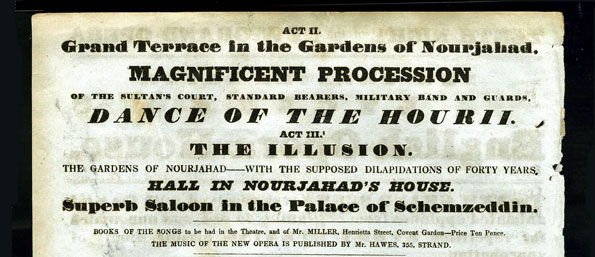
Nourjahad is overcome by wine, falls asleep, and in the second act, on awaking, is informed by Hasem, his attendant, that he has been in a trance for four years. He is also told that his wife Mandane has died in giving birth to a son. The story does not reform him, and the Sultan, in a visit which he makes to his house, finds him still obdurate. Nourjahad is wrapt up in his pleasures, and a fete, which was to have been enacted before his trance, is given with great magnificence and éclat. The surfeit of luxury drives him into another sleep, and in the third act the design of the Sultan is further developed. Forty years are supposed to have elapsed. Everything seems in ruins, and a mute in expressive action conveys to him the intelligence of the death of all his friends and relatives. He finds himself in a wilderness, and standing alone amidst a “wreck of matter”. The Sultan disguised comes upon his solitude, tells the tale of his own death, and avows himself to be the son of Nourjahad. Remorse acts upon the victim of illusion, and when his wife Mundane is brought again on the scene as his granddaughter he is overcome with the wickedness of his purpose. The Sultan finds the cure effectual, undeceives his friend, and all ends sec. art. (according to art, i.e. to usual practice) happily.
Reception
The Theatrical Observer (July 22, 1834) thought
The music, though not strikingly original, is pleasing and effective, and some of the melodies are flowing and harmonious; a trio in the third act, 'Sweet is the murmur of the summer breeze' is very beautiful, and was twice encored. The overture which is very spirited, a duet between Phillips and Miss Healy, and the song 'There's a light in her laughing eye', were also encored. The Opera has been got up without any regard to expense; the dresses are gorgeous and appropriate, and the scenery is picturesque.
The Morning Post (July 23, 1834) was of much the same opinion
Upon the whole the gratification which we have experienced from this opera has been very great. There were many beauties and there are signs of great promise. If reminiscences of other masters from time to time intrude themselves, they were fully counterbalanced by the striking originality of the choice morceaux, and is entitled to every latitude in the way of indulgence. It was received throughout with immense approbation, which at the termination burst into reiterated plaudits.
The Standard (July 22, 1834) thought "Its success, which was decided, fully answered all the expectations that had been excited". "The music... is very agreeable, and wants nothing but originality". "The choruses, too, are well composed and effective. The piece has been got up with great splendour; the scenery is pretty, the processions marvelous and well managed, and a ballet is introduced, which was remarkably well executed". Healy and Romer were both praised.
The Supplement to the Music Library (Sept, 1834), p. 71, was also very supportive praising Loder's instrumentation and asking that "the reminiscences met with in Nourjahad should be treated with lenity". Of the singers: "Mr H Phillips was, as he always is, excellent; Miss Healy and Miss Romer both sing in tune and in time, having nothing vulgar in their manner, and their voices are agreeable". "Mr Wilson acted his part well - better than he sang it". Its next issue in October 1834, p.80, included a short review of nine numbers in which "There's a light in her sparkling eye" was described as
one of the great favourites of the opera. It is an exhilarating air, the rhythm of which is strongly marked by an accompaniment of chords in quavers. The vivacity superadded to it by Mr. H. Phillips certainly has a large share in the electrical effect — to use the phrase of dramatic critics — it constantly produces. For pure vocal effect, the words are too many for the notes; but the number of words, and necessarily quick utterance of them, are not always considered faults on the stage.
The Era (Dec.2, 1834) when commenting on the sheet music talked of Loder being "sacrificed to the wretchedness of the libretto".
Comments
Arnold's resurrection of his twenty year old play with just some fresh songs interspersed suggests that he had no great ambition to see a marked change in the structure or approach for his envisaged new era of English opera. As always spectacle was a major focus and attraction. The short notice given to Loder also does not suggest that Arnold had anything very musically ambitious in mind. In the event though, despite the lack of time and the limited and predictable nature of the libretto, Loder produced music, which, if not that original, got away from the wholesale incorporation or adaptation of existing music and pointed the way towards a musically more interesting era for English opera.
Scores and libretto
Sheridan's original story, Illusion, or The Trances of Nourjahad, can be found at Google books and the Arnold/Kelly play at Google books and Hathi Trust. Arnold's submission to the Examiner of plays (Add MS 42927 ff.196-234b) interleaved the printed dialogue from the play with handwritten pages of songs and other vocal numbers. He was at pains to point out that the play already had a licence and so only the handwritten vocal numbers required examination and agreement. The opera was signed off on July 12, 1834
The vocal score of the inserted numbers is at IMSLP as is the score for the song "There's a light in her laughing eye". The vocal score and that for the song "There's a light in her laughing eye" are in the British Library.
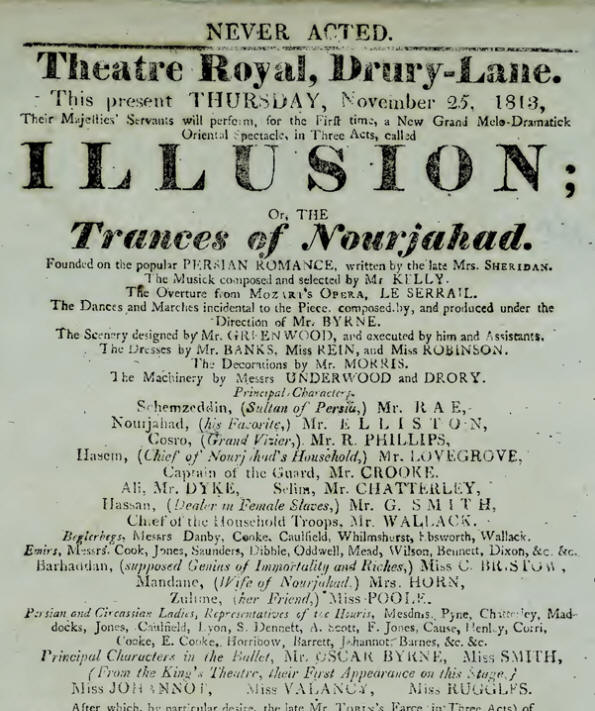
Playbill for Arnold/Kelly Illusions(1813)
Internet Archive
Recording
None known
Books, Articles, Online
David Chandler's "Edward Loder and his Librettos" (pp. 222 - 225) and Paul Rodmell's, "Edward Loder's Serious Operas" (pp. 236 - 243) in Nicholas Temperley (ed.), Musicians of Bath and Beyond: Edward Loder (1809-1865) and his Family, (Woodbridge: The Boydell Press, 2016) discuss the opera in some detail. The latter includes parts of the piano score of three numbers.
Sonja Lawrenson, "Francis Sheridan's The History of Nourjahad and the Sultan of Smock Alley", Eighteenth-Century Ireland / Iris an dá chultúr, Vol. 26 (2011), pp. 24-50, places the Sheridan's novel within contemporary Irish history and politics.
 |
 |
 |
  |
|
|