
|
 
Works created 1834-1866 sometimes described as English Operas
Various authors, e.g. Allardyce Nicoll [1],
George Biddlecombe [2] and the Stanford University Opera Premieres
website [3], named a number of works as English language operas that
have not been included
in the English opera list. This was because they were not seen or described as
such at the time or, in a few cases, the evidence is so slight that it
was not possible to be sure what they were.
Some confusion often arose because, in London
before 1843, only Drury Lane, Covent Garden and, in the summer, the
Haymarket, could offer spoken drama. To circumvent these rules, other
theatres included songs or other music in their drama thus sometimes
blurring the boundary between them and what was considered and
advertised as English Opera. This practice lingered on even when the
legal necessity had disappeared. Such works went under the titles of
operettas, burlesques, burlettas and, later, musicals and often drew
on existing, rather than original, music. English opera was usually distinguished by some level of dramatic
intent and a greater amount, originality and complexity of music. Its performers were known primarily as singers rather than as actors.
Another category that has not been included in the
list of English operas are the direct English translations of
continental operas, including Balfe's French operas. There is a
distinction between them and cases where the librettist used a
continental opera as a starting point but adapted it to fit the
presumed English differences in taste, particularly adding a happy
ending. The composer then used that new libretto as the basis for an
original English opera.
Towards the end of the period there was a move to
shorter works with flimsy and often comic plots that went under
different descriptions, such as operettas, comic opera, opera di
camera and musicals, and showed a definite break from English opera. This movement is
discussed below.
1834
The Dragon
George Alexander Lee / Thomas Morton (?),
English Opera House, August 4, 1834 Described as a one act comic operetta but The Standard (August 5, 1834) states that it would be more correct to call it "a
short farce with a few songs introduced". Lee contributed the songs with the main text by Morton. Nicoll [1]
states that this refers to John Maddison Morton (1811 - 1891) but the
Morning Post (August 5, 1834) calls him "the
veteran Morton", suggesting that it is more likely to be his father Thomas (1764-1838). It was introduced as an afterpiece
to a performance of Nourjahad.
The Widow Queen
Edward Loder / Thomas Serle, English Opera House, August 9, 1834 This was a drama by Serle for which
Loder wrote an overture and some songs.
Genevieve or The Maid of Switzerland
George Alexander Macfarren / Mrs Cornwell Baron-Wilson, English Opera House, November 3, 1834 This operetta by
Baron-Wilson was
introduced as a one act curtain raiser to Hermann or The Broken Spear.
According to the Morning Post (November 4, 1834), it was a translation of a French work and variants of it
seemed to have been staged in earlier years. Macfarren was said to have contributed an overture, a song and choruses.
The Red Mask or The Council of Three
Tom Cooke - Marco Aurelio Marliani / James R. Planché, Drury Lane, November 15, 1834 This was an English version with words by Planché and adapted by
Tom Cooke of Marliani's opera,
Il bravo, given in Paris earlier in the year.
1835
The Shadow on the Wall
John Thomson / Thomas Serle, English Opera House, April 20, 1835 This was a drama by Serle with music by Thomson, composer of Hermann. It is sometimes claimed as Thomson's second opera but it was advertised as
an afterpiece to Sadak and Kalasrade and its main actor was Serle (not a
singer). Thomson in a letter to the Musical World cited Hermann as his only opera [1].
I and My Double
George Alexander Macfarren / John Oxenford, English Opera House,
June 10, 1835 This was a
farce by Oxenford for which
Macfarren wrote some music.
The Dice of Death
Edward Loder / John Oxenford, English Opera House, September 14, 1835 This was a titled a romantic drama. It was by
Oxenford for which
Loder wrote some music.
Love in a Cottage
George Alexander Lee / Thomas Haynes Bayly, The Olympic, September 28, 1835 This was a burletta
by Bayly with songs by Lee. No reference to a performance at the
Strand Theatre in 1839 has been found as listed in the
Stanford University Opera Premieres page
Paul Clifford
George Rodwell - Jonathan Blewitt / Edward Fitzball - Edward Lytton Bulwer, Covent Garden, October 28, 1835 Advertised as a drama or musical drama, this was an adaptation by
Fitzball of
Lytton Bulwer's novel. Although the music was sometimes
attributed solely to Rodwell, who provided "some pretty
ballads", several sources also include Blewitt [1]. The novelty of including a coach drawn onto the stage by four horses seems to have been quite
a sensation.
1836
Quasimodo, or The Gipsy Girl of Notre
Dame
George Rodwell (Carl Maria von Weber) / Edward
Fitzball, Covent Garden, February 2, 1836
Described as an
operatic drama based on Victor Hugo's novel with the music arranged by
Rodwell from various works of Weber. The words of the songs can
be found
here.
George Alexander Macfarren / George
Macfarren, New Strand Theatre, August 15, 1836
A musical
burletta by George Macfarren with music by his son, George Alexander
Macfarren. The Naval and Military Gazette (Aug. 20,
1836) said it possessed "the sin of being innocent of everything
necessary to constitute a burletta" and it was soon withdrawn. The
News (London) (Aug. 21, 1836) claimed that it was a renaming of a
piece called Peccadilloes, which had been first given on
April 21, 1831 at the Queen's Theatre, whose management George
Macfarren had taken on in the previous February.
The Gaberlunzie Man
William Rede (?) / William Rede, English Opera House, September 26, 1836 Advertised as a Scottish operatic drama by Rede (It is not clear if he also wrote or arranged the music). The
Spectator (October 1, 1836) called it a musical afterpiece "serving ... to introduce several Scottish airs and
romantic adventures, and to show off (John) Wilson in a picturesque dress".
1837
King of the Danube
Auguste Pilate / John Buckstone, Adelphi,
March 27, 1837
This was described as a ballet - burletta stemming from Adam/Taglioni's
La Fille du Danube produced at the Paris Opéra in 1836.
The text was adapted by Buckstone and most of the music composed by Pilati, but
a few items were taken from Adam, Bellini and others [1].
Rory O'More
Jonathan Blewitt / Samuel Lover, Adelphi,
September 29, 1837
This was a burletta written by Lover based on his popular novel
published earlier in the year. Blewitt provided the music [1]. Lover
[2] claimed that it ran for 108 nights at the Adelphi in its
first season.
The Afrancesado or Secrecy and Truth
George Alexander Lee / Thomas James Serle, Covent Garden, October 19, 1837 This was a "melodramatic romance" (Morning Post, Oct. 20, 1837) by Serle with music by Lee.
1838
The Outpost
John Hullah / Thomas James Serle, Covent Garden, May
17, 1838
Described both on the manuscript submitted to the
Examiner of Plays and in the press as a one act operetta. The
Standard (May 18, 1838) called it "An amusing little operetta of
no great pretensions". It did note that "the music was of a popular
character".
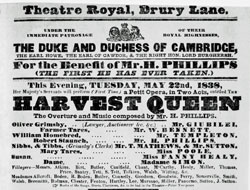
Henry Phillips / Henry Phillips, Drury
Lane, May 22, 1838
|
Phillips wrote both music and words as well as singing in it
for his benefit night. It was widely deemed a failure and
never repeated. Actors by Gaslight (June 2, 1838), p.
53, wrote that " Of the composition, as a whole, we can safely
say it is miserable; no plot, no melody (except it be
pilfered), no harmony, no dialogue (except it be worse than
naught)". The Morning Post (May 22, 1838)
described it as a "petit opera" and other newspapers called it an opera
but it
was a slight one act piece [1], an "agreeable trifle"[2], that
was staged ahead of Benedict's The Gipsy's Warning. The manuscript
[3] sent to the Examiner, Charles Kemble, described it as an
operetta.
|
 |
The Foresters or twenty five years since
Thomas James Serle / Edward Loder, Covent Garden, October 19, 1838 This was a drama by Serle, although The Era
(October 21, 1838) reported that he was said to have disclaimed
it. Loder wrote an overture and some songs. The
Times (October 20, 1838) reported that the spirited overture was unanimously encored but that the
"'interspersed airs,
although pleasing, made no great no impression, and gave no great relief to the whole".
1839
Agnes Bernauer, the Maid of Augsburg
George Alexander Macfarren / Thomas James Serle, Covent Garden, April 20, 1839
This was described as a romantic melodrama. It was written by Serle and had incidental music by Macfarren.
The Pupil of Da Vinci
Joseph Augustine Wade / Mark Lemon, St James's Theatre, November 29, 1839 The Champion (Dec. 8, 1839) described it as
"a pretty little operetta". The "smoothly written" libretto was
by Lemon and the music by Wade, whose
melodies were "distinguished by graceful simplicity". It was
said to have been eminently successful.
1840
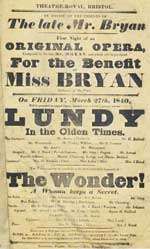
Lundy in the Olden Times
Cornelius Bryan / Miss Bryan (Ann
Bryan?)
|
Mentioned in George Biddlecombe's English opera from 1834 to 1864 with particular reference to the works of Michael
Balfe. (New York: Garland Publishing, 1994), p.333 as composed by Bryan to a text by Miss Bryan,
who was probably his sister, Ann.
However, the Bristol Times (Mar. 21, 1840)
reported that during a break in rehearsals on Wednesday, March
18, Bryan had been walking around the darkened stage, fell down
through an open trapdoor and died of his injuries the following
day. The opera had been intended to premiere on March 24 but
was postponed. It was given on March 27, 1840 as a benefit for
Miss Bryan but that appeared to be its only performance. Bryan had
been organist of St. Mary, Redcliff in Bristol. Although a
licence was issued (Add MS 71564), no manuscript seemed
to have been received by the Examiner of Plays
(Add MS 53702).
Although the poster referred to it as an
opera, James Love's Scottish Church Music (William
Blackwood and Sons: Edinburgh and London, 1891), p. 86, called
it as an operetta, probably more likely although no evidence
was given.
|
 |
Hedwig von Linden
Prince Albert / ?
Around the time of the marriage of Prince Albert to Queen
Victoria on February 10, 1840, there were reports that an opera
by Prince Albert was to be produced at Drury Lane. The Court
Circular for February 19, 1840, eventually denied
this. However, the publisher and bookseller John Limbird wrote
to The Times (Feb. 20, 1840) claiming that he had many
compositions by Prince Albert in his possession and that "these
have been placed in the hands of a well-known musician, who is
now moulding them into a dramatic form, and wedding them to a
libretto by a popular author". The Allgemeine
Theaterzeitung (Aug. 17, 1840) reported that Prince
Albert's Hedwig von Linden was in preparation in
London. Whether these two mentions refer to the same opera or
not, no performances were staged of any operas by Prince Albert
or using his music in some way. The Musical World
(Nov. 26, 1840), p. 347, in a satirical poem about Albert's
musical talents wrote "His highness write an opera! flam and
flash!". Nicholas Temperley, "The Prince Consort, Champion
of Music" Musical Times (Dec., 1961), pp. 762-764,
considers Albert's broader musical impact.
Triboulet or The King's Jester
( or The King's Fool or The Old Man's Curse)
Isaac Nathan / John Gideon Millingen, Sadler's Wells,
1840
The
Stanford University Opera Premieres site claims that this
was an opera first staged at Sadler's Wells in 1840. In fact, it
had first been performed at the Victoria Theatre on July 17,
1833. It was an English version by Millingen of Victor Hugo's Le Roi s'amuse and described as a drama
with music by Nathan, of which "we can say nothing
flattering", Sun (July 18, 1833).
The
Greek Boy
Samuel Lover [1] / Samuel Lover, Covent
Garden, September 29,
1840
This was described as a musical drama. It was an
afterpiece to the main work and designed as a vehicle for Lucy
Vestris, the Covent Garden manager.
1841
The Deer Stalkers
Edward Loder / Mark Lemon, English Opera House, April 12, 1841 This was first performed as an afterpiece to Balfe's opera Keolanthe and, according to The Stage (August
24, 1841) was basically a vehicle for a number of Scottish ballads sung by John Wilson and some characteristic highland comedy
from Mr M'Ian, the whole thing adding up to a stereotypical Scottish sketch that had become all too common.
Loder arranged the music, of which, "it would be gross flattery to say anything in
commendation". The text was by Lemon. It is sometimes labelled a Scottish opera.
Arcadia, or, The Shepherd and the Shepherdess
J. (?) Harroway / Edward Lytton Blanchard, Olympic Temple, April 19, 1841. Described by The Era (September 25, 1841) as a "grand mythological spectacle". It was put on at the
Olympic Temple because the Royal Grecian Saloon was undergoing extensive alterations. The text was by Blanchard and the music by Harroway[1]
Il Paddy Whack in Italia
Samuel Lover / Samuel Lover, English Opera House, April 22, 1841. Although referred to as an opera in the Morning Post (August 21, 1841), the score describes it as an Operetta in one
act. The text and the music was by Samuel Lover but possibly with help from Balfe[1].
1842
The Students of Bonn
George Rodwell / William Bayle Bernard (?), Drury Lane, March 21, 1842. Described in The Spectator (Apr. 2, 1842) as a "light operetta in one act". It claimed it was a musical
version of a play called Boarding-School with the
"pretty" music by Rodwell.
A play called
The Boarding School by W.B. Bernard had premiered at
the Haymarket on September 2, 1841.
The Follies of a Night
Tom Cooke / James R. Planché, Drury Lane,
October 5, 1842. This was described as a vaudeville comedy adapted by Planché
from a French comedy entitled Charlot. Planché in a
preface to the
libretto mentioned that some songs were adapted by Cooke.
It starred Charles Matthews and Lucy Vestris and was "perfectly
successful" (The Standard, Oct. 6, 1842). The
piece reappeared many times over the next 30 years and around
1876, Planché revised the text and Virginia Gilbert set it to
music[1]. However, Gilbert died in an accident before its
production [2]. There is a
libretto in the Library of Congress and a vocal score
here, which the British Library provisionally dated as 1860, which would seem too early.
1843
The Queen of the Thames
John Liptrot Hatton / Edward Fitzball, Drury Lane, February 25, 1843.
A one act operetta that played second on the bill. The text was by Fitzball and
the music by Hatton was described as " very common-place, but at the same time was pleasing" by
The Standard (February 27, 1843).
Geraldine, or, The Lover's Well
Michael William Balfe / Gilbert à Beckett - George Soane, Princess's Theatre, August 14, 1843
This was an English version of Balfe's Le puits d'amour that had been premiered at the Opéra Comique in Paris.
Biddlecombe [1] cites Gilbert à Beckett as translator but
the Morning Post (Aug. 15, 1843) names George Soane as
does Blackwood's Lady's Magazine. (September, 1843), p.184,
with its remarks about Soane's "mass of clumsy and vapid dialogue".
1844
The Castle of Aymon, or, The Four Feathers
Michael William Balfe / Gilbert à Beckett
- Thomas H. Reynoldson, Princess's Theatre, November 20, 1844 This was an English version of Balfe's Les quatre fils Aymon that had been premiered at the Opéra Comique
in Paris. Biddlecombe [1] cites
Beckett as translator.
However, the manuscript in the British Library (Add MS 42979,
ff. 677-694) names Thomas H. Reynoldson. Beckett was the
author of a "new extravaganza" called Joe Miller and his
Men that was introduced around a month later and followed the opera (Star of Freedom,
Dec. 28, 1844), which might be the source of the confusion.
See
here for the opera libretto. Henry Chorley considered it
Balfe's best opera [2]
1845
Adventures in America
Henry Phillipsl / Henry Phillips - Martin
Tupper, Northampton, August 11, 1845 (?) [1]. This was
a lecture/ song recital resulting from Phillips's recent trip to
America. He toured the provinces with it during autumn
1845 and spring 1846, accompanying himself on the piano. As well as songs he had learned on his
travels, there was some original material by Phillips with
Tupper also involved in at least one. [2].
1846
The Young Pretender
Mary à Beckett / Mark Lemon, Haymarket
Theatre, November 28, 1846. Occasionally cited as Mary à Beckett's third opera and
initially advertised as an Operatic Drama, this was a short,
lightweight play with some musical numbers performed by Mr
Hudson and Priscilla Horton. The Times (Nov. 30, 1846)
wrote that "there are some pretty pieces of vocal music ... but,
altogether, the piece is too flimsy even for an hour's
satisfactory recreation".
The Seven Maids of Munich, or, the Ghost Tower
George Rodwell / George Rodwell, Princess's Theatre, December 19, 1846. This was advertised as a one act musical romance. Both libretto and music were by Rodwell, who claimed in a letter to the
Morning Post (Dec. 22, 1846) that it was an entirely original. The
Morning Chronicle (Dec. 21, 1846) thought it "lively and agreeable".
1847
The Rival Clans
Henry Deval / Henry Deval, Theatre Royal, Newcastle, January 22, 1847 Advertised as "an entirely New Opera in Two Acts" (Newcastle Journal, January 16, 1847) but described
elsewhere[1] as a "ballad opera" with music by the Theatre Royal music director, Henry Deval. The Era
(February 7, 1847) noted that "the overture was original"
perhaps suggesting that some or all of the remainder was not but, as was often the
case with ballad opera, took existing ballads or ballad tunes for the majority, if not all, of the vocal numbers.
The review in The Era claimed that it was a great
success but it does not seem to have been revived
1848
The Andalusian or The Young Guard
Edward Loder / George Soane, Princess's
Theatre, January 20, 1848.
This was described in the Morning Herald
(Jan. 21, 1848) as "a little opera...apparently a portion of a larger
work...and containing a series of agreeable songs by Mr Loder".
Elsewhere it was described as a two act operetta. It seems to
have been a vehicle for the popular soprano, Anna Thillon, and was
well received. The Era (Jan. 23, 1848), having noted "the
somewhat flimsy plot", wrote that "Mr Loder has introduced some light
and pretty music, which, from its unpretending style, disarms
criticism. The ballads from their simplicity, are sure to attain
popularity". Soane, the librettist, had written The Night Dancers
(1846) for Loder. The libretto can be found at
Warwick Digital Collections and at
Internet Archive.
Jeannette and Jeannot
James Tully / James Henry Horncastle, Theatre Royal, Brighton, September 14, 1848
[1]. The music was by James Tully and the libretto by Horncastle, who were musical director and one of the singers doing a season at Brighton and then touring with the English
Opera Company. The opera was reported as given at Portsmouth a few days later and selections from it in Ipswich a month later.
It never played at a major London theatre and seems likely to have been an enterprising, but transitory, effort to take
advantage of the highly popular song by Charles Jefferys and Charles Glover, "Jeannette and Jeannot",
even though it boasted that "the Music all entirely original". No
manuscript appears to have been forwarded to the Lord
Chamberlain's office for approval. Another example that
capitalised on the song was Edward Stirling's musical romance,
which premiered at the Strand Theatre in London on
November 6,1848. That was sent to the Examiner.
1850
The Sleeper Awakened
George Alexander Macfarren / John Oxenford,
Her Majesty's Theatre, November 15, 1850 This was described as a serenata, which would normally feature
elements of opera, oratorio and cantata and, in this case, was
described as "a short opera without the aid of scenery, dresses
and appointments" (The Era, Nov. 24, 1850). It featured
as part of a Grand National concert.
1852
The Charmed Harp
Wilhelm Meyer Lutz / John Courtney, Surrey Theatre,
August 30, 1852 This was a "romantic operetta" performed as an afterpiece to
Balfe's The Devil's in it. The Daily News (Aug.
31, 1852) talked of the dramatic portion being "a jumble of the
stalest melodramatic ingredients" while none of the main company
vocalists were included.
1853
Pierre
Joseph F. Duggan / Henri Drayton, St.
James's Theatre,
November, 1853 This was described as a one act operetta and was essentially a
vehicle for the Draytons.
1855
The Minstrel's Return, or, The Sultan's Jubilee
Fourness Rolfe / Fourness Rolfe, Theatre Royal, Newcastle, March 22, 1855 George Biddlecombe [1] included this work in his list of operas with words and music by Fourness Rolfe. However, the well known
actor Samuel Phelps was booked for a short engagement that week and Shakespeare's Julius Caesar advertised
for that Thursday so it seems more than likely that this was a short afterpiece or similar. No work of this title was
lodged with the Lord Chamberlain and it does not seem to have been performed elsewhere. Rolfe was an actor, comedian and singer
with a very varied career mainly in provincial cities but with some London appearances.
1856
Never Judge by Appearances
Edward Loder / Henri Drayton,
Theatre Royal, Southampton, September 2, 1856 (?) The Hampshire Advertiser (September 6, 1856) reported
that Henri and Susanna Drayton had appeared
in Southampton in their "Duo-musical and Mimetic
Entertainment" entitled Illustrated
Proverbs, of which the second offering was "Never Judge by Appearances". Three weeks later the Liverpool
Mercury (September 27, 1856) was advertising them at Clayton Hall, Liverpool. By early 1857, they were in the Myddleton
Hall, London followed by further provincial cities. The music was by Edward Loder and
played on the piano, at least for some of the time by Edward's
cousin, George. In July, 1859, it was submitted to the Examiner of Plays for performance at the Adelphi on July 7,
1859, where it was advertised as a one act opera but still only featured the Draytons, although it may
have had orchestral accompaniment.
The Soldier's Return or Clara and
Valentine
Robert Goldbeck / Robert Goldbeck Goldbeck was a German pianist who took up residency in London
for a time. The Morning Chronicle (June 17, 1856)
announced that a one act opera of his was about to be produced
at Drury Lane. However, there was no obvious sign of it nor was
it submitted to the Examiner of Play and by
October, 1856, he had left for the US(Morning Post,
Oct. 18, 1856). TheMorning Post(May 21, 1857)
advertised the publication of the piano score of The
Soldier's Return, which was described as "a short comic
opera for amateurs". The Liverpool Mercury
(Aug. 4, 1885) advertised a comic operetta, The Soldier's
Return, at the Rotunda Theatre, Liverpool, which might
well refer to this piece while the Wellington Journal and
Shrewsbury News (Nov. 27, 1886) specifically named
Goldbeck in its description of a performance of the piece by
Mrs Burton's Opera Company in Shrewsbury the following year.
This, nearly 30 years later, suggests that it had been
circulating in the provinces for many years previously.
1858
The Dream
Michael Costa / William Bartholomew,
Birmingham Festival, September 3, 1858 This was a serenata to celebrate the marriage of Princess
Victoria to Prince Frederick William of Prussia. Birmingham was
its first public performance but it had been given previously
at Buckingham Palace on the night of the wedding on January 25,
1858.
1859
The Pirate's Isle
Frederick Clay / Benjamin Stephenson, 1959 This operetta was only given a private performance [1]
1860
Garibaldi, or, the Rival Patriots
Frederick Cowen / Rosalind Cowen, Private performance. A "drawing room operetta" with music by the precocious 8 year
old Frederic Cowen with words by his cousin Rosalind and given a
private performance at his home.
Romance or the Bold Dick Turpin
Henry Leslie / J. Palgrave Simpson, Covent Garden, February 2, 1860 A one act operetta with text by Simpson and music by Leslie.
Queen Topaze
Victor Massé / John Oxenford - George Linley, Her Majesty's Theatre, December 12, 1860. This was an adaptation by Oxenford, who wrote new dialogue, and Linley, who adapted the songs to the music of Victor Massé's opéra comique, La Reine Topaze.
1861
Out of Sight
Frederic Clay / Benjamin Stephenson, Bijou
Theatre (Her Majesty's), June 26, 1861. An operetta. The Morning Post (June 15, 1861)
advertised it for June 26 at the Bijou Theatre "with an
entirely new cast and band". It had been given at an amateur
concert on July 6, 1860 [1]. The Dublin Daily Express ( June 25, 1861)
stated that there had been some amateur performances but that
it was now being brought out at the Bijou "to a more general
hearing". Even here though there were amateur vocalists,
"who acquitted themselves tolerably well" (The Era, July 14, 1861). The Bijou Theatre
was an "elegant little theatre attached to the spacious
building to the Haymarket Italian Opera" (Her Majesty's
Theatre).
1862
Court and Cottage,
Frederic Clay / Tom Taylor, Covent Garden, March 22, 1862
An operetta by Clay to text by Taylor. It was originally scheduled for March 15 as part of Harrison's
benefit but was postponed for some undisclosed reason until March 22 and Louisa Pyne's benefit. She sung in it. The
advertisements referred to it as an operetta and it was only ever an afterpiece to the main work, in this instance to
Meyerbeer's Dinorah.
Law versus Love
George Linley / George Linley, Princess's Theatre, December 8, 1862.
A one act comedietta with words and music by George Linley.
1863
Freya's Gift
George Alexander Mafarren / John Oxenford, Covent Garden, March 10, 1863.
Described as an Allegorical Masque to mark the marriage of
the Prince of Wales to Princess Alexandra of Denmark.
A Lord for an hour
G.L.Saunders / G.L. Saunders, Theatre Royal, Sheffield, July 17, 1863.
An operetta with words and music by Alderman G.L. Saunders and sung by the Grand English Opera Company after their performance
of Wallace's Lurline.
Jessy Lea
George Alexander Mafarren / John Oxenford, The Gallery of Illustration, November 2, 1863.
Thomas and Priscilla German Reed opened the Gallery of Illustration with the aim of staging chamber operas, usually with piano
or piano and harmonium accompaniment, and with the hope of attracting those repelled by the notion of going to a public
theatre. Jessy Lea with music by Macfarren and
Oxenford was their first, very successful, offering.
1864
Fanchette
William Charles Levey / John Maddison
Morton, Covent Garden, January 4, 1864 Described as a musical farce and a one act operetta with words
by Morton and music by Levey. It was performed by the Pyne-Harrison
company and was revived into the 1870s. Rather
doubtfully, it was claimed to have had a run of over 300
nights (Northampton Mercury, June 15, 1878)
The Rival Beauties
Alberto Randegger / John Pratt Wooler,
Theatre Royal, Leeds, May 2, 1864.
Although described as a new comic opera given by the London
Operetta Company [1], the vocal score described it as an
operetta, as did press reports, such as The Era (May
15, 1864). The music was by Randegger and the text by Wooler.
Performances in Manchester and the Crystal Palace followed
through the rest of May and early June. It was revived from time
to time in London and the provinces until at least the 1889.
The Oracle
Adolph Gollmick / Carl Gollmick, Victoria
Hall, Bayswater (Bijou Theatre), July 6, 1864.
Sometimes described as
a one act comic opera and sometimes as an operetta. The libretto
was by Adolph's father, Carl. See
http://www.mmm2.mugemir.de/doku.php?id=gollmick for more
details on the Gollmick family. The first performance was for a
charity event on
July 6, 1864 and other performances followed [1]. However, the Lord Chamberlain's licence was
only sent on February 21,
1865. Perhaps Gollmick had thought that amateur performances did
not require a licence or else it was prior to an intended
professional performance that never materialised.
The Sleeping Queen
Michael William Balfe / Henry Brougham Farnie, The Gallery of Illustration, September 1, 1864
An operetta with music by Balfe and text by Farnie. One of the singers was Thomas Whiffen, who became
the husband of Louisa Pyne's niece, Blanche. The following year Balfe
developed it into a two act opera but this was never performed.
A video of a production by the DIT Conservatory, Dublin,
can be seen at https://www.youtube.com/playlist?list=PLECSSzvbzXlAw2IScFegEC9kU161PtLFd
The Soldier's Legacy
George Alexander Macfarren / John Oxenford, The Gallery of Illustration, October 19, 1864
Another successful chamber opera by
Macfarren and Oxenford.
The Bride of Song
Julius Benedict / Henry Brougham Farnie, Covent Garden, December 3, 1864 A one act operetta with music by Benedict and text by Farnie
Punchinello
William Charles Levey / Henry Brougham Farnie,
Her Majesty's, December 28, 1864 The vocal score (here)
and the libretto
described it as a one act comic opera. However, as it only has
one act and needed just 5 singers with a chorus being
optional, it has not been included as an English opera.
Elsewhere it was called an operetta, e.g. advertisement in
The Standard (Dec. 30, 1864). The music was by Levey
and text by Farnie.
The period 1865 into early 1866 marked a clear end
to the type of opera and organisation that had been familiar over the
previous thirty or so years of English opera. The most obvious sign was the hasty
disbandment of the Royal English Opera Company (Limited) at Covent Garden, when
the performance on the evening of February 17, 1866, was called off
because there was no money to pay singers or backstage staff [1], but the
continued inability to sustain a viable company derived from more deep
rooted causes.
It had become increasingly obvious in the 1860s that
the dialogue and song model of English opera could not deliver the
depth and range of drama and emotion that continental through composed opera
achieved. Partly this was down to the poor quality of librettists
and lesser qualities of composers but
more so to the irregular and uneven nature of song interrupted by
dialogue that broke continuity and undermined dramatic climaxes. Even continental
operas with dialogue, such as Gounod's Faust and Bizet's
Carmen, only achieved their full popularity after the dialogue
had been converted to recitative. Related to this, the primacy of
melody that reigned at the beginning of the 19th century and was usually
associated with Italian opera, gradually gave way to more
sophisticated musical ideas, particularly harmony, which were
sometimes labelled "scientific" and were initially associated with German
orchestral works. Although English opera
sometimes turned to extended "scenas", which gave scope for greater
musical sophistication, at its heart it relied on melody and thus was
unable to keep abreast of the new ideas and expectations.
Instead, encouraged by the success of opéra-bouffe
imported from France in the late 1850s and of small scale opera di camera at
places such as The Gallery of Illustration, English opera morphed into
a range of overlapping, generally less dramatic and ambitious dialogue
and song forms: operetta, opera di camera, comic opera and
the musical. The Royal English Opera Company (Limited) tried to
leaven its more serious offerings with some operetta while Elliott Galer and Fanny Reeves took over the New Royalty theatre
and dedicated it
solely to lightweight, smaller scale, works. Neither achieved a strong
and sustainable business but
pointed in a direction that others would follow with more success.
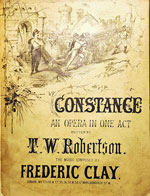
Constance
Frederic Clay /
Thomas W.
Robertson, Covent Garden, January 28, 1865
This was one of a number of lighter works produced by
the Royal English Opera Company (Limited) as they
sought to find a viable artistic and economic future.
It managed only a handful of performances.
It was
listed as an operetta on the manuscript sent to the
Examiner and usually called such in the press but there
were occasional references to it as an opera, as on the
title of the vocal score (opposite).
The
chorus and band parts at the sale of the Royal English
Opera (Limited) effects went for 22 shillings
[1].
|
 |
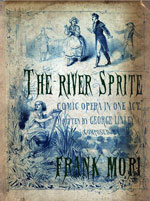
The River Sprite
Frank Mori / George Linley, Covent Garden, February 9, 1865 This was
called an operetta on the manuscript sent to the
Examiner but was often advertised as a one act opera.
The confusion as to classification can be seen in
The Era (Feb. 12, 1865) which first referred to it
as a one act opera in its review but later as an
operetta. According to The Times (Feb.
13, 1865) it had originally been composed three years
previously for the Pyne and Harrison Company at Covent
Garden.
It only
ran until February 25 but was
revived on February 16, 1866 at Covent Garden. However,
it
managed just one performance before the company folded.
It was then given in September later that year in
Newcastle by Edmund Rosenthal's English Grand Opera
Company with Florence Lancia singing the lead as she
had at its premiere. |
 |
The sale of the chorus and band parts at the sale of the Royal English
Opera (Limited) effects went for less than 22 shillings [1].
There is an online printed libretto at Google
Books and a vocal score at Google
Books.
Elliot Galer and Fanny Reeves at the New Royalty Theatre
Galer and Reeves took over the New Royalty Theatre
in September, 1865, with Reeves named as Directress. Their aim was to
run a small scale company devoted to lightweight operettas, comic
operas, burlesques etc. that required a smaller company than usual
with English
opera. The limited aspirations and reduced demands on the performers
are clear from The Press [London] (Sep 9, 1865) comment that:
"Castle Grim will be a boon to amateurs for drawing-room
performances, as it is so arranged in the complete edition published
by Messrs Metzler and Co. that it can be played with or without
chorus".
Although both were seasoned English opera
singers who had run their own touring companies, they did not attempt
any English opera except Wallace's Maritana for Reeves's
benefit on March 18, 1866, when extra forces were drafted in [1]. That
performance also marked the end of their tenure. Their enterprise was,
presumably, financially unsuccessful as there was no other obvious
reason for them to finish [2].
While at the New Royalty, they staged a number of new works, the main
ones being:
George Allen's
Castle Grim, September 2, 1865
Wilhelm Meyer Lutz's
Felix or the Festival of
Roses, October 23, 1865
John Mallandaine's
Love's Limit,
January 6, 1866
John Mallandaine's
Sylvia, or the Forest Flower,
February 17, 1866
|


