  |
 |

|
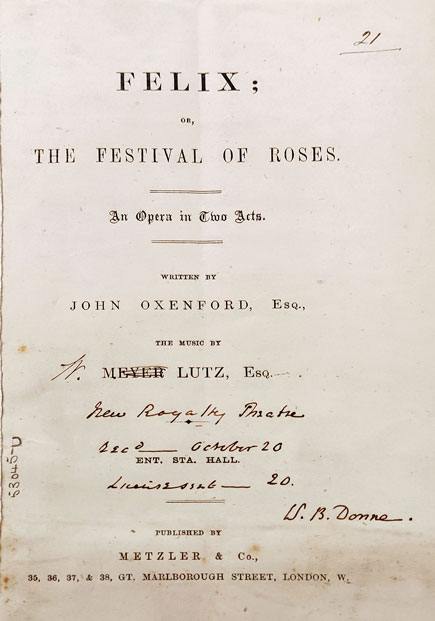
  Felix or The Festival of RosesMusic by Wilhelm Meyer LutzLibretto by John Oxenford
New Royalty Theatre
|
|
Prince of Provence Count Felix Bailie Lucas Bertrand
Countess of Martigne Amelia Jeannette |
- Mr Gaston Smith [1]
|
Conductor - Wilhelm Meyer Lutz
[1] The Examiner's copy of the libretto was printed. It had George Honey taking the part of the Bailie, For some reason this changed to Gaston Smith at the premiere (The Era, Oct. 29, 1865) and in the published printed libretto. The Morning Post (Oct. 25, 1865) had advised that in future the person playing Bailie should not "depend altogether upon the prompter". Thus it looks likely that Honey was supposed to perform the part but that Gaston Smith had to take over at short notice.
History
|
This was the second of the new works staged by Galer and Reeves at the New Royalty theatre. The libretto was by John Oxenford, a much experienced librettist and as often was based on previous works, in this case Nicolas Isouard's Joconde, ou Les coureurs d'aventures first performed in Paris in 1814 [1]. An English version, Joconde or the Festival of the Rosiere, by William Moncrieff was staged at the Olympic Theatre in London in January 1816. Essentially a shortened version of the dialogue from that production was used as well as making some name changes, while Oxenford provided new and more complex vocal sections to carry more of the action [2]. The composer, Meyer Lutz, already had completed two full length English operas, Faust and Marguerite (1855) and Zaida (1859), as well operettas, cantatas and other music. As with the other operas, it was often described as an operetta. It ran from October 23, 1865 through to November 24, 1865, just before the Galtons left the company. It was never revived.
[1] Other sources were wrongly suggested. The Queen (Oct. 28, 1865) reckoned it was based on an old "Spanish intrigue". The Morning Post (Oct. 25, 1865) cited "The favourite vaudeville of Jeannette, ou la Fête de Rosière", although no previous English production has been found under that name. There was a burletta entitled Fete of Rosiere or the Soldier's Return (Liverpool Mercury, Feb. 10, 1832), but that was probably some variation on an 1805 comic opera by Theodore Hook. [2] The Times (Oct. 26, 1865) |
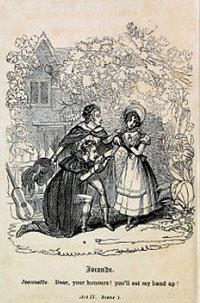 Scene where the two men vie for Jeannette's attention from Moncrieff's Joconde (1816) |
Plot
The Weekly Dispatch (Oct. 29, 1865) outlined the plot [1]:
The Prince of Provence and Count Felix, two fast
friends, are engaged to the Countess of Martigne and Lady Amelia;
and, indeed, the wedding morn has arrived, when the brides, doubtful
of their lovers' constancy, determine to try if 'tis proof against
farther delay; they, therefore, postpone the marriages indefinitely,
and the Prince and Felix, at first somewhat discomfited, determine to
test the ladies' faith in return. The Prince, therefore, decides on
making violent love to Amelia, whilst Felix, self-styled the
irresistible, attacks in like manner the Countess; but the ladies
overhear the plot, and determine to take the strategists in their own
toils. Accordingly, they are scarcely accosted than they declare
reciprocal affection, Amelia giving the Prince a locket as gage
d'amour, whilst the Countess bestows on Felix a scarf. Comparing
notes (the trial over), the bamboozled lovers rail, of course, against
womankind, and then, to assuage their grief, they of make up their
disturbed minds to travel disguised as wandering minstrels, or, more
genteelly, troubadours, and thus pay court to all the good-looking
damsels whom fortune may throw in their way. In this mood, then, they
arrive at the village of Martigne on the eve of the Festival of Roses,
of which a certain Jeannette is not only to he chosen Queen, but is to
receive a thousand crowns as a wedding portion, the Baillie of the
village, who, with spectacles on nose, awards this prize, conceiving
the wild idea of obtaining her for himself. For this idea, however, it
is our private belief he had some foundation, inasmuch as Jeannette is
not only a decided flirt, but has a sharp eye for business; thus,
although she has plighted troth to a young soldier, Lucas, who has
just returned from the wars, she not only accepts the advances of the
Prince and Felix, coupled with presents, but leads them into a fool's
paradise by suggesting an appointment for 9 o'clock in an arbour.
But the lovers have not arrived at Martigne alone. Discovering
their intention, the Countess and Amelia have followed in gipsy
disguise, and, disinterestedly taking compassion on Jeannette's youth
and inexperience, they reveal to her the rank of her admirers, and,
having with this warning forearmed her, they next disclose the
assignation to the Baillie; and, the witching hour of 9 arrived, the
Prince and Felix fall foul of this functionary in the dark, are taken
up for breach of the peace, and, vainly protesting, they are led off
to pass the night in a stable. The next morning they declare their
rank, but without credit; then they try to bribe the Baillie, but with
no better effect than to have their purses appropriated; at last they
demand to be led before the Countess, who is reported to have arrived
in the neighbourhood. She, thinking that their folly has been punished
enough, graciously condescends to recognise them; they are forgiven,
so is the Baillie, and the Festival of Roses is thus graced with three
marriages instead of one, for of course Jeannette throws over the
Baillie and decides in favour of Lucas.
[1] The Times (Oct. 26, 1865) carried the same plot description
Reception
The Daily News (Oct. 24, 1865) thought it "an agreeable trifle". "The plot is ingenious, and treated by Mr Oxenford with a vivacity truly French". "The music is uniformly well written" and referred to the concerted pieces, "often worthy of Auber himself". But even so, there was too much music "Evidently written for sale", i.e. ballads and songs. It judged the opera "admirably acted and sung". Although no doubt it would be successful, if would be more so "if free use were made of the pruning knife".
The Times (Oct. 26, 1865) thought that Oxenford had determined "rather to construct a satisfactory work of art than to tickle the ears of the ignoble vulgar". Lutz had not followed the traditional ballad opera route but had "made his concerted pieces not only more important but more numerous than his songs" with "ingenious orchestral accompaniment. The songs on the other hand...[were] less in keeping with the spirit of the story, being of a sentimental and even impassioned character". The reason being that "they will sound pretty when sung to a piano". The singers were praised, particularly Susan Galton, although the absence of George Honey was regretted. However, the acting had some "grievous shortcomings. Some of the performers seem to have abstained altogether from the trouble of committing the spoken words to memory"[1]. "In spite of all obstacles, however, the music of M. Lutz has obtained an unequivocal success".
The Era (Oct. 29, 1865) was of a similar opinion. It talked of Oxenford's "polished versification" and of Lutz shunning the ballad, his "qualities proclaim themselves in a much more creditable manner. He is thoroughly at home when combining voices in duets, trios etc. and in orchestration, which is from the beginning to the end of The Festival of Roses, elegant, technically clever, and effective. In some cases the instrumentation might appear superabundant, and musical continuity somewhat sacrificed". Other than a plot description, there was comparatively little comment on the performance itself.
In general, newspapers confined themselves to the plot and limited comment on both opera and performances. The Morning Post (Oct 25, 1865) complained that it would have been better as a true ballad opera but that "There is no longer any demand for the ballad-opera". Aside from this it had only a general description of plot
and performance aumming up that:
This pretty
little opera - which will be all the better for judicious compression
- has the advantage of picturesque scenery, and is acted and sung in
excellent style.
The Illustrated Sporting News (Oct. 28, 1865) struck a more negative tone. It could not understand why composers were drawn to such bad librettos, "nothing in the way of improbability or dullness seems to daunt
them". In this case it thought it "one of the silliest stories ever
put into operatic form" and lamented that,
It will hardly
console Herr Lutz to be told that by the short-comings of his band,
chorus and singers, with three or four exceptions, the beauties of his
work have been left for the enjoyment of some audience of
the future.
The Chronicle and Mercury (Leicester) (Nov. 11, 1865), quoting Punch magazine, wrote that the music is "full of harmonies enchanting, of flowing melodies, but only two or three 'toons' for popular whistlers of the streets".
[1] This might refer to Galton Smith whom the Morning Post had already noted had made liberal use of the prompter.
Scores and librettos
The manuscript submitted to the Examiner was a printed libretto. It is available in the British Library, Add MS 53045 U. The Examiner, Donne, received it on October 20, 1865 and, according to the front of the manuscript, returned the licence the same day. The Lord Chamberlain's Office Day Book 1852-1865 (Add MS 53703) also has the licence returned on October 20. There is an online published libretto at the Library of Congress, Internet Archive and HathiTrust. It looks to be identical to that submitted to the Examiner, except that performance information was added on the Cast page and the name of the singer playing the Bailie was changed from George Honey to Galton Smith .
There does not appear to be an extant vocal score although one was published by Metzler [1]. However, there are scores for three numbers: "The Trysting Hour", "Sleep, thou fickle rover" and "Lovely peasant maiden", in the British Library.
[1] The Era (Jan.7, 1866)
Recordings / Streaming
None known
Books, Articles, Online
None known.
 |
 |
 |
  |
|
|