  |
 |

|
  Love's LimitMusic by John Elliot MallandaineLibretto by Robert Reece
New Royalty Theatre
|
|
Pierre (a Sergeant) Jacques Jabot (A Villager) Max (a Villager)
Cecile (a Peasant Girl) Susanne (her Friend) |
|
Conductor - John Mallandaine
History
This was the third of the new works produced by Galer and Reeves's and the most lightweight of the four. As often the libretto was based on a previous play, a farce, Diamond cut diamond, as acknowledged by Mallandaine [1]. That farce had been adapted from an earlier 19th century farce, How to die for love, its latest guise being in a version by William H. Murray, probably first produced in 1838 [2].
The opera opened on January 6, 1866 and ran until February 16, 1866, so reasonable success. There do not appear to have been any further performances although the National Standard Theatre put on a show called Love's Limits in April 1866.
[1] The Era (Jan.14, 1866)
[2] The Scotsman (Oct. 3, 1838) wrote of Murray performing it at the Adelphi theatre, Edinburgh, and that it had been "pleasingly remodelled".
Plot
The Weekly Dispatch (Jan. 14, 1866) outlined the plot:
A young French coquette has couple of lovers - a soldier and a peasant - whose attentions are so agreeable that she fancies it impossible to decide between their merits; and at length, to solve the difficulty, subjects her choice to the condition that the favoured being shall be the one who induces his antagonist to pass a certain boundary or "limit" of her farm by a certain hour. The wavering of the girl between her lovers and their several devices to entrap each other into defeat, form the simple but sufficient substance of this pleasant entertainment assisted by the arts of another peasant, a young friend of the coquette, who is very anxious she should make her choice in order that her friend may obtain the surplus lover for herself.
Reception
The Daily News (Jan. 8, 1866) wrote that "the operetta is a trifle - a mere piece of badinage". "Really this subject is not worth the few words we have spent in telling it; but on the stage, with the help of lively dialogue and pretty music, it passes off trippingly enough". "The music without being in the least pretentious, is fluent and melodious; there is no attempt at new or striking effects; and indeed the merit of the music lies in the absence of uncalled for display. The whole performance was animated and pleasing".
Lloyd's Weekly Newspaper (Jan. 14, 1866) judged that "Miss Reeves is queen of the piece [although she was not the main character]. Her beautiful voice and perfectly natural manner of singing gave general delight. Madame D'Este Finlayson has great capacity, but is not so pleasing because being in want of both modulation and moderation. Mr. Galer is quite unsurpassed in gay operetta...But for Mr Connell [Jabot who marries Susanne] we hope ...that he will cease to sing or improve his voice as soon as he marries". "Mr Mallandaine's music will be much liked; not unlikely upon the ground that here and there the bar is well known". "The instrumentalists appear to be at feud with the vocalists. The orchestra occasionally drowning the singing."
Most papers were of a similar mind. The Musical World (Jan. 13, 1866) summed it up "The piece was charmingly mounted, and the chorus and orchestra sufficiently effective, though in the latter a few more strings and less brass would be a decided improvement". The Standard (Jan.8, 1866) wrote that "The music...though slight and without any pretensions to art-workmanship, recommends itself by its liveliness and tuneful character, and is well adapted to the sentiment of the words". The Era (Jan. 14, 1866) was complimentary about music and performances going into more detail about individual numbers.
One discordant voice was the Illustrated Sporting News (Jan. 13, 1866) which could not "compliment [Reece] on the way in which he has turned the worn-out farce of Diamond cut Diamond into an operetta...he seems to think nothing too stupid or vapid for an operetta; a fatal mistake". Of Mallandaine, "we cannot say we entertain any high opinion of his work, which is fluent, pretty in parts, and not undramatic; but entirely void of originality". Reeves and Galer were praised, "D'Este Finlayson...has a voice of good quality...but is terribly ill at ease on the stage" while of Connell "we hardly know whether it is worth saying anything". It summed up "We are convinced the public will support a first rate operetta theatre - but not a second rate one".
Scores and librettos
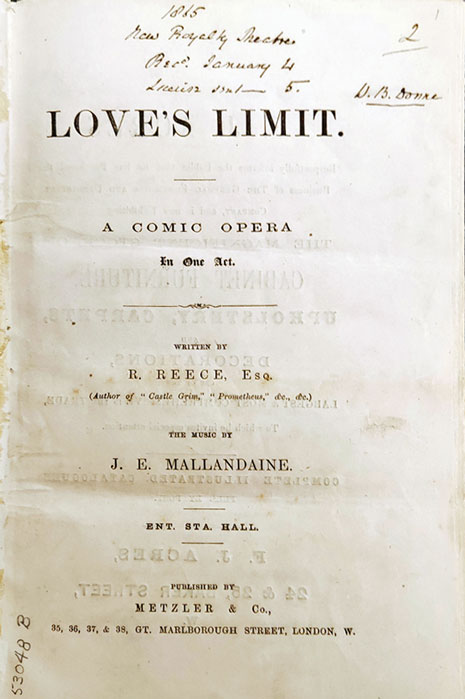
The manuscript submitted to the Examiner was a printed libretto, although not actually the final published libretto as there is a pencilled note on a blank page to say that an advertisement was to be put there. The manuscript is available in the British Library, Add MS 53048 B and a transcript can be found here. The Examiner, Donne, received it on January 4 and sent the licence back on January 5. The year stated is 1865 but this was a slip for 1866. The Lord Chamberlain's Office Day Book 1852-1865 (Add MS 53703) has 1866. It had the title as Love's Limits. Comparison with the vocal numbers listed in The Era review showed that the production stuck to the licenced libretto and did not appear to add or omit any, although one cannot tell about possible dialogue changes.
The vocal score (London: Metzler & Co., 1866) is available at Google books.
Recordings / Streaming
None known
Books, Articles, Online
None known.
 |
 |
 |
  |
|
|