  |
 |

|
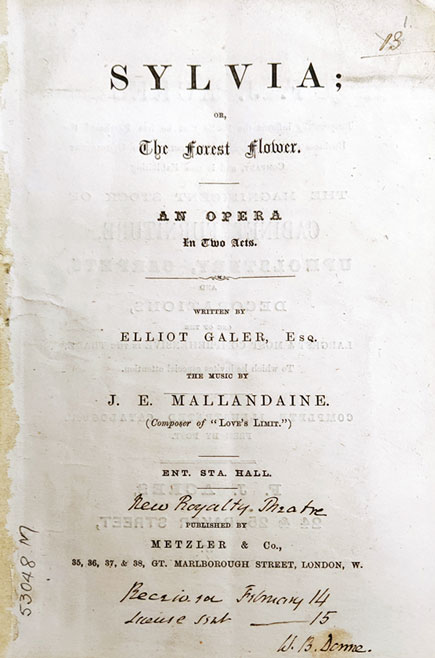
  Sylvia, or, The Forest FlowerMusic by John Elliot MallandaineLibretto by Elliot Galer
New Royalty Theatre
|
|
Lord Belmore Sir Walter Seaton Reuben (A Gipsy Chief) Toby 1st Gipsy
Sylvia Madge Ronald (a Gipsy Boy) |
|
Conductor - John Mallandaine
History
|
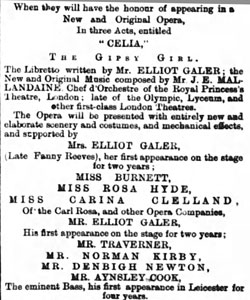
Sylvia was the last of the four works produced by Galer and Reeves at the New Royalty theatre. It ran until March 17 after which Galer and Reeves gave up the theatre and returned to touring. It was revived in a somewhat covert fashion at the Royal Opera House, Leicester, in October 1879, when an act and completely new music were claimed to have been added and the whole publicised as "a new and original romantic opera, in three acts, entitled Celia, the Gipsy Girl". Galer, the theatre's lessee, made this claim and it was was strongly disputed by a local correspondent, Thomas McInliffe. There was an acrimonious exchange of letters in The Era (Feb, 2, 7, 16, 1879). Interestingly, Galer does not seem to have submitted his "new" opera to the Examiner, so clearly was relying on the fact that the earlier version, Sylvia, had been passed even though, at the least, some new material had been added. Leicester Mercury (Oct. 13, 1879) |
 |
Plot
The Standard (Feb 19, 1866) outlined the plot,
The plot of the piece is literally as plain as a pikestaff and as old as the hills. Sylvia, the infant daughter of Lord Belmore, was found by Reuben, a Gipsy King, in the woods (how she got there is not of the slightest consequence) and brought up as his own child. As the foundling grows up every male body belonging to the tribe falls in love with her - even Reuben himself. But Sylvia in heartwhole[1] until one day Sir Walter Seaton crosses her path, and then her fate is sealed. She loves Sir Walter and Sir Walter loves her. Rich, romantic, his own master, and well dressed, what would he do? Why, marry the gipsy girl, of course, and throw to the winds all considerations about equal birth, dowry, rank, and family obligations. He rushes off to declare this gallant determination. On the way, however, he learns that his lowly maiden is high-born, and no gipsy, but the only daughter of Lord Belmore, and heiress to large estates. Whereupon the last finale is sung, and everybody's heart is bounding with rapture and delight. It is indeed a small canvas to paint upon, but, nevertheless, sufficiently large on which to delineate a bright and attractive picture.
[1] unattached
Reception
The Era (Feb. 18, 1866) commented that Galer's experience in the theatre had shown him what was "most desirable in a libretto, and the eagerness with which the audience followed the progress of the story" showed how successful he had been. Mallandaine's music was "by no means remarkable for originality...[though] an improvement upon its predecessor [Love's Limit]". A detailed song by song description followed. The performers were all complimented. "The scenery is very pretty, and the opera mounted with due care. The band is much more efficient than formerly, but might be still more subdued in the accompaniment".
On the other hand Reynolds's Newspaper (Feb. 25, 1866) commented on the "striking resemblance" in many respects to Balfe's The Bohemian Girl and the "superfluity of dialogue", dialogue that was "the most worthless fustian that ever was penned. Indeed, in some of the most serious and pathetic scenes the audience laugh outright at the high flown balderdash spoken by the characters". The Standard was not impressed by the verses and preferred Galer's "singing to his poetry". Some of them were so awkward that it wondered if they might have been taken from Alfred Bunn. Reynolds's Newspaper finished its review, rather grumpily, that the performance "evidently gave great pleasure, and the piece will undoubtedly have a successful run". The Bath Weekly Chronicle (Mar 1, 1866) quoting The Orchestra wrote that "in plot, verse and setting it is very sickly and will scarcely survive infancy".
The Morning Post (Feb. 19, 1866) confined itself mainly to a description of the plot and a rather odd cataloguing of alleged Gypsy wrongdoing in everyday life that had been overlooked in painting them in a
romantic light as "the most noble,
magnanimous people in the world" [1]. It briefly mentioned the performers:
The part of the
heroine, Sylvia, is assigned to Madame d'Este Finlayson, who was
obliged to repeat several of the songs incidental to the character.
...Miss Fanny Reeves, as Ronald, acts pleasantly and sings sweetly.
... Elliot Galer is a spruce and melodious representative of Sir
Walter Seaton...Mr. E. Connell gives formidable expression to the
villany of the irrepressible Reuben. The part of Toby, the "comic"
personage of the story, is allotted to Mr. Bentley, who, ignoring all
the characters upon the stage, and giving the go-by to the occupants
of stalls, boxes, and pit, plays as usual to, and at, the galleries,
where he appears to be highly appreciated.
Lloyd's Weekly Newspaper (Feb 25, 1866) thought that Mallandaine was "far too loyal towards ancient authorities, and not sufficiently confident in himself. We know all about Auber and Offenbach; and perhaps just a little of Mr Mallandaine himself would be pleasant". It praised the "spirited acting and general performance of this graceful trifle".
[1] In Lutz's Felix or the Festival of Roses, which Galer and Reeves had given the previous year, the Bailie does warn about locking barns and stables because the gypsies are around. However, others sing that "Our fête without gypsies were scarce complete".
Scores and librettos
The manuscript submitted to the Examiner was a printed libretto. It is available in the British Library, Add MS 53048 M. The Examiner, Donne, received it on February 14 and sent the licence back on February 15. There is an online published libretto in the Library of Congress. It looks to be identical to that submitted to the Examiner except that at least one typo has been corrected - Sylvia for Sylyia on page 6.
There does not appear to be an extant vocal score and no advertisement of its publication has been found, although Metzler & Co had published the vocal scores of the three other new works given by Galer and Reeves [1]. The letter to The Era (Nov. 16, 1879), which accused Galer of trying to pass off Celia, the Gipsy Girl as a new operetta when it was an expansion of Sylvia, talked of Metzler & Co having published Sylvia's music.
[1] Kurt Gänzl,The British Musical Theatre. Vol. 1 (Basingstoke: Macmillan Press, 1986), p.1116, list Sylvia as having been published
Recordings / Streaming
None known
Books, Articles, Online
None known. .
 |
 |
 |
  |
|
|