  |
 |

|
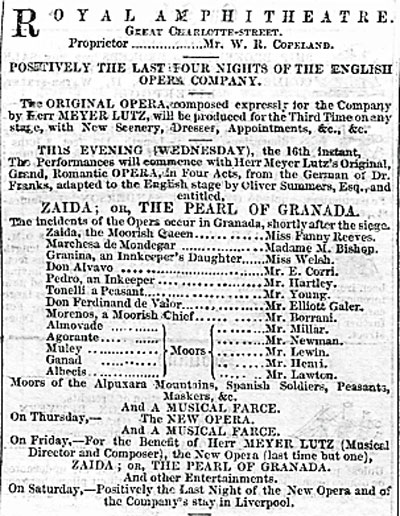
  Zaida, or The Pearl of GranadaMusic by Wilhelm Meyer LutzLibretto by Oliver Summers
Royal Amphitheatre, Liverpool
|
|
Don Alvaro Pedro, an Innkeeper Tonelli, a Peasant Don Ferdinand de Valor Morenos, a Moorish Chief Almovado >
Zaida, the Moorish Queen Marchesa de Mondegar Granina, an Innkeeper's Daughter |
- Mr Young -
Mr Millar
|
Conductor - Meyer Lutz
History
Zaida was one of only four English operas of this era that received its premiere outside of London, but, unlike, for example, Loder's Raymond and Agnes (1855), it never received a London performance. Unusually it claim to use a German play or scenario by Dr Franck (Gustav von Franck) as its starting point [1] rather than a French or English one.
The opera was premiered as part of Galer's Liverpool season but only for the last of its six weeks stay, so 6 performances. They then moved to Sheffield and performed it twice and then twice more in Leicester, giving 10 performances only in total. It was never revived. Quite why Galer bothered is unknown. The opera required them to hire extra orchestra players [2] as well as spending time learning and rehearsing the work for comparatively little return. Perhaps they thought their repertoire was too slight to sustain two weeks, although they offered 10 works in their advance publicity not including Zaida [3]. Perhaps Galer wanted the prestige of a premiere and thought it would be better than it was and lead on to a London booking or perhaps it was part of an agreement with Meyer Lutz.
By the time the production reached Leicester, considerable cuts had been made but newspaper articles gave no clue as to what [4]. No further performances or even instances of individual songs being included in concerts have been found.
[1] Northern Daily Times (February 16, 1859). Unfortunately the particular source work has not been identified.
[2] Sheffield Daily Telegraph (Mar. 2, 1859)
[3] Liverpool Daily Post (Feb. 7, 1859)
[4] Leicestershire Mercury (Mar. 12, 1859).
Plot
Ferdinand wanders into the mountains seeking inspiration and is captured by Moors, and meets Zaida, their Queen. His song reminds her of her infant years. They share a growing romantic connection, while Morenos becomes jealous, as he is also in love with her. Zaida and Ferdinand are on the point of running off but she decides that she must stay. Ferdinand goes but then the Marquis and Marchesa de Mondegar appear and are captured. The Spanish army led by Don Alvaro approaches, leading to conflict. Zaida is wounded but rescued by Ferdinand.
The group seeks refuge in a village inn, with Zaida disguised as the innkeeper's daughter. Don Alvaro and his soldiers turn up at the inn shortly followed by the Marquis and Marchesa of Mondegar. There are then various comic incidents as Zaida and Morenos confuse and trick Don Alvaro.
There is a carnival with many people in disguise leading to further mistakes as Don Alvaro pursues the Marchesa and the Marquis, Zaida. The Marchesa discovers the Marquis’s deceit and swears revenge on Zaida. Morenos plots revenge on Ferdinand, but Zaida warns him. Zaida confronts Don Alvaro but is exposed through the Marchesa’s jealousy and is captured and condemned to death.
Zaida awaits execution but is faithful to her people and ideals. Morenos tries to rescue her but is fatally wounded. Ferdinand, discovering Zaida's true identity (the Countess Emma Cabra, daughter of the King's dead friend), obtains a royal pardon. Zaida is freed, her band pardoned, and the opera ends in reconciliation and celebration. ,
Reception
According to reviews audiences liked the opera but Galer's failure to revive it on one of his subsequent tours must cast some doubt. Liverpool reviews were few and positive but not of any great length or insight. The exception was the Northern Mail (Feb. 18, 1859) which laid out in detail the numbers and outline of the opera.
It
wrote that
The general character of the music is sweetly flowing
melody interspersed with choruses of wild Moorish
character, and, here and there, a sparkling bit of
brilliancy, such as the quartett, "Love in ambush
lying," at the close of the first act. The concerted
pieces are admirably harmonised and the accompaniments
instrumented with the greatest taste. The overture is
dignified, elegant, characteristic, and a most
appropriate introduction to the music which follows.
It concluded with a rather modern sounding sentiment in recommending Lutz's forthcoming benefit as he was a composer who has a proper sense of the meaning of melody, as derived from the Greek word for honey - sweetness, and of "harmony" as concord, instead of discords, as we too frequently have it in the present day
before noting that the opera was
admirably
mounted, and the three tableaux in the last act are really exquisite
pictures doing [stage manager] Mr Villiers the highest credit
The
Liverpool Albion [1] wrote that
The piece abounds with exciting
incidents, and the characters are sufficiently numerous
to include every member of the company. In addition
there is a pleasing ballet, quite in the Moorish style,
the introduction of which was hailed with marked
applause. Of the music, we are enabled to speak in terms
of high commendation, and if we are unable to enter
minutely and professionally into its details, we can at
least record its capability of affording pleasure to all
who have listened to it - a fact as favourable to the
composer, in a general point of view, as the most
elaborate and classical dissection of his work. It is
true, that occasionally we almost detect something
approaching to airs that appeared familiar, but before
we could satisfy our doubts, or detect any decided
plagiarism, the composer judiciously glides into new
melody, and we speedily lose the unpleasant sensation in
the genuine satisfaction afforded by the attractive and
original finale.
It then went on to complement all the singers, Meyer Lutz and the staging of the opera.
The Sheffield Daily Telegraph (Mar 2, 1859) concluded that "Altogether this opera is most effective and cannot fail to give satisfaction to musical connoisseurs, and redounds to Mr. Lutz's fame".
The Leicester Mercury (Mar. 12, 1859),
while endorsing the Liverpool Albion's opinion added that
Some
portions are very effective, especially the concerted finales to the
different acts. The connexion of the incidents in the plot is hardly
clearly enough revealed to be satisfactory; but the interest is well
sustained to the end, and the mode in which the execution of the
heroine is prevented at last, is much more pleasing than a tragic
termination would have been. The dream scene in the last act [2], in which
several incidents in the life of the heroine were pourtrayed, was
very much admired and applauded. We understand that the pruning knife
has been freely used in this opera since its first representation, but
it is still rather too long both for the performers and the audience,
and in places might still be judiciously shortened; as, for
instance, in the masked ball act, where the harlequinades of Mr. Corri,
though very amusing, are perhaps continued rather longer than
necessary.
A week later it wrote that the opera "gave on a second hearing greater satisfaction than at first".
[1] This comes from a reproduction of the article in the Leicester Journal (Mar. 4, 1859). The original article in the Liverpool Albion has not been found although the Liverpool Albion (Feb. 21, 1859) includes some of the points. The article was also reproduced in The Era (Feb. 20, 1859), although without any attribution.
[2] The dream scene is not mentioned in the libretto. Presumably it was a series of tableaux or pictures during Zaida's singing of her opening ballad in the manner of the three tableaux for Ferdinand's dream in Act 4, Scene 2..
Comments
Libretto
English opera librettos usually come in for
harsh criticism but Zaida's must rank as the worst. It
seems to be Summers' first and last effort at writing a
libretto. Parts of it are clearly copies other opera
librettos. However, the main problem is that it
almost seems like two separate works with a typical
musical melodrama of hero rescuing heroine in the face
of various obstacles being mixed up with a verbose,
mainly spoken, farce oftwo silly men and one of their
wives. This is no doubt what was heavily cut before it
reached Leicester. The two do not sit well together, a
point clearly shown in the finale where Zaida's pardon
and elevation is suddenly interrupted by several lines
of dull dialogue continuing the pointless bickering
between the Marquis, Marchesa and Don Alvaro. Finally,
we then get to Zaida's Rondo Finale that rounds the
opera off. Further there are inconsistencies in laying
out the plot with only a vague idea of what Islam was
and its customs and muddling it with Christian ideas at
some points.
Quite whether Gustav von Franck had any hand in any of this is unknown but there are no known possible works that fit. Possibly Meyer Lutz and Summers thought it would look better claiming such an antecedent.
Scores and Librettos
The manuscript libretto is in the British Library, Add MS 52979 Q. It is signed by the copyist J.L. Angel. The Examiner received it on February 10 and the licence was sent on February 12. No printed libretto or music has been found but a transcript can be found here.
Recordings
None are known
Books, Articles, Online
None are known
 |
 |
 |
  |
|
|