  |
 |

|
  Singers (R)
This section also includes people who were primarily actors but fulfilled either non singing roles, which were sometimes included in English opera of this era, or in roles that did not make great demands on vocal ability. A few have been included because they were namesakes or relatives of English opera performers and so, hopefully, help avoid any confusion that might arise. Kurt Gänzl, Victorian Vocalists, (Abingdon, UK: Routledge, 2017) describes the lives and careers of around 100 Victorian singers from different countries and backgrounds but all of whom have some connection through singing Italian or English opera in London. The singers covered are listed here. Please see the section on the main Singers page for provisos about the material included here. Please email englishromanticopera@gmail.com with any comments and suggestions about errors or further material.
Rafter, Mr John (1822-1907)John Rafter and his sister Halkett (1824-1885) were born in Jersey and were said to have begun their singing careers in Manchester [1]. They were announced as "a great accession to the vocal strength of the company" when they joined the Southampton Theatre in September 1843 [2]. They left at the end of the season and a few months later were in Manchester where they stayed for around two years. In March 1846, John Rafter appeared at a Philharmonic Society concert in London, having possibly studied with Domenico Crivelli in the intervening year [3]. He was hired as part of the 1846-1847 Drury Lane company where he sang in the premiere of Balfe's The Bondman. The Morning Post (Oct. 30, 1846) wrote that "he is young and good looking, and, although his voice is neither very powerful nor very extensive...he is unquestionably an acquisition to the establishment". He then followed Bunn to the Surrey for the 1847-1848 season but, by April 1848, he was in a series of operas at the Grecian Saloon before moving on to the Princess's and a year later, the Lyceum. By 1850, he was back at Drury Lane until the end of the 1851 season when he and his sister went to Germany where they sang with various companies. John married and stayed in Germany, where he died, but his sister returned to England at some point. [1] The Guardian (April 30, 1885) Obituary for Halkett Rafter. It is possible that the Guardian took their 1844 appearance in Manchester as their first appearance. [2] Hampshire Chronicle (Sept. 16, 1843) [3] Daily News (March 17, 1846). It wrote that he had never appeared in public, but comments in The Guardian (March 21, 1846) makes it clear that it was the man who had appeared in Manchester.
Rainforth, Miss - Elizabeth Rainforth
Reeves, Fanny (1826 - 1897)According to Jennifer Carnell, Mary Elizabeth Braddon and the Victorian Theatre, (Hastings: The Sensation Press, 2016), p. 153, Fanny Reeves was born Mary Ann Bassett. She married a Mr Hodson and it was as Mary Ann Hodson that she married Elliott Galer in June, 1859. The direct supporting evidence of these links has been lost but it is suggestive that Reeves had started to sing with Galer from, at least, 1851 and featured in all his various touring companies from 1854 onwards. An article in The Era (May 8, 1859), a month before the marriage, referred to them as Mr and Mrs Galer [1]. Certainly their partnership endured throughout the rest of Reeves's life. Reeves first appearances were in 1851 in Dublin; an early role was as one of the witches in Shakespeare's Macbeth. He main career was as a singer, a contralto. In 1853, she moved to London where Lloyd's Weekly Newspaper (Oct 30, 1853) referred to the Grand National Theatre, Shoreditch, "introducing Miss F Reeves in a spectacle called Bluebeard". Her career was very much bound up with Galer's often appearing with him and being a part of his touring companies. She sang a considerable amount of English opera but her only premiere was in Meyer Lutz's Zaida or the Pearl of Granada at the Royal Amphitheatre, Liverpool on February 14, 1859. She and Galer took over New Royalty Theatre in 1865 concentrating on operetta; she was named Directress. She appeared at their opening night in the first properly staged performances of Allen's Castle Grim in September 1865 and in the premieres of Meyer Lutz's Felix or the Festival of Roses in October 1865 and John Mallandaine's Love's Limits and Sylvia, the Forest Flower in early 1866. She continued to sing for a few years more although Galer was winding down his career and she occasionally appeared at his Leicester theatre in a variety of roles well into the 1870s. There was also a Fanny Reeves who had a career as an actress and singer in the United States a little later in the century [1] Mary Ann Hodson had declared herself a widow when she married Galer, which would fit with Carnell's supposition.
Reeves, John Sims
Richards, Mr.No information has been found about Richards, who had a small part in Alexander Mitchell's short lived opera, The Last Crusade (1850).
Ridgway, Thomas Frederick (1807-1879) and Ridgway, John Henry (1811-1878)The Ridgways came from a musical and theatrical family. Their mother was Ann Loder, one of the Loder family from Bath, and aunt to the composer Edward Loder[1]. She was a dancer and pianist and married Thomas Edmund Ridgway but left him in 1815 to live with John Distin. Ridgway was a well known Harlequin. On his death in 1829, she married John Distin, a trumpeter, who formed a famous brass quintet with his sons. Thomas appeared with his father at the Royal Olympic Theatre, Newcastle in 1828. After his father's death in 1829, Thomas continued to perform in provincial theatres, often as Harlequin, and was joined by his brother George, but he died in 1832. The following year Thomas was joined by his brother, John, and they continued to perform in the North of England for several years with a base at the Theatre Royal, Liverpool. In 1839, Thomas appeared in the pantomime at Covent Garden being advertised as having spent five years as a clown and mime at the Theatre Royal, Liverpool (Manchester Courier, Dec. 28, 1839). He stayed with Vestris's company at Covent Garden during her management stint, 1839-1842, appearing in the pantomime and playing minor parts in other productions, including the only performance of Jolly's Mabel (1840). In the 1841-1842 company, he was joined by John and John's wife, Mary, who came down from Liverpool. The three stayed at Covent Garden after Vestris's departure. Thomas then went to Drury Lane, where he appeared in Benedict's The Brides of Venice (1844) and then to the Surrey for the 1844-1845 season followed by a stay in Liverpool, three years in Dublin and a return to London at the Grecian in late 1851, where he stayed for three years. There is then little sign of him afterwards but a Mr T Ridgway appeared in Australia and New Zealand from 1864-1866 in burlesque and clown roles, so may well have been him. The Times of India (Nov 13, 1868) reported on "acrobatic and miscellaneous drawing room scenes" of the "the inimitable brothers Ridgway" as part of a variety troupe at the Grange Road Theatre in Mumbai (Bombay). According to the 1871 census, Thomas was living in Southampton and described himself as a dancing master and could well have helped in his brother's Southampton classes. In the meantime, John and Mary went to Birmingham after Covent Garden and appeared as dancers at theatres there for a couple of years before settling there and starting to teach in 1844, extending this later to Southampton. Mary died in Birmingham in 1875 and John in 1878. [1] Nicholas Temperley, (ed.), Musicians of Bath and Beyond: Edward Loder (1809-1865) and his Family, (Woodbridge:The Boydell Press, 2016), pp.94-95
Roberts, Mr. Henry BallA Mr Roberts appeared at the New Strand Theatre and the English Opera House in 1836 but then joined the Covent Garden company for the 1836-1837 season where he played a number of subsidiary roles such as Guildenstern in Hamlet and Malcolm in Macbeth. The Theatrical Observer (Oct. 26, 1837) wrote that "one of the ablest and most experienced critics of the day, who expressed himself highly delighted with Mr R's performance in that part (Lord Allcash in Auber's Fra Diavolo), and prophesied that he would attain a high rank in his profession". Although he sang in that part, his appearance at Covent Garden in Rooke's Amilie in December 1837 was in a non singing role. He was retained for the 1838-1839 season and featured in the premiere of Rooke's Henrique (1839). The Odd Fellow (Feb. 2, 1838) in its assessment of the 1838-1839 Covent Garden company wrote that he "dresses well, and sings pleasingly". The next season he switched to Drury Lane. He never seemed to progress beyond supporting roles and the Theatrical Observer (Feb 5, 1840) now deemed his Lord Allcash "a shocking affair". After Drury Lane's closure in March 1840, he moved between several London theatres. Lloyd's Weekly Newspaper (Jan. 21, 1844) reported a rumour that "the Keeleys, in conjunction with a Mr Roberts, intend to venture upon the English Opera House", but nothing came of it. However, by August 1844, Lloyds Weekly Newspaper (Aug. 11, 1844) named Mr H. B. Roberts as lessee of the Strand theatre where he stayed until the end of the 1844-1845 season. The Era (Sep. 15, 1844) reported a presentation by a grateful company for his efforts but the relationship soon soured and Coplestone Hodges took over in May 1845 "after a season of disagreement with the staff and unpaid salaries" [1]. He returned to acting moving to different theatres seemingly in smaller roles as he was not listed in the press advertisements for his roles in either Balfe's The Sicilian Bride at Drury Lane in March 1852 or Balfe's The Devil's in it at the Surrey in July 1852. [1] Laura Monrós-Gaspar, Victorian Classical Burlesques (London: Bloomsbury Academic, 2015), p.19. The Morning Chronicle (Jun. 6, 1845) reported the Douglas Jerrold had brought an action against Roberts but that proceedings were abandoned because of the discovery that Roberts "was insolvent, having lost all his property by the Strand Theatre speculation".
The RomersThe Romers were a well recognised name in the theatrical world of the 1830 to the early 1850s and beyond through their various offspring. A Stephen Romer was listed as a bankrupt jeweller in June 1788. Given the occupations of John and Thomas Romer, it seems very plausible that they were his sons. John remained a jeweller in London but his brother, Thomas, went to Liverpool where he set up as a watchmaker [1]. [1]There was a Mr Romer who was an actor in the first two decades of the 19th century and was said to be from the Liverpool Theatre. He went to the US where he committed suicide shortly after his arrival in 1819. It is not known if he was related to this branch of Romers. The Liverpool RomersThomas Romer and his wife, Ann, had 9 children of which, at least, four had significant stage careers, three as singers and one as an actress. The singers all sang with the best known Romer, their cousin, Emma, on the London stage at various times.
The London RomersAt least three of John's children were involved in the theatre. Some general information about the family can be found at https://caliendi.com/Beal/indiI1689.html
Rowland, George Charles (1839-1913) [1]On his marriage certificate in 1860 he listed his profession as vocalist, although no mention has been found of him before 1859 and his appearance in the London premiere of Loder's Raymond and Agnes at the St James's Theatre [2]. There is then no sign of him in the theatre world and his professional singing career must have been fairly short as in the 1871 census he was listed as Compiler of Indices for the London Gazette, in 1891 as Secretary to Richmond Hospital and in 1901 as Pensioner Army, so perhaps he was in the Army in the 1860s. In the 1870s he appeared in a few London suburban concerts. [1] The Era (Jun. 12, 1859) gave his full names [2] This was according to the libretto. The cast list in The Era (Jun. 12, 1859) does not mention him
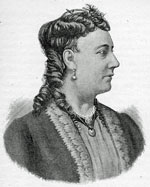
Rudersdorff, Erminia (Hermine) (1822 - 1882)
Kurt Ganzl, Victorian Vocalists (London: Routledge, 2018), pp.590 - 609, has a detailed chapter on her. |
 |
 |
 |
  |
|
|