  |
 |

|
  Singers (N)
This section also includes people who were primarily actors but fulfilled either non singing roles, which were sometimes included in English opera of this era, or in roles that did not make great demands on vocal ability. A few have been included because they were namesakes or relatives of English opera performers and so, hopefully, help avoid any confusion that might arise. Kurt Gänzl, Victorian Vocalists, (Abingdon, UK: Routledge, 2017) describes the lives and careers of around 100 Victorian singers from different countries and backgrounds but all of whom have some connection through singing Italian or English opera in London. The singers covered are listed here. Please see the section on the main Singers page for provisos about the material included here. Please email englishromanticopera@gmail.com with any comments and suggestions about errors or further material.
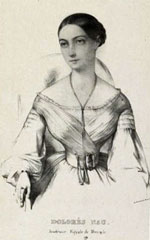
Nau, Dolores - Mademoiselle Nau (1818-1891)
She returned to Paris for some years before being re engaged at the Princess's in Spring 1849, singing continental operas in English. Further London and provincial roles followed before she again returned to Paris. In 1854, she was hired by William Niblo for his opera company in New York but he was forced to close at the start of 1855. After a tour of a few US cities and a short spell at the Surrey, in September 1855 she formed a company with Alfred St Albyn to tour the English provinces and London. Vocal problems caused her to end her career around the middle of 1856 and she retired to Paris. Kurt Gänzl, Victorian Vocalists (London: Routledge, 2018), pp. 408-418, has a chapter on her.
Nelson, Miss - Ann (Annette) Hawley
Nelson
|
|
According to Col. Tom Picton, "Miss Nelson, originally of an excellent family in Devonshire, England, had gone upon the stage in consequence of some youthful indiscretion for which she had incurred the displeasure of her family, who thereupon discarded her" [1]. She made her London debut at Covent Garden in 1828 in an adaptation of Wycherley's The Country Wife. She made quite an impression, although more by her looks than her acting ability. On June 25, 1831, she married Coplestone Coward Hodge [2], whose stage name was Hodges. Around the same time was said to be taking on the management of the Hastings theatre [3]. Two years later she took on that of the Chichester Theatre [4] but by the end of 1833, she and her husband were said to have been hired by the Park Theatre in New York for a year. In fact they seemed to have ended up in New Orleans [5] and she did not make her debut in New York until August 14, 1836 , where she starred in Barnett's The Mountain Sylph [6]. Shortly afterwards, she took over management of the Richmond Hill Theatre in New York for a short time [7]. She enjoyed considerable success in New York but by 1838 she was off touring. |
|
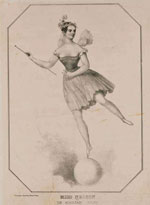
The marriage broke down at some point but Nelson never seems to have returned to Britain [8]. Around 1844 she struck up a relationship with John Brougham that led to the breakup of his marriage with Emma Williams [9]. By 1847, Nelson was being referred to as Mrs Brougham but he did not obtain a divorce until 1852 so this was a nicety to smooth over any moral concerns. She was referred to as a widow [10], which was not true either as her husband did not die until 1855. She retired through ill health and died in 1870.
[1] Tom Picton, Old Gotham Theatricals, (San Bernadino: The Borgo Press, 1995), p.18. Perhaps a child, Georgiana, born out of wedlock (March 27, 1827) might have been the indiscretion (baptism record for February 18, 1831).
[2] Marriage record shows at the Old Church, St Pancras, in London
[3] Sunday Times (June 26, 1831)
[4] Theatrical Observer (Jan. 8, 1833)
[5] The National Banner (June 17, 1835) named them as part of the visiting New Orleans company to Nashville.
[6] Morning Herald (Aug. 11, 1836). Debut at the Bowery Theatre
[7] Jane Kathleen Curry, Nineteenth-century American Women Theatre Managers. (Westport: Greenwood Press, 1994), p.95.
[8] The Morning Herald (June 6, 1837) referred to "Miss Nelson, whom some ill natured persist in calling Mrs Hodge". However, The Tennessean (Aug. 13, 1839) referred to Hodges managing the Nashville Theatre and Nelson appearing there. The Courier-Journal (May 17, 1844) showed Nelson, Brougham and Hodges on the same bill in Louisville. Some sources claim, incorrectly, that Nelson met Hodge in the US and married there. Some sources claim that she was Brougham's first wife but that was Emma Williams.
[9] Pat M. Ryan, "The Hibernian Experience: John Brougham's Irish-American Plays", MELUS, Vol. 10, No. 2 (Summer, 1983) p. 35. The New York Herald (Apr. 16, 1844) noted that "Brougham and Miss Nelson are performing, with much success, as we hear, at Natchez.". By the June, they were in New York.
[10] William Winter, Other Days being Chronicles and Memories of the Stage. (New York: Moffat, Yard and Company, 1908), p.121.
New, Mr
Very little has been found about Mr New. He had a small part in the revival of Mary à Beckett's Little Red Riding Hood at the Princess's in February 1843. He was in the Drury Lane chorus for Forbes The Fairy Oak (1845) and took a minor part in Wallace's Maritana (1845), so presumably had been hired for the 1845-46 season at Drury Lane.
Newcombe, Mrs
Listed at Covent Garden early in 1829, she then appeared there, Drury Lane and the Haymarket over the next few years. In 1835, she was at Drury Lane for the premiere of Balfe's The Siege of Rochelle and stayed for the first half of 1836. Towards the end of the year she went on tour to Scotland and was at the Adelphi Theatre in Edinburgh in the October, in Perth in the November and December and then probably to Aberdeen. There seem to be no later mentions of her.
Newman, Mr
Newman appeared in the premiere of Meyer Lutz's Zaida or the Pearl of Granada at the Royal Amphitheatre, Liverpool, in February, 1859. Hartley appeared in other operas in Galer's Liverpool visit but was not mentioned after that. He was possibly a member of Galer's chorus, whose names would not ordinarily be included.
Newton, Mrs Alexander - Emily Clementina Ward (1819-1881)
Ward was born in London. Her father was listed as a professor of music on her marriage records. In 1843, she married Alexander Newton and then in 1853, now widowed, she married Bridge Frodsham Cooper, whom she sang with over several years. The latter marriage did not go well and he deserted her causing her to apply to the Courts for a protection of her assets against any claims by him.[1] In the 1871 census she listed herself as a teacher of singing.
Newton started her career in the early 1840s singing in concerts in London and the East of England, which she continued much the same after her marriage to Alexander Newton, although ranging further afield. The Morning Post (Mar.19, 1846) commented on her performance at a Hanover Square concert:
Mrs. Alexander Newton sang "With Verdure Clad," and "Lo, hear the Gentle Lark" (her performance of which elicited a rapturous encore) most exquisitely. This lady's voice embraces a compass of two octaves and a half, and is of equal excellence in all its registers. Its tone is beautifully fresh and clear, and her execution is faultless. She has much improved since we last heard her, and may now fearlessly take her stand among our leading vocalists, whether in the concert-room or the theatre.
She maintained a steady reputation, even if not achieving the first rank, appearing with many of the leading singers including Mrs Alfred Shaw, Jenny Lind, Sims Reeves and Louisa Pyne (Mrs Bodda).[2] Her appearances became much fewer by the 1860s but she appeared as late as 1879 at a birthday for Lord Milton at Wentworth House.[3] Her one known attempt at opera was in the premiere of Mitchell's The Last Crusade (1850), a very short lived failure, although numbers from operas featured in her concerts. She had also sung in the two earlier private performances of the opera.
[1] Ancestry.com
[2] The Examiner (May 29, 1869)
[3] Barnsley Chronicle (May 3, 1879)
Norman, Miss Ellen
There are several Miss Norman in 19th century theatre but the one who appeared in the premiere of Balfe's The Enchantress in May 1845 was very probably Miss Ellen Norman. In September 1840, a Miss Norman was listed as Desdemona in Shakespeare's Othello at the New Strand, her first appearance there [1]. She first appeared at Drury Lane was as the Fairy Queen in Cinderella on October 1, 1844 [2]. The Standard (Oct 2, 1844) rather cruelly wrote "A Miss Norman ... soared occasionally within reach of mediocrity, but she did not pass it". While at Drury Lane she sang in various operas, including Barnett's The Mountain Sylph in May 1845.
She was not retained for the 1846-1847 season and in October 1845 was in Manchester [3], in early January in Plymouth [4] and in March, The Era (Mar. 29, 1846), recorded that a "Miss E. Norman, late of Drury Lane, has been added to the [Bath and Bristol] company, and already established herself as a favorite". By January 1848, she was back in Drury Lane in an English version of Donizetti's Linda di Chamounix and later that year went to the Princess's singing Clotilda in Bellini's Norma. She then seemed to pop up in various London and provincial theatres until 1856, although there is the possibility of confusion with other Miss Normans.
[1] New Court Gazette (Sep. 12, 1840)
[2] Morning Post (Oct 1, 1844)
[3] Manchester Courier (Oct 25, 1845)
[4]The Era (Jan.4, 1846)
Novello, Miss - Cecilia Novello - Mrs Serle (1812-1890)
She was an older sister of the better known Clara Novello and second daughter of the publisher, Vincent Novello. She had drama and elocution lessons with Mrs Blaine Hunt and then attended the Royal Academy, as a pupil or ex-pupil of which she sang in one of the operas they mounted in Brighton in autumn 1829 [1]. Her voice was considered "hardly powerful enough even for our small theatre"[2] . Even so the next year she got engagement with the Olympic and the English Opera House during its time at the Adelphi and moved with them to the Lyceum in 1834, where she appeared in the premieres of Loder's Nourjahad (1834), Barnett's The Mountain Sylph (1834) and Rodwell's The Spirit of the Bell (1835) as well as the revival of de Pinna's The Rose of the Alhambra (1836). In 1836, she married Thomas James Serle, actor, playwright, editor and stage manager but continued to perform for several years. She spent 1841 and 1842 at the Surrey, where she appeared in the premiere of Mary Ann à Beckett's Little Red Riding Hood (1842). She had also taken up teaching describing herself as a Professor of Singing in the 1841 census. She joined Macready's company at Drury Lane for the 1842-43 season but that seemed to mark the end of her stage career. She was with Macready's tour of Paris in late 1844/early 1845 and, although not a part of the company, on December 30, 1844, she stood in at the last moment as Ophelia when Helen Faucit was ill [3].
Things can get confused because Serle was sometimes spelled Searle and there was a Mrs Searle. However, the two Searles' careers barely overlapped and their disciplines were quite different, so differentiation is fairly straightforward.
[1] Morning Chronicle (Nov.9, 1829)
[2] Morning Advertiser (Nov 25, 1829)
[3] J.C. Trewin (ed.), The Journals of William Charles Macready. (London: Longmans, Green and Co. Ltd., 1967), p.220.
Novello, Clara
 |
 |
 |
  |
|
|