  |
 |

|
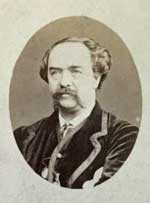
  Elliot John Norman Galer (1823 - 1901)[1]
at the Haymarket, the same paper (Feb. 12, 1854) thought that "he sang prettily,but was much too stiff, formal, and statue-like, to create a very favourable impression". A month later he had moved on to Drury Lane, where he sang in the premiere of Duggan's Léonie and by June was at the Surrey only to return for a short engagement at Drury Lane in the September. This does not seem to have gone well [4] and perhaps the uncertainty of permanent London employment or the ambition to be the leading tenor encouraged Galer to form the London Grand Opera Company to tour the provinces. He continued to organise touring companies under different names until 1864. Their history can be found here. He staged and sang in the premiere of Meyer Lutz's Zaida or the Pearl of Granada at the Royal Amphitheatre, Liverpool on February 14, 1859. During this period there were concert bookings and some appearances in London theatres, but usually at lesser known venues as time went on. In late 1861 he was with the Milner and Cooper company, and comments by the Hull Packet (Oct. 26, 1861) give a clue to his apparent failing London career: "His voice is one of great sweetness, and this, combined with the uniform taste that he displays, almost compensates for its lack of power". It was also noticeable that he moved increasingly towards operetta. Galer married Fanny
Reeves by licence
on June 18, 1859 [5]. Perhaps feeling his
singing career was not
achieving what he had hoped
and drawing on his
touring experience, in
May 1862 he took over
management of the
New Royalty Theatre in
London with the
intention of
making it an operetta house. He
also started to write plays
and books for operettas. However,
by the November the theatre was being
advertised as under new
management [6] and the Galers
were appearing at the Pavilion Theatre and
at the Great National Standard
Theatre in London. In March
1863, the Galers organised an operetta
company which had a
successful engagement at the
Crystal Palace and then went
on the road. However,
this was brought to an
abrupt end in May when he
was thrown from a carriage
and suffered a compound
fracture to his leg. He did
not reemerge onto the stage
until the December. The next
year the Galers again took
an operetta company on tour,
what they termed their Opera
Comique or Opera Lyrique, as well as appearing
in concerts. Even such
a pared down performance
managed to fall foul of
Leicester magistrates in
1864, who fined him for
contravening the theatre licencing
laws. However, these
entertainments proved
popular and were hired for
private parties as well as
public halls. With his performing career tailing off, it is no surprise that Galer once again turned to theatre management by leasing the Assembly Rooms in Reading in September 1869, where he directed Loveday's English Opera Company in April 1870 in a series of English Operas [8]. A few months later the Rooms burnt down and the next year Galer built another theatre, known as the Albert Hall or Theatre Royal, on the site. He continued to keep that theatre, although usually leasing it out, but went, in early 1873, to Leicester where he set about demolishing and rebuilding the Theatre Royal, which reopened in the October with Galer as lessee and manager. The Galers still found time to act in Rob Roy up in Glasgow in June 1872 but other than a few scattered appearances in the pantomime and the like, Galer concentrated on management from then on. However, he did not neglect English opera: "The Lessee has done all he can to cultivate a taste for English opera in its best form"[9]. In 1877, Galer moved from the Theatre Royal and leased the newly built Leicester Royal Opera House where, on October 20, 1879, the premiere was given of Celia, the Gypsy Girl with text by Elliot Galer and music by his nephew, John Elliot Mallandaine [10]. Further, Galer made what was by that time a rare appearance on the stage as Captain Seaton, which he carried out "with all his old histrionic ability, and most of those remarkable vocal powers by which he won his greatest triumphs in the concert room" [11]. A rather testy correspondence followed as to what degree the opera was a based on an operetta, Sylvia, that Galer had put on at the Royalty Theatre back in 1866 [12]. Celia was revived the following year but this time without Galer. In a sign of the way the theatre was evolving, Galer hired a London company touring a play The Old Love and the New to mark the reopening of his refurbished Royal Opera House in September, 1880, rather than assembling his own. In 1882, he again took to organising, but not performing in, tours with a drama company staging his play For Gold and continued with annual tours until his retirement from leasing the Leicester Royal Opera House in September 1888. He donated his collection of theatrical drawings and paintings that had hung in the theatre to the Shakespeare Memorial Art Gallery at Stratford-upon-Avon. In
1892, the owner of the
Leicester Royal
Opera House, Thomas T.
Paget, died and bequeathed
it to the Galers along with
his
house and £6000 each [13].
In August 1894, Galer's theatre
in Reading was destroyed by
fire ending his theatrical
interest there and in
October 1896, he put the
Leicester Royal Opera House
up for sale. Galer's wife,
Fanny Reeves, died on
October 5, 1897 and Galer on
June 11, 1901. He left a
considerable fortune, over £40000,
and
this despite owning several
racehorses. Part of his
fortune was donated
for a scholarship at the
Royal Academy and part for
the construction of a
lifeboat, both to be named after
him. [1] His death certificate claimed that he was 73, i.e. born in 1828. The 1871 and 1881 censuses implied a birth date of 1831, and the 1901 census one of 1836. However, Ancestry.com shows an Elliot John Norman Galer christened on August 24, 1823. Given his census disparities, the unusual combination of names and that he appeared at Sadler's Wells in 1852 apparently after training as an architect and time at the Royal Academy, the 1823 birthdate looks the most likely. [2] The Stage (Apr. 8, 1881) made him the subject of one of its brief sketches of theatrical people and these details come from that. However, some points in the article appear to be incorrect. For example, he was at the St James's before 1855. His early career is corroborated by the statement in one of his many court cases, that he had been brought up as an architect and surveyor, The Era (May 12, 1878). The Lamperti is presumably Francesco Lamperti. The Soho Theatre had been known as Miss Kelly's and later was known as the Royalty Theatre and the New Royalty Theatre, which the Galers managed for a time. It had a brief renaming as "The New English Opera House" in November 1850, when Alexander Mitchell's The Last Crusade was given. Galer may have been part of that, although he was not named in the press or in the cast as set out in the libretto. [3] The Sunday Times (Feb. 15, 1852) [4] The Era (Sep. 17, 1854) referred to Galer along with others as "feeble pillars whereon to support an operatic edifice" as well as thinking that the opening should have been deferred because London was comparatively empty. [5] The entry for Galer's marriage in 1859 gave his bride as Mary Ann Hodson, widow, with father John Bassett. According to Jennifer Carnell, Mary Elizabeth Braddon and the Victorian Theatre, (Hastings: The Sensation Press, 2016), p. 153, this was Fanny Reeves, born Mary Ann Bassett and who had married a Mr Hodson. It was not until 1861 that the press began to refer to her as Mrs Galer. [6] The Era (Nov. 9, 1862) [7] Birmingham Daily Post (Apr. 19, 1866) [8] Leicester Chronicle (Apr.16, 1870) [9] The Era (Oct. 15, 1876) [10] Mallandain family history web site, available at http://www.mallandain.com/rf.galer.htm [11] Leicester Chronicle (Oct. 25, 1879) [12] To judge from the plot as described in The Standard (Feb. 19, 1866) there was considerable truth in the accusation. Mallandaine had also written the music for Sylvia. In fact Sylvia had been given earlier in Bath in October 1864. [13] Leicester Chronicle (Nov. 5, 1892) [14] The licencing rules were rather confusing. For example, Galer's company were scheduled to appear at the Music Hall in Sheffield but a licence was refused. However, by omitting dialogue and dispensing with scenery, they were able to sing and play all the music of the opera, The Era (Feb. 16, 1862). In Leicester, in March 1864, Galer was fined for performing a play in unlicenced premises (Derby Mercury, Mar. 23, 1864) but when the same charge was brought at Shrewsbury two years later, it was thrown out (The Era, Nov. 18, 1866) . |
 |
 |
 |
  |
|
|