  |
 |

|
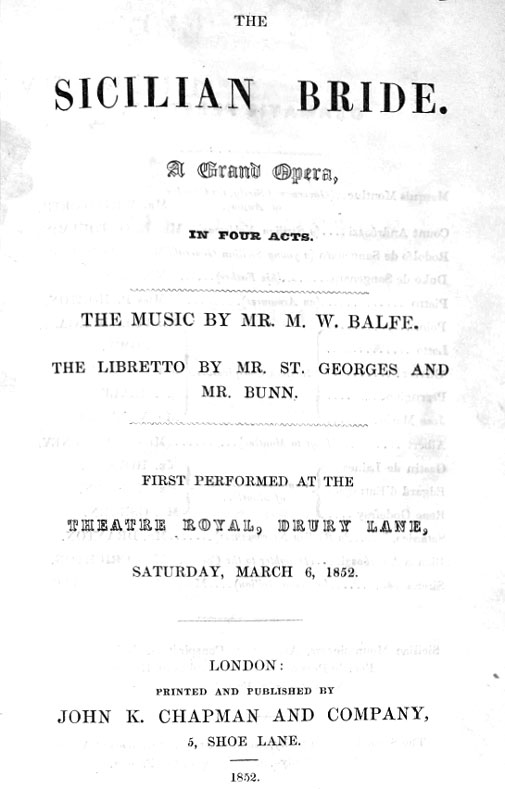
  The Sicilian BrideMusic by Michael William Balfe
Libretto by
Alfred Bunn
/
|
|
Marquis Montluc (Governor of Sicily for Charles of Anjou) Count Andréozzi (A Sicilian Nobleman) Rodolfo de Sangenaro (a young Sicilian General) Duke de Sangenaro (his Father) Pietro (an Armourer) Polo Albert (Page to Montluc) Gastin de Laines Satanico (a Sicilian Necromancer) Bianco Andréozzi (Daughter to the Count) Sirena (a young Sicilian) |
-
Mr Prendergast |
Conductor - Michael William Balfe [1]
[1] Balfe certainly conducted the first and possibly other performances before handing over to Francesco Schira, the Drury Lane Musical Director. Reynolds's Newspaper (Mar. 7, 1852) wrote that "Mr Balfe made his exit from the orchestra to bow his acknowledgements on the stage".
History
With his assumption of the position of musical director at Her Majesty's Theatre in 1847, the next few years saw no new Balfe operas. However, in early 1852, he again joined forces with Bunn to produce The Sicilian Bride. Bunn translated and adapted it from an unperformed work by Jules-Henri Vernoy de St. Georges, which does not seem to have been identified. The Times (Mar. 8, 1852), presumably James Davison, thought the libretto was not very good and wondered whether St. Georges "not finding a purchaser for [it] at home, condescended to intrust [it] to the most popular and prolific of our English composers". The Examiner (William Bodham Donne) received the manuscript on February 28, 1852 and returned it on March 1.
The Morning Chronicle (Mar. 1, 1852) announced that the first performance would be on March 4 but it was postponed until March 6. The production did include one innovation. The Morning Chronicle (Mar. 6, 1852) carried an advertisement that
the magnitude of Mr. Balfe's new work (being an opera in four acts), it has been deemed advisable to carry out, for the first time in this country, the principle adopted in all continental theatres - that of the opera constituting the entire evening's entertainments.
Other Balfe operas had been described as grand opera but this was his most obvious attempt to emulate the French grand opéra of Meyerbeer and Halévy. However, while it did occupy the whole evening on the first night, subsequently the opera was curtailed and an extra item was included, probably because the full work was unable to sustain satisfactorily its four hours rather than that the audience demanded a return to the multi work evening format.[1]
The opera had very modest success achieving only 11 performances running until March 30 when Sims Reeves's left Drury Lane. It then came back for a further three performances in late April/early May with a Mr Fédor as Rudolfo. Fédor was probably a continental singer brought over by Bunn for the season, as there seems little other information about him.
In January 1853 and again in June 1859, the National Theatre in New York advertised a drama entitled The Sicilian Bride with the two main characters having the same names as in Balfe's opera.[2] It is not mentioned in Vera Brodsky Lawrence's, Strong on Music, Volume 2, which covers music in this period in New York, so it was probably a reworking of the plot in some form rather than a version of the opera.
[1] The Star of Freedom (Mar. 13, 1852). The Daily News (Mar. 15, 1852) in its follow up review of the work noted the many cuts in the first act finale, cuts in the second act finale and of a long trio in the third act, all of which helped relieve "the heaviness of the first night's performance". For example, the second and third performance evenings included the "ballet fantastique", The Star of the Rhine (Morning Chronicle, Mar. 8, 1852).
[2] New York Times (June 30, 1859)
Plot
The plot was based on events leading up to the rebellion that broke out against French rule in Sicily in 1282. This event had been the source of several works, notably Eugene Scribe and Charles Duveyrier's libretto of 1838 for Donizetti's unfinished opera Le Duc d'Albe, which was later revised for Verdi in Les vêpres siciliennes (1855). The St Georges-Bunn libretto was a rather complicated farrago loosely using some of these elements and steered, unconvincingly, in a happy ending.
The story was set in Sicily during the French occupation in late 13th century. At a village festival, growing unrest among the locals is voiced by Pietro, a patriotic armourer who urges resistance against the French under the command of the Governor, Marquis de Montluc. Montluc is enamoured of Bianca Andreozzi, daughter of Duke Andreozzi, and forbids any marriages without his consent to give himself time to win her over. Bianca is in love with Rodolfo, the son of Duke di Sangenaro, Andreozzi's bitter rival. The two families meet and prepare to fight but Andreozzi calls for them to put aside their differences and unite against the French. Bianca and Rodolfo are secretly married to seal the reconciliation. Andreozzi asks his daughter to write down the names of all the conspirators. They are then summoned by the Governor's page to a celebration at the palace.
|
During the celebration, Montluc schemes to possess Bianca by drugging her. While asleep in this state she rewrites the conspiracy agreement, revealing the names of the rebel leaders. Montluc lets her go but then visits her in her chamber where Rodolfo interrupts and Montluc hears of their marriage. The conspirators meet at Pietro's armoury where they are surprised by Montluc and his men. Reading aloud the conspiracy document, he accuses them of treason and claims that Rodolfo gave it him. Rodolfo's denial is cut short when he recognises that it is Bianca's writing and he takes the blame. His compatriots turn on him and he flees. The rebels are supposedly led off to execution. |
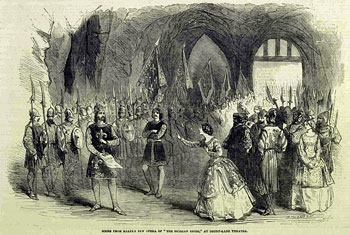 Illustrated London News (Mar. 20, 1852) |
In the final act, the conspirators are inexplicably still alive. Rodolfo returns to face judgment by his fellow conspirators but is defended by Bianca, who is given time to prove Rodolfo's innocence. When they confront each other, Bianca denies the betrayal causing Rodolfo to get angry, but the couple eventually reconcile. Unwilling to name Bianca, Rodolfo is about to be executed when Montluc appears, now repentant. He confesses to his misdeeds and reveals the truth about Bianca's unintentional involvement. Meanwhile, the Sicilians have defeated the French forces. In a final act of forgiveness, Montluc and the remaining French troops are allowed to leave peacefully.
Reception
Balfe's choice of an unfamiliar four act grand opéra format for his return to the stage was questioned. The Morning Chronicle (Mar. 8, 1852) wrote that "We could have wished Mr Balfe to have continued his devotion to the lighter and more graceful opera comique".[1] The Era (Mar. 14, 1852) voiced similar sentiments and feared that the opera would "not take a long run, nor become very popular with the public"..
However, in some quarters there was considerable enthusiasm particularly about the plot even though remarks about the resulting text were largely absent, the Morning Chronicle offering a laconic "suffice to say that it is Mr Bunn's". The Illustrated London News (Mar.13, 1852) wrote that the story:
is full of interest, especially after the first act: the scene of somnambulism is one of the most exciting ever witnessed; the accusation and self-condemnation of Rodolpho, and his subsequent reproaches of his innocent bride, fulfill all the conditions of profound operatic emotion. The subject is altogether excellently adapted for musical purposes, and affords scope for brilliant spectacle and picturesque groupings.
Musically, it was more ambivalent criticising the "unfortunate predominance of the ballads", many of which were "complete impediments to the development of the plot". The opening night apparently had problems but the second night with its "judicious cuts" was much better and the singers, chorus and orchestra altogether more effective. "The mise en scène, [was], in most respects, striking, gorgeous, and effective, and quite worthy of Mr. Bunn's well-known tact and judgment in mounting great lyric works".
The Morning Post (Mar. 8, 1852) was also very positive about the "most exciting dramatic situations". It thought that Balfe had been "even more than ordinarily successful in his ballads" and overall that the performance was excellent with compliments to all of the singers with a warning to Miss Crichton to guard against unnecessary exaggeration.
As was seen above, The Times was not impressed by the libretto elaborating that "The characters... are uninteresting, the incidents improbable, and the situations neither very striking nor very new". As for the music, it considered "That Mr Balfe has struggled successfully with the difficulties that beset him and composed an opera, which may possibly live in spite of the book, is greatly to his credit" but noting the drawback of a "certain heaviness". It was not prepared after one hearing, to rank the opera amongst his best works even though "it contains some of his best writing". Apart from the mistake in assigning the main female part to such an inexperienced singer as Miss Crichton, it thought the performances good. Davison's other outlet, the Musical World (Mar. 13, 1852), p. 167, had a paragraph repeating that the opera included some of Balfe's most ambitious and best music and was "received with great favour by a crowded house".[1] A much more detailed review was said to be being held over to the following week but never materialised. Perhaps by that time it had become clear that the opera was only destined for a short run.[2]
The Spectator (Mar. 13, 1852) p.9, was more balanced. "His subject, though turning on a new and striking incident, was overloaded with irrelevant and superfluous matter". It felt his adoption of "the ponderous form of French grand opera" and exchanging "his agreeable Italian style for the more ... imposing but much less popular manner of the modern German school" meant that "the audience became fatigued before his four long acts came to a close". It praised the concerted pieces but thought the solo pieces "less remarkable", having "a sort of trivial prettiness" and being "not only undramatic but anti-dramatic". The opera suffered from the hurried and haphazard rehearsal practices of the day:
The performance on the first night was very imperfect. In the choral and concerted music, both the voices and instruments were often in confusion, and endeavoured by loudness to make up for want of clearness. The haste to bring out the piece[3] had occasioned unremitting and laborious rehearsals, which fatigued the principal singers. At the second performance, on Tuesday, things went much better: the piece was condensed and shortened; the performers, after an interval of repose, sang with renewed vigour; the concerted and orchestral music was better executed; and the whole performance was warmly applauded by a full house".
The Daily News (Mar. 15, 1852) writing after seeing the opera again on its fourth performance supported much of the Spectator's observations, adding that "it now promises to be among the most successful, as it is unquestionably among the best - if not the very best - of Balfe's operas".
[1] Judging from several identical sentences, Davison also wrote the review for The Star of Freedom (Mar. 13, 1852), a Leeds newspaper and the St James's Chronicle (Mar. 9, 1852)
[2] Tyldesley, p.157, saw the lack of a complete vocal score as an indication that Chappell, the publisher, had assessed its likely failure.
[3] Even with a two day slippage in premiere date.
Comment
Balfe's choice of the grand opera format might have stemmed from his five years as musical director at Her Majesty's Theatre with its weightier repertoire that had whetted his ambition.
Several of the reviews have a sense of willing Balfe to succeed after his five year absence but the audience was possibly less impressed, Reynolds's Newspaper (Mar. 7, 1852) wrote that "Partial applause followed the curtain's descent", a contrast to others' descriptions of enthusiastic audiences.[2] They possibly did not find the grand opéra format attractive when it was not done well, which seemed to be the case here with the immediate changes and excisions that were instituted and the comments on its length and heaviness. One suspects that the later reduced version made even less sense than the full one. Further, using recitative rather than dialogue had never proved very successful for Balfe.
Sims Reeves departure at the end of March brought performances to a temporary halt but it does not seem that this was necessarily a cause of the opera's failure for, on its brief revival, Reynolds's Newspaper (May 9, 1852) thought "Mr Fedor makes an excellent substitute for Mr Sims Reeves" .
An odd aspect of this opera was Priscilla Horton singing the male part of the chief armourer. Although such cross casting was not unknown in opera, particularly when the woman was impersonating a young man as here when Harriet Coveney played Albert the page, this was the only Balfe opera to do this. Horton must have looked rather incongruous given the role. One possibility is that Bunn had a surfeit of good female singers and a dearth of good male singers so that Balfe was driven to use Horton.[3] Reviewers took little notice of this curiosity, although the Atlas (Mar. 13, 1852) remarked that, perhaps rather obviously, "the music was made too low for her".
[1] Morning Chronicle (Mar. 8, 1852). The Era (Mar. 14, 1852) voiced similar sentiments and feared that the opera would "not take a long run, nor become very popular with the public"..
[2] The Era (Mar. 14, 1852) remarked on the "indifferent audiences" at the following two performances
[3]Donizetti was forced to make a similar switch in his L'assedio di Calais (1836)
Scores and librettos
The libretto manuscript is available in the British Library (Add MS 52930 J). This was returned by the Examiner, William Bodham Donne, on March 1, 1852. Donne was standing in for the official Examiner, John Mitchell Kemble. He stipulated that "In the opening scene the image introduced must be simply that of a female figure and not conspicuously an image of the Madonna"[1].
Printed librettos are available at Yale, McMaster and Birmingham. A transcript of the printed libretto together with a note of differences from the manuscript can be found here. The main difference is that several sections in the manuscript are omitted in the printed version, presumably to reduce running time. There are only a few additions in the printed libretto that did not occur in the manuscript.
There appears to be no complete vocal score[2] but scores for 12 individual numbers are available in the British Library. The vocal score of Sims Reeves's song "Friendship and Love" is available online at musicaneo.com . The full score is in the British Library, Add MS 29350/29351. [3]
[1] Lord Chamberlain's Day Books, 1852-1865, Add MS 53703
[2] Tyldesley, p. 157
[3] Tyldesley, p. 157. These have not been confirmed at the British Library
Recordings
None are known
Books, Articles, Online
William Tyldesley, Michael William Balfe: his life and his English operas, (Aldershot, UK: Ashgate Publishing, 2003), pp. 156 - 162, includes a brief history and some discussion of musical aspects. Unfortunately, his description of the plot is a little in error.
 |
 |
 |
  |
|
|