  |
 |

|
  Singers (I)
This section also includes people who were primarily actors but fulfilled either non singing roles, which were sometimes included in English opera of this era, or in roles that did not make great demands on vocal ability. A few have been included because they were namesakes or relatives of English opera performers and so, hopefully, help avoid any confusion that might arise. Kurt Gänzl, Victorian Vocalists, (Abingdon, UK: Routledge, 2017) describes the lives and careers of around 100 Victorian singers from different countries and backgrounds but all of whom have some connection through singing Italian or English opera in London. The singers covered are listed here. Please see the section on the main Singers page for provisos about the material included here. Please email englishromanticopera@gmail.com with any comments and suggestions about errors or further material.
Isaacs, Miss - Rebecca
Isaacs (1828-1877)
|
|
Isaacs was born into a theatrical family and made her first appearance at the age of four in 1833 in The Barn Burners at the City Theatre [1]. At the age of ten she was William Tell's son in Macready's production at Covent Garden. From then on she was a regular presence in the theatre, concerts and oratorios for the rest of her life in both London and the provinces. A well regarded singer and actress, she was prominent in English opera of the day being part of Bunn's later efforts at Drury Lane, where she sang in the revival of Balfe's The Maid of Artois (1846) and the premieres of Lavenu's Loretta (1846), Balfe's The Bondman (1846), Wallace's Matilda of Hungary (1847) and Balfe's The Sicilian Bride (1852). In 1847, she was in the premiere of Tully's The Forest Maiden and the Moorish Page at the Surrey Theatre. She was manager of the Strand Theatre in late 1852 - early 1853 and again in 1855. In 1856, she and Augustus Braham (John Braham's son) managed a season of opera at the City of London theatre. From late 1856 to 1857 she was joint manager with Elliott Galer of the London Grand Opera Company. A year later she was drafted in at short notice to the Pyne-Harrison company at Covent Garden when Louisa Pyne fell ill in early December 1858. She remained with them to sing in the premiere of Balfe's Satanella (1858). In 1856, she married Tom Roberts, who was acting (business) manager |
|
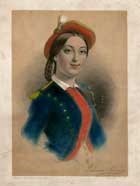
at the Princess's Theatre in the 1860s, but she continued to perform throughout the 1860s and 1870s. In the summer of 1873, she took on the management of the Oriental Music Hall in Margate and in 1874 was listed as one of the teachers at the British Musical and Dramatic Institute in London but soon left that and concentrated on having her own pupils. Performances became fewer as she aged and by 1875 she was advertising herself "for First Singing Old Woman in Opera, Opera Bouffe and Operetta" [2]. She was also looking after her husband, who had started to suffer a long term illness in 1870. After his death in 1876 a fund was started to help her [3]. Although she continued to advertise as a teacher and performer, she never really recovered from his death and died the following year. Her daughter, Florence, had a minor career as a singer.
Jennifer Carnell, Mary Elizabeth Braddon and the Victorian Theatre, (Hastings: The Sensation Press, 2016), pp. 193-194 has a short biography of her.
[1] The Era (Apr. 29, 1877) had a short obituary. It dated The Barn Burners as 1832 but it was 1833. Jennifer Carnell, Mary Elizabeth Braddon and the Victorian Theatre, (Hastings: The Sensation Press, 2016), pp. 193-194 has a short biography of her.
[2] The Era (Feb. 7, 1875)
[3] The Era included the appeal in several issues in July through to September. Isaacs sent a letter to the October 1 issue to say that the appeal brought in £160 3s 6d.
 |
 |
 |
  |
|
|