  |
 |

|
  The Rose of the Alhambra
|
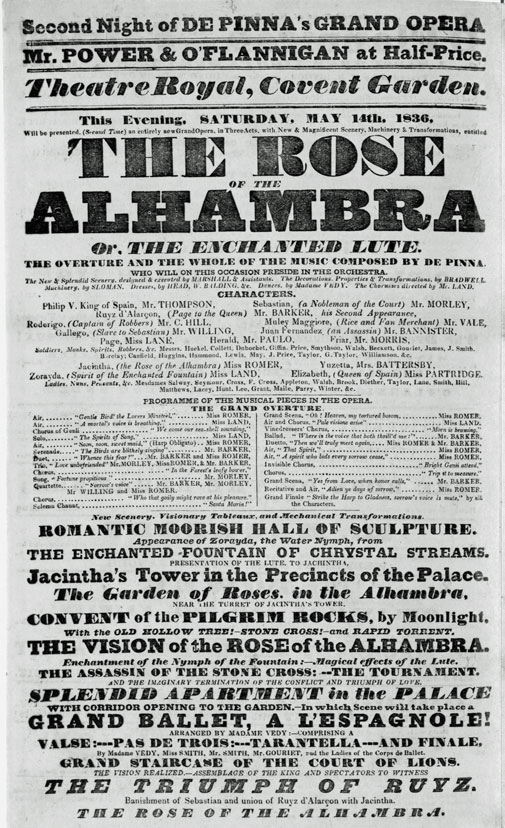
|
Philip V Ruyz d'Alercon Sebastian Muley Maggoire Rodrigo Gallago Juan Ferrandez Page Herald Friar
Jacintha Zorayda Yuzetta Elizabetta, |
Covent Garden
|
EOH (Lyceum) - Mr Lewis
|
Conductor - George Rodwell or Joseph de Pinna [1]
[1] Rodwell was Director of Music at Covent Garden at this time but de Pinna may have followed the frequent practice of the composer conducting the first few performances
History
On his way back through London in 1832 from a stay in the Alhambra, the author, Washington Irving, published a book of stories, under his pseudonym Geoffrey Crayon, entitled The Alhambra, of which "The Rose of the Alhambra" was one. That tale was also published in various newspapers[1]. Later Irving revised and added to the collection. Given the usual practice, it would be expected that people would have quickly assessed whether the story could be turned into a play or opera. In late 1833, the Caledonian Mercury (October 5, 1833) reported that the pianist and composer, Joseph De Pinna was "far advanced" on an opera, which reports later confirmed was The Rose of the Alhambra, for the winter season. Nothing appeared until 1836 when it was premiered at Covent Garden. However, it only lasted 2 nights supposedly due to some argument between Captain Frederick Polhill, whom some sources claimed to be the librettist [2], and Alfred Bunn, but it is not clear what was the problem [3]. The opera reappeared in July 1836 at the English Opera House where it ran for 19 performances.
The following year there was a court case in which De Pinna sued Polhill for the £300 (some sources say guineas) that the latter had promised to pay him for the copyright of the opera. The various accounts are not consistent but one reading is that this was to enable Polhill to claim ownership of the libretto and furthermore that he paid for the performances at the EOH, all aimed at raising his artistic reputation [4]. The court case claimed that the librettists included a Mr White, an unknown person and a song from the ubiquitous Edward Fitzball [5]. Fitzball [6] acknowledged his involvement but said that he had "merely curtailed the leaves" and never touching "the poetry" . The next year, De Pinna was back in court trying to get money from the Sheriff of Middlesex, whom he stated wrongly allowed Polhill to get out of paying by claiming no assets. Again he was awarded damages, although it is not known if he ever managed to collect them [7].
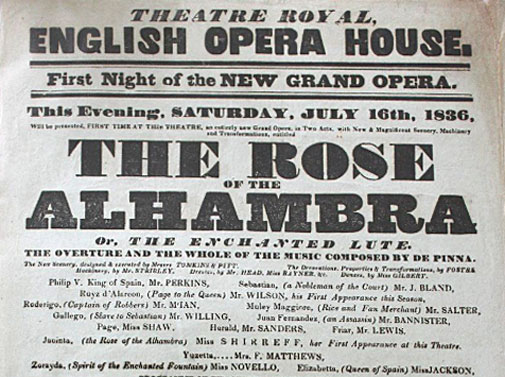
The Revival at the English Opera House
Plot
The story is set in the reign of Philip V of Spain and the efforts to conjure him out of his depression. Jacintha's mother has died leaving her in the care of her old friend Yuzetta, who is not altogether pleased with the responsibility as she thinks it has stopped her finding a husband. The two of them live in a tower near the palace where Jacintha is kept in seclusion to avoid the corruption of the court. Jacintha goes to the courtyard fountain for water and sits there bemoaning her lot. Her distress causes Zorayda, the spirit of the fountain to appear. She had drowned in the fountain many years before and still haunts the place. She gives Jacintha a magic lute whose music will attract Ruyz d'Alercon, the queen's page, whom Jacintha met at a dance in one of her few forays from the tower. When Yuzetta briefly returns she is much taken with how much Jacintha's lute playing has improved.
Ruyz comes to the tower to try to gain access but Jacintha won't let him in until he tells her of the trouble he will have because the Queen's falcon has taken up residence in the tower and won't return to him. Eventually she gives way and he goes to get the falcon. However, the door being open, Sebastian also enters. He has evil designs on Jacintha but is thwarted by Ruyz's presence and eventually he and Ruyz leave, but not before she promises the latter a note on where to meet. After he has left, he suddenly realises there is no one to bring the note but the rice merchant and general factotum, Muley Maggiori, suddenly springs out of nowhere and volunteers. They see Yuzetta returning so Ruyz leaves and Muley initially hides before joining in some banter with Yuzetta whom he has vaguely promised to marry at some time.
The scene switches to rocks near a convent (monastery [8]) home to a band of robbers led by Rodrigo, whom Sebastian is paying to help him overthrow the king. The scene then moves back again to Jacintha and Ruyz, who have met again only to be interrupted again by Sebastian who sends Ruyz off with a package from the Queen to the distant convent. As Ruyz tries to gain access to the convent he is attacked and stabbed by one of Rodrigo's men but before he can finish the job, Muley appears and kills the assassin and puts Ruyz's hat on him, while Ruyz staggers off wounded eventually ending up in the convent. Rodrigo disposes of the body assuming it to be Ruyz's. Sebastian hands Rodrigo a paper with the details of the forthcoming plot. However the paper blows away and Muley finds it substituting a blank paper.
Muley tells Jacintha of Ruyz's wounding and disappearance and she is determined to go to the king to seek justice. On her way, she discovers Ruyz who has now recovered but is in disguise and they plan to ask the king to get Sebastian to account for Ruyz's disappearance. Meanwhile, the king is in a deep depression but hears her singing outside and tells her to enter. Cured he asks what reward she wants and Sebastian is ordered to attend the lists. Muley also enters and hands the incriminating paper to the king. Before Sebastian receives the summons, he again attempts to accost Jacintha but Muley disguised as a monk intervenes,
Sebastian and Ruyz, still in disguise, meets for a duel. Sebastian is about to kill him when Jacintha takes off Ruyz's helmet. Initially Sebastian is indignant that he has been falsely accused of doing away with Ruyz but is then charged treason on the basis of the paper and of his fellow conspirators who have been captured. He is exiled while the rest sing a happy finale.
Reception
The premiere did not seem to have attracted a full audience but it was announced for repetition to general approbation. The Morning Post (May 13, 1836) had a fairly low opinion of the opera, its biggest complaint being the "insufferably dull and tedious libretto", while also writing of the lack of design as well as variety of the music. It was the staging which most impressed. In fact the Morning Advertiser (May 13, 1836) saw it as "being entirely designed as a vehicle for music, accompanied with splendid scenery, and excellent dancing". The Times (May 13, 1836) was much of the same opinion, "The music here and there was pleasing, but was on the whole rather calculated to lull than to arouse the passions" and thought the applause more down to the "goodness of the ballet and and the splendour of the scenes than any merit of the drama" - a moonlight view of the convent deserving special mention.
The Times (July 19, 1836) reported on it again after the transfer to the English Opera House but its opinion was largely unchanged seeing it as a "dull and pointless", although it thought it better staged than at Covent Garden. The Evening Chronicle (July 18, 1836) talked of the great pains to stage the piece which were "in some measure thrown away; for the piece... is a silly nursery tale, and the music is commonplace and feeble". On the other hand, the Dublin Morning Register (July 20, 1836) talked of it being "full of elegant melody and well-harmonised parts" and of achieving "success of no mean extent", a report that was carried in other provincial newspapers.
Edward Fitzball reminiscing over 20 years later claimed that the opera "was exceedingly well received" and that "the music was greatly admired, and the libretto also" [9] .
Scores and libretto
The manuscript of the libretto is available in the British Library at Add MS 42936, ff. 23-44. It was sent on April 28, 1836, but there is no sign off date. Its transcription is here. The text of the vocal items published by John Miller in 1836 is available at the British Library, see here. That shows some differences from the songs as laid out in the manuscript but not of any great importance. No score is known, not even of any of the numbers, although there are 29 pieces by de Pinna held in the British Library.
Recordings
There are no known recordings of the opera or parts of it.
Books, Articles, Online
Apart from the reviews, there are no known publications or web sites discussing the opera in any detail.
[1] For example, The Belfast Commercial Chronicle, (May 14, 1832)
[2] For example, "Drama", Bell's Life in London (May 8, 1836). The Observer (June 5, 1836) reckoned that Captain Polhill's brother was the author. "English Opera House", Morning Post (July 18, 1836) saw it as a vanity project for Polhill.
[3] "English Opera", Morning Advertiser (June 20, 1836). Bunn had given up the Covent Garden lease by this time. Possibly he made difficulties releasing some singers from Drury Lane. Polhill had been the lessee of Drury Lane so there might have been some problems between him and the current lessee, Bunn, about that.
[4] "English Opera House", Morning Post (July 18, 1836)
[5] "Court of Common Pleas", The Standard (June 30, 1837)
[6] Edward Fitzball, Thirty Five Years of a Dramatic Author's Life. Vol. 2 (London: T.C. Newby, 1859), p.130.
[7] "Common Pleas", The Era (December 16, 1838) stated that the case had been found for the defendant but an "Erratum" ,The Era (December 23, 1838) stated that the verdict was for the plaintiff with £2500 damages, which seems rather large in the circumstances, given it was being claimed that Polhill had owed £800 (it is not obvious how this fits with the original case).
[8] The libretto talks of both a convent and a monastery
[9] Fitzball, p. 129
 |
 |
 |
  |
|
|