  |
 |

|
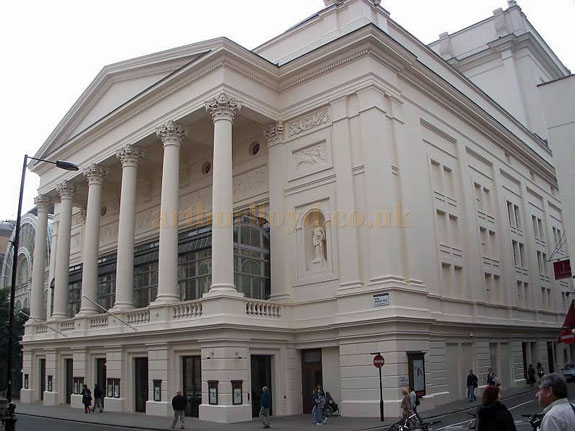
  Theatre Royal, Covent Garden
http://www.arthurlloyd.co.uk/RoyalOperaHouseCoventGarden.htm Opened in 1732, Covent Garden was the other patent theatre offering spoken drama and some English opera, mainly the rather trivial opera of the time but including Arne's Artaxerxes. It was rebuilt in 1808-1809 to a design by Sir Robert Smirke (see below). It was claimed "to hold upwards of 3000 persons and, when crowded, to produce more than £900". The prices, in 1830, were:- Boxes-7s, Pit-3s.6d., Gallery-2s., Upper Gallery-1s. Performances began at 7pm. [1] From 1810-1824, Sir Henry Bishop was musical director and included a number of continental operas translated into English but also heavily adapted for the supposedly different English conditions. Charles Kemble took over the management and, in 1826, he invited Weber to become musical director. Weber died shortly after the premiere of Oberon and there were no new English operas, although older English operas and some new continental opera were given. Alfred Bunn took over the lease in May 1833 in tandem with Drury Lane, hoping to cut costs by using performers at both theatres on some evenings. He put on a number of German operas in German as well as Bellini's La sonnambula and Mozart's The Marriage of Figaro in English and followed up with more continental operas in English for his final year of management in 1834-35. David Osbaldiston, who had managed the Surrey, became manager for the next two seasons. He was less interested in opera but did stage George Rodwell's The Sexton of Cologne in June 1836. Rodwell was his director of music. Charles Macready took over in 1837 to 1839 and, although disliking singers and opera, did premiere John Hullah's The Barbers of Bassora (1837) and William Rooke's Amilie (1837) and Henrique (1839). The next lessees, Lucy Vestris and Charles Matthews only managed John Jolly's Mabel (1840), which lasted one performance. On Vestris and Matthews' departure at the end of the 1841-42 season, various people, including a brief stint by Bunn, attempted to make a go of it but without success. The theatre hosted a variety of events and activities but, operatically, mainly focused on French and Italian opera. The theatre was completely remodelled in 1847 and, on reopening, was renamed the Royal Italian Opera House concentrating on continental opera, although Bunn had a short English season in the last quarter of 1848 before failing yet again. This manifestation of the theatre burnt down again in 1856.
Books on the theatre include- Online information on the theatre include- http://www.arthurlloyd.co.uk/RoyalOperaHouseCoventGarden.htm https://www.british-history.ac.uk/survey-london/vol35/pp.71-85 https://www.british-history.ac.uk/old-new-london/vol3/pp.227-237 [1] Extract from an unidentified book published around 1830 (pp.345-346) |

 |
 |
 |
  |
|
|