
 |
 |

|

 Matilda of HungaryMusic by William Vincent WallaceLibretto by Alfred Bunn
Theatre Royal, Drury Lane, London
|
| The Marquis de Vernon | - Willoughby Weiss |
| Count Floreville (his Son) | - John Rafter |
| Ardenford (The Bondman) | - William Harrison |
| The Viscount Morliere (His Friend) | - Henry Horncastle |
| The Baron de Laville (His Friend) | - Mr Galli |
| Mal-a-pro-pos (The Valet of Ardenford) | - Mr Harley |
| Jaloux (An Innkeeper) | - Mr S. Jones |
| Michel (Servant to the Marquis) | - Mr Connell |
| Attrappe (A Police Officer) | - Mr Howell |
| First Huntsman | - Mr Hodges |
| Keeper | - John Birt |
| Notary | - Mr Sanger |
| Madame Julia Corinne (A Creole Widow) | - Emma Romer [1] |
| Frivole (Her Lady's Maid) | - Mrs Hughes |
| Grisette (Wife of Jaloux) | - Rebecca Isaacs |
Conductor - William Vincent Wallace / Francesco Schira [2]
[1] Elizabeth Rainforth sang most of the performances because Romer was ill.
[2] Wallace conducted the early performances until he was ill around the end of February when The Musical World (Mar. 6, 1847) reported that he had caught a severe cold when conducting and that this had affected his eyes, so much so that he was unable to bear the light for several days. However, according to the Era (Mar. 7, 1847) he was advertised as conducting it on March 8, although The Musical World (Mar 13, 1847) wrote of him as still "seriously afflicted with inflammation of the eyes".
History
Alfred Bunn had promised three new operas for the 1846-1847 season, one of which was to be by Wallace [1]. Bunn provided the librettos for all three of them. None of the operas was particularly successful and Bunn's mounting losses forced him to curtail the season on May 3, 1847, and to give up the Drury Lane lease.
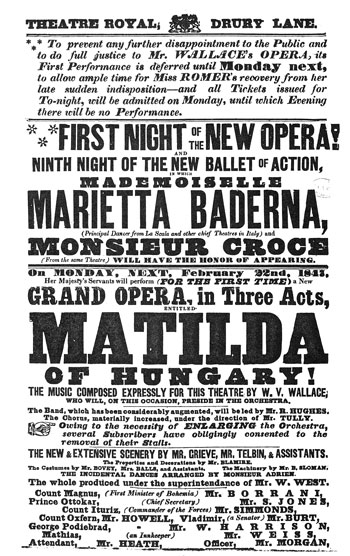
Part of playbill announcing Matilda's
premiere, missing the female
cast |
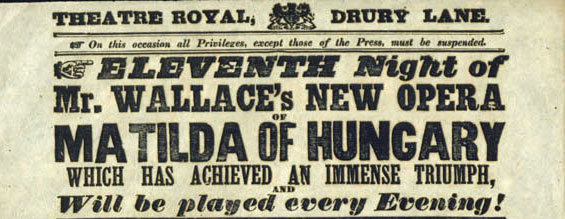
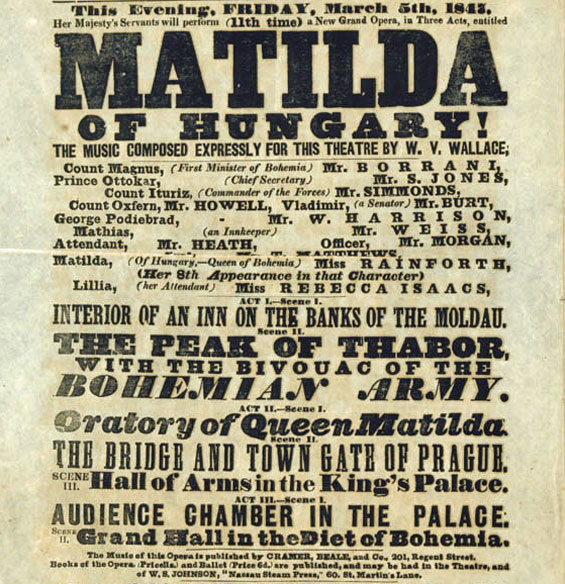
The libretto for Matilda was an original plot based very loosely on the history and legends surrounding King George of Poděbrady, rather than Bunn's usual practice of adapting an existing play. Balfe's The Bondman was thought to have been brought hastily to the stage because the previous two operas had failed to last as long as planned. In turn, Wallace's opera possibly had to be brought forward because Balfe's opera was failing to draw. Having suffered criticism for the poor quality of his previous production, Balfe's The Bondman, Bunn spent heavily on the production. The premiere was planned for February 15, 1846, but, with an expectant audience in attendance, Bunn had to come on and announce a postponement due to Emma Romer's indisposition, seemingly caused by rehearsing while still singing most nights [2]. The reaction was very hostile but quelled somewhat by Wallace conducting Matilda's overture. A performance of The Bondman followed with the young Sophie Messent singing Corinne. The theatre then closed for the rest of the week. The premiere took place the following Monday (playbill opposite) but Romer was still not fully recovered so that Elizabeth Rainforth learnt the part in the meantime and substituted when necessary, which ended up being most of the performances. The clumsy join in the playbill above, where Rainforth was listed, suggests that they pasted the bottom half over the original playbill when there was a change of cast or possibly the bill was printed in two halves with the bottom half changed depending of whether Romer or Rainforth was singing. This may account for the shortened playbill opposite. |
The Illustrated London News (Feb. 27, 1847) reported that the opera lasted four hours but was reduced by omitting dialogue and cutting some five or six numbers from the original thirty, which would imply something in the region of an hour less [3]. Further, it thought that the music in the first two acts could "advantageously bear additional cuts, and then Matilda would be heard with unalloyed gratification".
Matilda was not successful but did manage around 30 performances with the final performance on April 28, 1847. The Musical World, (Feb. 27, 1847), guessed that it would need to achieve 50 performances in order to pay off the high costs, so Bunn clearly lost heavily on it. It was never revived either in the UK or abroad [4].
[1] Morning Advertiser (Dec. 12, 1846). It also mentioned operas by Lavenu and Balfe
[2] See Comments section
[3] The reduction is discussed further below in Scores and Librettos . The recurring problem of overlong operas is discussed in the comment section of Lavenu's Loretta.
[4] W.H. Gratton Flood, W.H. William Vincent Wallace. (Waterford: The Waterford News, 1912), p.24, wrote that "it was well received by the Austro-Hungarians" but no evidence has been found. He may have mixed it up with Maritana, which was performed in Vienna. The Era (May 23, 1857) claimed that Matilda was to be produced in Germany but again there is no evidence that that happened.
Plot
The opera opens at an inn with the innkeeper Mathias bringing news of a battle between Queen Matilda and some of her nobles. The Queen’s husband, Ladislaus, has been missing for some years and the nobles want a new king proclaimed. All leave and George Podiebrad, a hunter, enters. He tells of how he saved a woman who then disappeared. Count Magnus appears. He has brought the Queen to be hidden at the inn. Podiebrad recognises her as the woman he saved and whom he loves. Magnus, the chief minister but also ambitious to be king, advises the Queen that she must remarry to quell the unrest and offers himself but is rejected. Podiebrad enters and Magnus sees that he looks exactly like Ladislaus. He conceives the idea of using Podeibrad to claim that Ladislaus has returned and then to rule through him. Podiebrad, who does not know Magnus’s plan, is reluctant to agree to go with him to Prague until he realises that it will mean that he can be near the Queen. He is told of Magnus’s plan and is introduced as the returning Ladislaus to the other nobles, who accept him.
Podiebrad has sent the Queen a letter appraising her of Magnus’s plan. However, when Magnus tells him that rebellion will break out and the Queen killed, he goes ahead with the deception. Podiebrad is accepted as king by the people. Magnus enters bringing papers for him to sign giving Magnus control of the army and the finances and naming him as successor but Podiebrad refuses to Magnus’s fury. The Queen makes it clear that she knows Podiebrad a fraud but, before she can act, news is brought of a rebellion and Podiebrad goes off to quell it.
Podiebrad returns victorious and has come to sign a treaty, while the Queen is having second thoughts about her rejection of him. She goes along with the peace ceremony to avoid unrest breaking out again. A would be assassin, the innkeeper Mathias, is brought in and confesses that Count Magnus hired him. Podiebrad confronts Magnus with this evidence and has him taken away. The Queen thanks him for what he has done and understands that it was motivated by her love for her, while also remembering that he had saved her before. Magnus escapes and, in front of the court, denounces Podiebrad as an imposter. The Queen sentences Magnus to death for his treachery and after admitting that Podiebrad had saved her realm, crowns him and announces that she will marry him. |
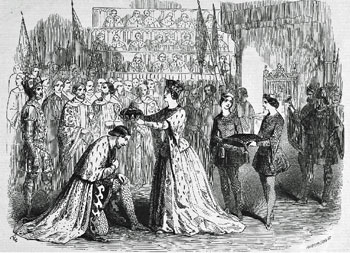
The crowning of George Podiebrad Illustrated London News (Mar. 6, 1847) |
Reception
Matilda was one of the most highly anticipated English operas in the light of the success of Wallace's first opera, Maritana (1845). From the public's standpoint it was a failure but critics were more divided.
J.W. Davison (The Musical World, Feb. 27, 1847) thought that "The plot is interesting enough, albeit manifestly improbable" but that it would have been better reduced to two acts. As others did, he wondered what Hungary had to do with it when the opera was set in Bohemia . On the composer he wrote that "Mr Wallace ... has arisen from his task with honour and increased reputation; he has written a score which exhibits the tuneful exuberance of his Maritana, combined with other and more durable qualities". As often, Davison then went through the numbers in the opera usually praising some aspect of them. He noted that "The scenery was magnificent" with several scenes bring greeted by applause and that, apart from a few complaints, the opera was "completely and splendidly mounted" having been done "in the best and costliest style". In all, "Matilda of Hungary is a great advance upon Maritana"[1].
The Illustrated London News (Feb. 27, 1847) posed much the same comparison but thought the difference in type between a comic opera and an opera seria made that difficult to judge. However, it judged that "his fame must be increased by Matilda of Hungary, the third act of which is as fine as anything can be in the way of fertile imagination and elaborate treatment" although there was a greater charm and completeness about Maritana. The chief difference as far as it was concerned was that Maritana was infinitely better acted than Matilda.
Miss Romer excepted, nothing could be worse played than the parts attempted by Harrison, Borrani, and Weiss, and yet their characters, in the hands of skilful actors, would have told immensely.
Its publication date meant that it was also able to review Rainforth in the title role. It found her performance
dignified and impressive, and, if her singing has not the power of her predecessor in the Royal part, it is superior in respect to artificial finish and precision.
The Morning Post (Feb. 23, 1847) used the occasion to write about the little interest in English opera by the ruling classes as opposed to Italian opera which was about to get a second theatre (see comments). It thought the libretto provided "very few good situations for musical effect, but great scope for brilliant scenery, gorgeous spectacle, and multitudinous supernumeraries" and identified its weakness that "the subject is quite strange to the general public" because "An English audience much more readily appreciate an opera which is founded on a familiar subject"[2]. It looked on the music less favourably than that of Maritana but excused Wallace on the grounds that the libretto had given him so little opportunity with its lack of strong feelings and well defined characters. It much admired Emma Romer's efforts saying that she did every justice to her part and thought Rebecca Isaacs "proved herself an acquisition of importance to the vocal strength of the company". It was also much more positive than the Illustrated London News about the male singers. Despite its misgivings it concluded that "upon the whole, the reception of the opera justifies our pronouncing it decidedly successful".
Henry Chorley (The Athenaeum, Feb.27, 1847) also saw Wallace's efforts as having been weakened by the libretto as well as by anxiety on composing his second opera (presumably because of the huge success of the first). The result was "a general timidity of idea and over elaboration as to detail". "There is a want of contrast, simplicity and transparency in almost all the concerted pieces: and the instruments are for ever in the way of the voices". He also thought that Romer "sang her very best - with considerable delicacy added to her usual force of expression". Harrison received qualified praise, Weiss more wholehearted praise and Borrani accused of singing out of tune all evening. "The chorus and orchestra were feeble". Some of the scenes were praised but although there was a show of luxury in the procession, many of the costumes looked shabby and second hand - "and this in an opera where story and music are spoilt for the sake of spectacle is by no means to be forgiven".
The Era (Feb. 28, 1847) also saw the book as "being better adapted for spectacle than for musical illustration". This had resulted in Wallace having to
overload his work with ballads, a boon certainly to the music shops, but destructive of the effect of a grand opera in three acts. There is, therefore, a sufficient quantity of melody, and a correspondent lack of concerted pieces.
The singers were all complemented (including Rainforth on the following Thursday). The spectacle was described as superb, "full of fine artistic effects" with the last scene "a veritable chef d'oeuvre of grouping and happy combination of colours. At the fall of the curtain, the house rose and cheered for several minutes".
The Spectator (Feb 27, 1847) was "not so certain that it will exalt the author's name" as
though much more elaborate, it is neither so fresh nor so pleasing as Maritana; and, in so far as could be discerned through the "glamour" of a first night, it did not make so great an impression on the audience
It thought Wallace's qualities were similar to Balfe's being "destitute of any individuality", but rather "a clever compound of the styles of the fashionable composers of the day".
It is fluent, animated, and showy; never rousing the listener by bold and original thoughts, nor moving him by strokes of feeling; but affording much more of the mere auricular gratification which is derived from pleasing musical sounds.
Despite this assessment, it judged wrongly that the opera would have a similar run to Maritana.
[1] As would be expected, Davison's review in The Times (Feb. 23, 1847) covered much the same ground but adding that a few curtailments of the dialogue would help the opera go all the better.
[2] Edward Fitzball was of a similar opinion believing that an existing play was the best source for a libretto (Andrew Lamb, William Vincent Wallace, p.92). R.H. Legge claimed that Matilda had "one of the worst librettos in existence" (Gratton Flood, William Vincent Wallace, p.23), but that description had been used of other English opera librettos, e.g. Balfe's Diadesté, and the many poor librettos had hardly proved a stumbling block to operatic success. Compared to some, its plot, at least, held some interest.
Comment
The Problems with Rehearsals
In his review of Balfe's The Daughter of St. Mark (1844), Chorley had commented at length about the poorly organised rehearsals and the toll they had taken of Elizabeth Rainforth's health. He returned to the subject (Athenaeum, Feb. 20, 1847), although here the singer affected was Emma Romer, who was forced to cancel even though the audience was already in place for the premiere of Matilda:
The postponement ...was caused by the sudden illness of that zealous and energetic lady, Miss Romer; who had been in the theatre, rehearsing, till nearly 5 o'clock, it is said - and had been singing on most, if not all, the evenings of the previous week, in grand opera [1], while the exhausting preparations of the new piece were going on in the mornings! In the musical theatre of no other country save England would such a ruthless strain on the exertions of any artist or set of artists be possible, Setting aside the increase of risk to every new work - illustrated in its most mortifying form on Monday evening - till this fashion be forsaken, we can never look for anything save slovenly and mechanical performance.
The Observer (Feb. 28, 1847) pointed to a further risk from such practice, the fact that Rainforth had to take on a role she was unsuitable for and thus compromising the opera's potential success.
[1] Romer sang in three performances of Balfe's The Bondman and one of Donizetti's The Favourite during the previous week..
Understudies
The postponement of Matilda because of Romer's illness highlights the question of understudies. The last minute substitution by Balfe's The Bondman was possible because Sophie Messent "played the part without a rehearsal, having [understudied] it voluntarily". The Illustrated London News (Feb. 20, 1847) continued that the lack of an understudy was not the manager's fault but "the foolish vanity and dignity of the leading artists", prima donnas considering it "derogatory to understudy the part of another". This was at a time when singers were the most powerful persons in the opera hierarchy. Bunn learnt his lesson on this occasion and was able to get Rainforth to learn the part to guard against any further problems, a sensible precaution as it turned out.
Davison (Musical World, Feb. 27, 1847) touches on an aspect of staging that has not been found elsewhere, the use of dummies on opera stages. Noting some ways in which the staging could be improved, he included
the summary banishment of the dummies as the back of the stage, which are strangely out of sorts with their flesh and blood companions.
Thus it seems that dummies were used to bulk out the size of crowds for scenes such as processions but would obviously look out of place once the crowd moved around. When The Sun (Feb. 23, 1846) claimed that there would be 500 people on the stage at one point in Benedict's The Crusaders (1846), the question arises whether some of these would have been dummies and, if so, how many.
English versus Italian opera
The Morning Post (Feb. 23, 1847) used the opera review to complain bitterly about the lack of interest in English opera from the ruling classes.
It is the peculiar fate of our public to have to endure the peculiar taste of our royalty and aristocracy to patronise, and the peculiar policy of our Legislature to license, a second establishment for the performance of Italian operas, an enormity unknown in any other capital outside Italy
This was on the occasion of the opening of Covent Garden for Italian opera in addition to that already staged at Her Majesty's Theatre. It clearly thought such support should have been directed at English opera as one quarter of the money expended on its opening
would have been a fund of sufficient magnitude to place the struggles of English musicians beyond the influence of temporal circumstances, of public caprice, and of managerial necessities, by the endowment of a worthy arena for the display of native talents.
It went on to observe that the royal presence had not graced the performance of an English musician for more than two years.
The Morning Chronicle (Feb.26, 1847) echoed the Morning Post's grievance by ending its review, "It is to be hoped that no prejudice in favour of foreign names will prevent the public from acknowledging the great beauties of Matilda of Hungary".
Scores and librettos
The original manuscript sent to the Examiner (Add MS 43000 ff. 356-379) was actually a printed text but without a performance date or singers named. It was printed by W.S. Johnson and was received by the Examiner on February 9, 1847 and signed off on February 13. The published printed librettos (London: Cramer, Beale and Co., 1847) were also printed by W.S. Johnson and can be found at LoC and Google books. They obviously used the version sent to the Examiner as the starting point but have text and songs omitted cutting the libretto from 43 to 33 pages, presumably to reduce the performance time.
The British Library has the vocal score and scores for four of the numbers. IMSLP has vocal scores for "Adieu fair land", "Gone is the calmness from my heart" and "In that devotion which we breathe". Internet Archive has the scores for "A Lowly Youth" and "Adieu fair land".
[1] The published librettos were also printed by W.S. Johnson and were, presumably, produced some days after the premiere.
Recordings
No recordings of any numbers are known
Books, Articles, Online
Andrew Lamb, William Vincent Wallace. (Croydon, UK: Fullers Wood Press, 2012), pp. 84-94, has a chapter on the opera giving its history and reception in some detail.
Robert Phelan, William Vincent Wallace: A vagabond composer. (Waterford: Celtic Publications, 1994), pp. 42-44 and pp. 107-110, discusses the work and gives some reviews of the first performance.
Pip Clayton, "Opera in London during the Nineteenth-Century, No. 3", Donizetti Society Newsletter, No. 98, (June 2006), pp. 21-23, has a short article on the opera.
George Biddlecombe's book, English opera from 1834 to 1864 (see book list), p.133, has a paragraph on the opera.
 |
 |
 |

 |
|
|