
|
 
Emma
Romer
1814-1868
|
Romer
came from a theatrical family.
She received
training from John
Elliott and possibly
Sir George Smart [1].
Her first appearance
was as Clara in
Sheridan's The
Duenna at
Covent Garden in
October 1830. She
had a large voice,
which was a
considerable asset
given the size of
Covent Garden and
Drury Lane. "Her
"delicately feminine leg, a neatly-turned ancle
[sic], and as pretty a little foot as
'o'er brushed the dew from the daisy' " probably
also helped and she was soon seen as "a more
formidable rival [to Miss Shirreff and Miss
Inverarity] than the imagined they had to
encounted" [2].
In the
1830s she took many
leading roles
including the
premieres of Loder's
Nourjahad (1834), Barnett's
The Mountain Sylph
(1834), Rodwell's
The Sexton of
Cologne
(1836), Barnett's
Fair Rosamond
(1837), Balfe's
Joan of Arc
(1837) and
Diadeste
(1838), Loder's
Francis the First
(1838) and
Benedict's
The Gipsy's Warning
(1838). She
took over from Maria Malibran in Balfe's
The Maid of Artois
after
Malibran's untimely
death in September
1836 and starred in several English versions of
continental operas.
In
November 1840, she
premiered her brother Frank's opera, Fridolin,
which was the first venture of John and
Morris Barnett's management of
|
 |
Possibly Emma Romer
National Portrait Gallery |
|
the
Prince's Theatre. Its staging
had been her condition for singing but its
failure was held to blame for the collapse of the Barnetts'
enterprise
after eight days. She continued to star
through the 1840s, including the lead in à
Beckett's
Red Riding Hood
(1842) at the Surrey and Wallace's Maritana (1845)
and Matilda of Hungary
(1847), Benedict's The
Brides of Venice (1844)
and The Crusaders
(1846) and Balfe's The Bondman (1846),
all at Drury Lane.
|
When Bunn's
management at Drury Lane ended in 1847, she spent the 1847-1848
season as part of the Princess's Theatre company. Romer then
seems to have taken a break before re-emerging at the Surrey in
the summer of 1849 and then disappearing again until August
1851 again back at the Surrey [3] for the rest of that year,
sometimes singing with her cousins, Anne and Thomas. The
Daily News (Sep 23, 1851) commented on her appearance
there in Donizetti's Linda di Chamounix, "always an
excellent musician and an experienced and intelligent
actress... [the part] is far too youthful for her face
and figure. Her voice still possesses the full rich
volume...but it has lost much of its flexibility". In May
1852, she became manager of
a summer operatic
season of English opera and continental opera in
English at the Surrey Theatre
finishing in 1855.
She continued to sing but her parts became fewer. Generally
her productions met with large audiences and
considerable critical praise, particularly significant given the
Surrey's position, reputation and status. She sang in the premieres
of two
English operas at the Surrey: Balfe's The Devil's in it (July 26,
1852) and Meyer Lutz's Faust and Marguerite
(May 28, 1855). There are no mentions of any musical
involvement by her following her spell at the Surrey. She retired
to Margate after
her husband's death
in 1863.
|

|
Romer as Amina
National Portrait Gallery
|
|
Henry Phillips[4] said of her that she "had a charming
liquid voice, a figure light
as air...and she was,
moreover an admirable
and graceful actress....she
imparted such an exquisite
grace and beauty to her
personification of the
sylph" [in Barnett's The
Mountain Sylph].
The
Sunday Times (Feb.
4, 1838), in its survey of
the 1837-1838 Drury Lane
company, was more ambivalent
noting that in "peculiar
parts, such as The
Mountain Sylph, she
makes her own but she wants
compass and power for a
leading vocalist. Her Amina
is only an imitation of
Malibran; her voice is
uncertain. In particular
things she has greater
claims to the title of
actress than any singer of
the day".
The Fine Arts Journal (Dec. 19,
1846) commenting on her performance in Balfe's The Bondman
(1846) wrote that
Miss Romer was never in much favour with
us, yet she acquitted herself well in some parts; her voice, from
being strained, has now no tone, no resonance, perhaps would be a
better word; and she has such a perpetual smile, that it becomes
wearisome to see it. In her acting, Miss Romer seems to think not
of her part; but that she herself is singing to the public; she does
not identify herself with her character sufficiently, except in some
occasional burst, in which she is generally good.
|
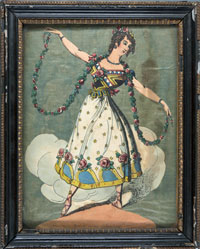 Romer
as Columbine
Robertson Davies Collection
|
The Age
(Aug. 30, 1835) was most
disparaging of her character
blaming her for undermining
Arnold's management at the
EOH. It wrote that "her
conduct at all times has
been so impudent, vulgar and
outrageous, that it is a
matter of congratulation she
is about to quit the stage
[on her marriage (she did
not)]. She is a girl of
remarkable abilities, but
being of low extraction, has
been ruined by her vanity
and arrogance".
Her
intransigence in insisting
on continuing to stage
Fridolin was claimed by
John Barnett as the key
reason for the failure of
his company in 1840 (The
Era, Dec.6, 1840).
Charles Macready [5]
recorded how she had refused
to sing in The Poor
Soldier
in February 1842 because she
was jealous of one of the
other singers, Priscilla
Horton.
Romer also composed
and published a few songs.
Her brothers were Frank, the
composer of The Pacha's Bridal
and Fridolin, and the comic
actor, Robert. Her cousins
were
the singers,
Anne and Thomas Romer and
the
actress, Elizabeth Romer. Her sister,
Helen, was married to Mark
Lemon, editor of Punch. |
Romer was
one of the first
women to continue to
use her maiden name
on stage after
marriage, "why does
the woman not take her right
name?" grumbled the
Naval and Military Gazette
(Oct 7, 1843) [6].
|


