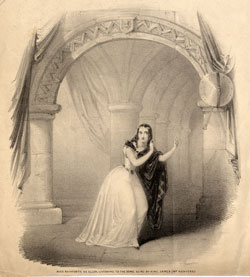
|
 
Elizabeth Rainforth
1814-1877
|
Rainforth's first
professional
operatic was at the
St James's Theatre
on December 6, 1836, where she
sang in the premiere
of Hullah's
The Village
Coquettes. She
went on to become a
familiar presence in
English opera over
the next two
decades
in both London and the provinces. She sang in the
premieres of Ellerton's Domenica (1838) at Drury Lane, Macfarren's
The Devil's Opera (1838) at the EOH and Rooke's
Henrique (1839) and Jolly's Mabel (1840) at Covent Garden. In 1843,
at Drury Lane, she created
the role of Arline
in
Michael William Balfe's
The Bohemian
Girl, the most
successful English
opera of the 19th
century and
was the lead in a revival of Balfe's The
Siege of Rochelle.
She went on to sing in
the premieres of
Balfe's The Daughter of St Mark (1844) [1], Forbes
The Fairy Oak (1845), Macfarren's An
adventure of Don Quixote (1846) and Benedict's The
Crusaders (1846). She sang in most of the
performances of Wallace's Matilda of Hungary in early 1847,
although Emma Romer sang in the premiere. When Bunn closed
early in May 1847, she moved with many of the company to the
Surrey Theatre for a short season during which she sang in the
premiere of John Tully's The Forest Maiden and the Moorish
Page.
Mrs
Cornwall (Margaret)
Baron Wilson in her
book, Our
Actresses. Volume 2
(London: Smith, Elder & Co.,
1844), p 160, wrote
that "although she never astonishes or electrifies, yet she
always pleases and generally delights - in a word, she
|
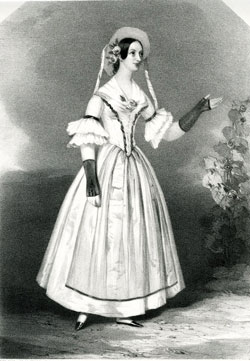
Rainforth in Love in a Village |
|
is a most charming English
singer". Robin Legge in
the Dictionary
of National Biography (Lee, Sidney(ed.), London: Smith,
Elder & Co., 1896, p.179)
wrote that she was "an
admirable singer, but lacked
sufficient power to place
her in the
foremost rank of great
sopranos". The Observer
(Feb.28, 1847)
in criticising her
portrayal of Matilda in
Wallace's Matilda of
Hungary (1847) wrote:
|
That Miss Rainforth
is a pleasing singer is not disputed; that in parts which lie
within the scope of her powers she gives great satisfaction is
undeniable; and that she is, in a general way, a good vocalist -
for an English musician - may not be questioned; but withal she
did not succeed in this character. It was entirely beyond her
physical strength; and her conception of the score was palpably
insufficient, either from deficient study [2] or deficient force
or perhaps from both causes.
According to George Grove
she had a high soprano
voice, even and sweet in
quality [3]. Edward
Fitzball wrote that she was "the most modest and lady-like
singer and actress (a real model for the imitation of others of
her sex)" [4].
She appeared in concerts and
oratorios, giving the first
performance of Mendelssohn's
Hear My prayer
in London in 1845.
On occasion, she accompanied herself on the piano and
composed the accompaniment to at least
one song.
She tried her hand at
theatre management taking
Sadler's Wells for a four
week season of English opera
and opera in English
in July and August 1847.
Lloyd's Weekly Newspaper
(Aug. 22, 1847)
|
|
remarked that the experience
had "not been a bed of
roses; but her conduct has
been most praiseworthy". She
did not appear to have tried
again.
After her
retirement from public
performance in 1859, she
taught singing for some
years.
She was sometimes titled as
Rainsforth.
|