  |
 |

|
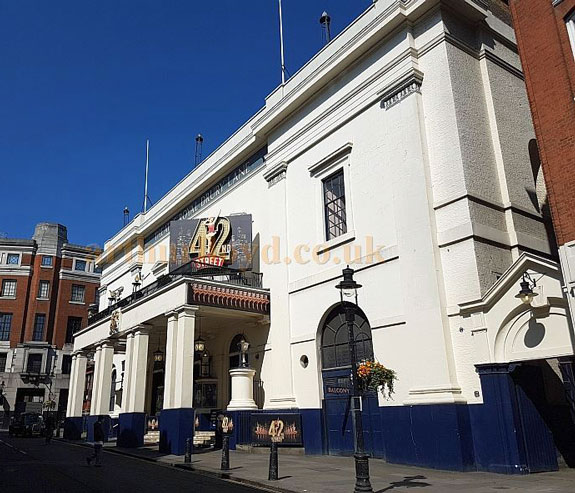
  Theatre Royal, Drury Lane
http://www.arthurlloyd.co.uk/DruryLane.htm Originally opened in 1663, Drury Lane was one of the two theatres that had a patent to present spoken drama. In the second half of the 18th century into the first part of the 19th, it also mounted English opera, though of the usual trivial variety. It was rebuilt to a design by Benjamin Wyatt after a fire and reopened in 1811. The stage was 43 feet wide and 38 feet high. Alfred Bunn began managing Drury Lane in 1831 under Captain Polehill as lessee. Polehill surrendered the lease in December 1834 and Bunn took it on in addition to the Covent Garden one, partly hoping to cut costs by using the same performers at both theatres on some nights. He gave the latter up after the 1835/35 season. It was estimated, in 1830, that the theatre would "accommodate 3611 persons with seats, the boxes containing 1828, the pit 800, the lower gallery 675 and the upper gallery 308". The prices, in 1830, were:- Boxes-7s, Pit-3s.6d., Gallery-2s., Upper Gallery-1s. Performances began at 7pm. [1]
management experience, took over in October 1841, for two seasons. Bunn succeeded him for the 1843-44 season and stayed until May 1847, when it sounds as if the ruling committee would not renew his lease on favourable terms [3]. During that time he staged 12 new English operas, including the most famous, Balfe's The Bohemian Girl. Louis-Antoine Jullien, the new manager, claimed to be starting a new English opera house but was soon bankrupted with his lavish productions and James Anderson took over only for him to withdraw in June 1851 due to his losses. Bunn again took up the lease from December 1851 to June 1852 but only managed to launch one new English opera, Balfe's The Sicilian Bride. After 1852, the theatre became primarily devoted to plays. However, there were occasional seasons of Italian opera most notably the four organised by James Mapleson from 1871 to 1875. There were also short seasons of continental opera sung in English and a few well established English operas, such as The Bohemian Girl. Although the Pyne and Harrison Company took it over for a season of English opera in September 1858 they did not stage any new works. That did not happen until the Carl Rosa company later in the century with premieres of Goring Thomas's Esmeralda (1883) and Nadeshda (1885), Mackenzie's Colomba (1883) and The Troubadour (1886), Stanford's Canterbury Pilgrims (1884) and Cowen's Thorgrim (1890). Books on the theatre include- Brian Dobbs, Drury Lane. (London: Cassell, 1972) Robert Whelan, The Other National Theatre ( London: Jacob Tonson, 2013). This book has an associated website titled The Theatre Royal Drury Lane at http://www.jacobtonson.com/index.html, which includes a history of London theatres from 1660 to 1737, a history of the Theatre Royal, Drury Lane and a list of performances there from 1852 to 1879. Pages 349-394 cover the Bunn era when Drury Lane was a focus of English opera. Pip Clayton wrote a series of articles on the theatre's history in the Donizetti Society Newsletters no. 83 (June 2001), no. 84 (October 2001), no. 85 (February 2002) and no. 87 (October 2002) . Nos. 85 and 87 cover the English Romantic Opera era Alfred Bunn, The Stage: both before and behind the curtain. 3 Volumes (London: Richard Bentley, 1840) gives his particular inside view on the theatre. Terry M. Russell has published a number of books about aspects of Drury Lane in the early 19th century - https://www.blurb.co.uk/user/Cross13
Online information on the theatre includes- http://www.arthurlloyd.co.uk/DruryLane.htm https://www.british-history.ac.uk/survey-london/vol35/pp.9-29 https://www.british-history.ac.uk/old-new-london/vol3/pp.218-227 [1] Extract from an unidentified book published around 1830 (pp.344-345). [2] Quoted in Whelan, p. 379. [3] The Morning Post (May 4, 1847) carried Bunn's valedictory speech in which he said he might return but implied that if others thought they could make it pay then he would not. |

 |
 |
 |
  |
|
|