
 |
 |

|

 Loretta, a Tale of SevilleMusic by Lewis Henry LavenuLibretto by Alfred Bunn
Theatre Royal, Drury Lane, London
|

| Don Carlos Ferdinand Spanish Varaez Noblemen Cordova |
-
William Harrison - Donald King - Mr Morgan - Mr I Hodges [1] |
| Don Henriquez (Governor
of Seville and Uncle to Don Carlos) |
-
Mr S. Jones |
| Philippo (Brother to Loretta) | - Conrad Borrani |
| Don Juanito (Father to Loretta) | - Willoughby Weiss |
| Pablo (Waiter) | - Mr J.W. Morgan |
| Crespo (Alcade [2]) | - Henry Horncastle |
| Provost Marshall | - Mr Hodges [1] |
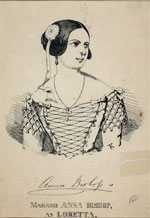
| Loretta (Daughter of Juanito) | - Anna Bishop |
| Florinda (Daughter
of Henriquez) |
-
Elizabeth
Poole |
| Joanno
(Nieces of the landlady) Inesillo |
-
Mrs Hughes - Miss Collett |
| Gaetana (Landlady of the 'Golden Sun') | - Rebecca Isaacs |
| Peasant Girl | - Miss Jackson |
| Child | - Miss Hoskings |
Conductor - Francesco Schira [3]
[1] The printed libretto by W.S. Johnson listed Mr Howell as Provost Marshall and Mr Hodges as Cordova but the November 21 and November 24 playbills listed Mr Hodges in the former role and Mr I Hodges in the latter and this seems the more likely pairing. Mr Hodges and Mr I Hodges but not Mr Howell were listed in the cast by the Morning Advertiser (Nov. 12, 1846) and later on November 26 and December 8, However, the Sun throughout the run listed Howell as Provost Marshall.
[2] Alcade was a mayor or chief magistrate.
[3] Unusually at this time Lavenu did not conduct the first performance despite being a conductor. He left it to Schira, the musical director (The Musical World, Oct 31, 1846)
History
|
Alfred Bunn had promised an opera by Lavenu as part of his announcements for the 1846-1847 season. He provided the librettos for all three. It is not clear whether Lavenu, freed from his responsibilities in the family firm and renewing his musical interests, approached Bunn or whether Bunn having concocted a libretto and, with his regular composers unavailable, turned to Lavenu. Several newspapers claimed that Bunn based the plot on one or more of Les Cent Nouvelles of Marguerite de Navarre. Although there is no obvious source tale, the plot has much the same salacious air of "that dark storehouse of moral monstrosities"[1] and made for quite a risqué plot by Victorian standards. Bunn had managed to hire Anna Bishop on one of her rare home visits to sing in Loretta and in a revival of The Maid of Artois. The opera ran for 24 performances [2] until December 8, 1846. Bishop left after a final Maid of Artois on December 10 for a provincial tour [3]. Presumably, Bunn did not think it worth trying to groom someone else to take over the role. Balfe's The Bondman replaced it and it was never revived, although a few numbers continued to be sung at concerts. |
|
Despite its comparative success for a first attempt at opera, Lavenu never seems to have attempted another.
[1 Morning Post (Nov. 10, 1846)
[2] Some writers (e.g. Davis) claim 25 performances. The Musical World (May 8, 1847) reckoned "thirty nights or thereabouts", one assumes a typical example of Davison trying to talk up English opera.
[3] Morning Post (Dec. 11. 1846)
Plot
Juanito, his son, Philippo, and daughter, Loretta, come to an inn. They are bidding Philippo goodbye as he is leaving to join the army. The customers are about to go home when Pedro runs in pursued by four cavaliers led by Don Carlos, who force him to drink and play the guitar while they dance. Carlos has no partner but spies Loretta and seizes her. The guards have been called and they enter but the cavaliers have escaped taking Loretta. Carlos has imprisoned and raped her in the house of Don Henriques, whose daughter, Florinda, he is supposed to be marrying. He is feeling remorse for what he has done but has to go off to be engaged to Florinda. When he has gone Loretta escapes.
Some 5 years later in a village near Seville the villagers are preparing for a fete including Loretta with a small child. Henriques, Carlos, Ferdinand and Florinda enter. Carlos recognises Loretta and realises the child is probably his. Henriques tells him that it is time to finalise his marriage to Florinda. Soldiers enter including Philippo, whom Loretta embraces. The fete gets underway. Carlos enters and watches Loretta and Philippo and accosts Philippo, who explains the relationship. Carlos tells Philippo that he wants to marry Loretta but she refuses. The appearance of her child explains her reluctance. Philippo is outraged and threatens to kill the child. Loretta rescues the child, Philippo is held back by Carlos and the villagers come to protect her. Henriques, Florinda and Ferdinand enter and the scene ends in chaos.
In the final act, Florinda is getting ready for her wedding. Ferdinand, who loves Florinda, enters but she tells him to go even though she realises Carlos has no love for her. Carlos enters and then Philippo and Loretta. Philippo has understood her history and vows to stand by her giving up his commission in order to do so. Carlos and Philppo leave and Loretta realises that the room they are in is where she was held captive. When the men return she accuses Carlos who admits his guilt. Philippo attacks Carlos but Henriques and Ferdinand intervene. Philippo is led away by the guards. Ferdinand and Florinda realise that there is some dark secret about Carlos and hope that they will be able to marry instead. Philippo has been tried for insubordination and is brought out to be executed. Loretta rushes in with the child to shield Philippo from the firing squad. She publicly states that Carlos is the father of the child. Carlos confesses and says that he will marry Loretta leaving Ferdinand and Florinda also to wed.
Reception
Overall, there was a wide consensus of the opera's merits bearing in mind that it was Lavenu's first opera. Bunn received rare praise for the libretto that, "were it not too overloaded with incident, would be one of the best which has emanated from the manager's pen" (The Era, Nov. 15, 1846).
The Economist (Nov. 14, 1846) was somewhat contradictory in its verdict initially judging that, "though not a complete 'hit', may be pronounced successful, and likely to have a long run." However, it did not think Lavenu had made the most of "the striking situations" provided by Bunn while his abilities in the ballads were hampered "by the badness of the words". It conclusion was that
The music of the opera, though occasionally pleasing, is by no means of a first-rate quality; ... and, in spite of the curtailments which have been effected, there is much that may still be rejected on its own merits, or, rather, demerits.
"Madam Bishop sang exquisitely, the only fault... a deficiency of power". "Harrison was better than usual and Weiss did the little he had to do with the care and feeling which mark the first rate artiste". The decorations and mise en scene were declared "magnificent".
The Morning Post (November 10, 1846) pronounced "the new opera to have been completely successful, notwithstanding its enormous length of nearly four hours' duration". Bunn had "very felicitously interwoven with it numerous striking incidents, and has ingeniously evolved a moral". "The general character of the music is brilliant and popular, although "we cannot give it the credit of decided originality" but the "instrumentation displays a command of the orchestra which greatly surprises us in so young and inexperienced an author.. "Madame Bishop was eminently successful...the freshness of her voice, and the brilliancy of her execution remained undiminished to the last note of the final rondo" while "Miss Poole sang and acted charmingly". As with other papers, it looked forward to "Mr. Lavenu's second opera with much interest" but that never happened.
The Observer (Nov. 15, 1846) was much less welcoming mildly ridiculing the gaps and assumptions in the plot and declaring that
The music of Loretta is by no means of a character to elevate this country in the regions of high art. It is flimsy and free; and it is moreover one mass of plagiarism from beginning to end... The instrumentation generally displays a creditable command of the resources of the orchestra.
It then went on to point out various weaknesses such as sharing the accompaniment of Anna Bishop's numbers between various instruments so disturbing the flow of melody[1]. It claimed that its best known number, "On the banks of Guadalquiver", had been written by a certain Charles W. Glover and was now "the subject of a contest between the parties". A second review in the same paper, possibly by someone else as it seems a little more sympathetic, noted that "the music appears to have been expressly written for [Bishop's]voice", being "set in the very highest range of the soprano".
The exquisite softness of her intonation is incomparable, and her brilliant and florid vocalization is admirable. Her greatest defect consists in that utter incapacity to make any single word distinctly audible; for , without a book, of the opera, her audience are left entirely in the clouds as to the meaning of what she is supposed to utter.
The Illustrated London News (Nov. 13, 1846) thought that
Mr Lavenu will gain credit but not fame by
Loretta. The libretto being of a most exciting nature has, in
fact, taxed his powers too much, with his want of experience. In its
opinion compo, but sers should first try their hands at one or two act
operettas before they venture on grand opera...
It largely agreed with the Observer about Bishop's voice but had some reservations. Bishop had cultivated her high soprano
to the highest degree of perfection, with correct intonation, and the purest method but with indistinct articulation, and labouring incessantly for effect from beginning to end, giving often the painful notion that such continuous exertions must come to a standstill.
[1] The Morning Post had made a similar criticism.
Comment
The Heroine trope
George Biddlecombe [1] in his analysis of the conventions of the English opera libretto noted its close relationship to Victorian melodrama and its three stock characters: the Heroine, the Villain and the Hero. The Heroine instinctively understands what is right and strives unceasingly to achieve it no matter what the obstacles or the pressure applied and being prepared to die rather than compromise her vision or her honour. A quick glance down the list of English operas provides ample evidence of it in action. Here Loretta does not comply with the model but it is not as a result of her own wishes or actions but of Carlos's "ungovernable passion" and even though she worries about her "eternal dishonour". This is different to John Jolly's Mabel (1840) where she willfully goes against the Heroine trope. As in that case, the matter is righted after a fashion by their marriage and his acknowledgement of their son, although seemingly as much from a bad conscience as from love. In effect, the Villain was transformed at the last moment into the Hero by virtue of him marrying the Heroine rather than his implicit goodness, as was meant to be the case. Perhaps the main surprise is the the libretto was by Alfred Bunn, a past master in using the Heroine-Villain-Hero tropes.
Conductors
The role of the conductor was created and evolved over the 19th century from little more than a time beater to someone who shaped and controlled the performance. the first English Romantic operas In were usually conducted by the composer for the first few performances and then left to others. Here Lavenu, although he was a conductor, left it entirely to Schira. James Davison in The Musical World (Oct 31, 1846), was all in favour noting that this practice helped to account for the superiority of continental performances. It ensured "a perfection of ensemble in the execution, which can only arise from confidence in the conductor" rather than seeing a performance "perilled by the inevitable anxiety and nervousness of the composer.
In common with many English operas, Loretta was way too long at four hours and, after the opening night, "Lavenu, Bunn, Schira, Boscha set about hacking at the score until it was reduced to little over three hours" [1]. It is curious how often operas were quite significantly cut after the opening night. The manager and composer must have got a good idea of length from rehearsals, although given the chaotic and rushed nature of some rehearsals, it could be that in some cases no full run through had been completed. Given how limited rehearsal time was, one would have thought that they would not want to spend time on material that would quickly be ditched. The obvious conclusion is that they were unsure which parts would meet with approval and, when it became clearer after the initial performance, they then bent their editing efforts to retaining them and discarding actions or numbers that had not worked The impression is that these operas (or plays) were given without an interval as we would understand it today except for a break between acts or scenes when scenery was being changed. Otherwise people came and went as they saw fit.
Standard of performance in premieres
The Observer (Nov. 15, 1846) in its second review included some remarks nearly a week after the premiere that throw an interesting light on the state its preparation.
The performance is greatly improved by frequent repetition. The performers were at first evidently imperfect, and, if not absolutely wrong, were in many respects wanting in that firmness and precision so very requisite for giving effect to operatic music. The orchestral effects are more palpable; and the various false notes, so evident on the first representation. have now been replaced by those which the composer intended
[1] Richard Davis, Anna Bishop: The Adventures of an Intrepid Prima Donna. (Sydney: Currency Press, 1997 ), p.118. The Illustrated London News (Nov. 13, 1846) reckoned the revised length was 3 hours 20 minutes, which it thought was still half an hour too long.
Scores and librettos
|
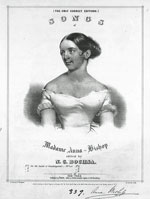
[1] Cover image on the right. It is mislabelled as being from Linda di Chamounix. The recitative may be but the ballad is from Loretta.
Recordings
No recordings of any numbers are known
Books, Articles, Online
There are no articles or books with substantial discussion of the opera.
 |
 |
 |

 |
|
|