  |
 |

|
  Fair RosamondMusic by John Barnett,Libretto by Charles Zachary Barnett / Frances Shannon [1]
Theatre Royal, Drury Lane, London
|

|
King Henry II Walter, Lord de Clifford Sir Alberic de Vere (betrothed to Rosamond) Sir Thomas Vaughan (the King's Favorite) Sir Raymond de Burgh Le Baron Chatelet Le Comte Marcel Hubert (page to Sir Raymond)
Eleanor (Queen of England) Rosamond (de Clifford's daughter) Lady Blanche (her friend) |
- Mr Henry - Mr Mears [1]
|
[1] According to The Songs, Duetts, Choruses etc in Fair Rosamond (London: John Duncombe, 1837?), Le Comte Marcel was played by Mr Fenton. However, the playbill named Mr Mears. Both were at Drury Lane that season but the part was so small that no press report mentioned who played it.
History
Having had considerable success with The Mountain Sylph in 1834, Barnett probably started to plan a further opera. However, on May 12, 1835 a letter appeared in The Times from "A very popular, but almost starving dramatic composer" complaining about Samuel J. Arnold's (manager of the English Opera House) refusal to pay composers for their operas. Arnold replied that the normal practice was for a composer to be recompensed by a publisher for the rights. While it is not clear whether Barnett was the writer of the original letter, his forthright response to Arnold's letter meant that he became publicly embroiled in the dispute. This can hardly have helped him get another work staged at the EOH and he had to wait until Bunn gave him the opportunity at Drury Lane.
|
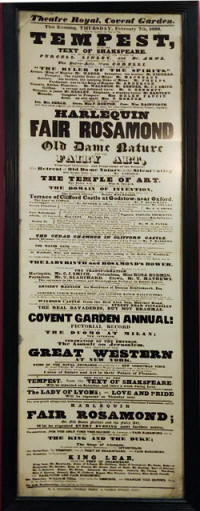
The Morning Post (Oct. 31, 1835) wrote that Barnett had finished the opera and it was rumoured that it was to be staged in Paris, where he seems to have gone to compose it [1]. However, almost two years later the same paper on August 16, 1836, reported that he was still finishing the opera. There was then some derision at reports that he was asking £1200 for the opera [2], which he did not get, although he was said to have got £700 from a publisher for the rights [3]. There were also disputes with singers; Jane Shirreff refused her part as the Queen because it was not the title part and Maria Caradori Allan asked for too high a salary (£30 a night) [4]. Barnett conducted the opera. The opera's libretto is usually credited to his John Barnett's brother, Charles. However, The Observer (Mar.5, 1837) wrote that Mrs Shannon claimed to be the author but that this was disputed by Mr Joseph Barnett, a brother of John Barnett. Joseph Barnett was a music teacher and minor composer and was obviously mistaken for his younger brother, Charles. The vocal score was put out under both Shannon's and Charles's names. Details of the dispute can be found at Frances Shannon. The opera opened on February 28 and initially appeared to do well, the Morning Post (Mar. 13, 1837) reporting that receipts were averaging £300 a night. However, on April 23, the London Dispatch reported that it was not drawing and April 25 seems to have been the final performance. Alfred Bunn [4] claimed that it ran for 17 performances. It does not seem to have been revived in London or staged anywhere else, although a few numbers found their way into concerts that year. It made enough of an impression for various comic works that made fun of it to be performed, such as the Harlequinade on the right staged some two years later. Incidentally, the reaction to the suspension of a performance of the opera led to a petition to the Lord Chamberlain and to Parliament for the abolition of the archaic ban on performances of non sacred works on Wednesdays and Fridays during Lent at Covent Garden and Drury Lane but not at other theatres within the City of Westminster even though they were all under the remit of the Lord Chamberlain [5]. |
 |
[1]em>The Spectator (Mar. 5 1837), p.14
[2] Sunday Times (Sep. 25, 1836)
[3] Morning Post (Jan. 27, 1836)
[4] The Observer (Jan. 8, 1837). On February 6, 1837, it wrote that she had demanded £25 a night.
[4] Alfred Bunn, The Stage: both before and behind the curtain. Vol. 3 (London: Richard Bentley, 1840), p. 244.
[5] The Examiner (Mar. 12, 1837).
Plot
Charles Barnett is often cited as the sole librettist but it was almost certainly a joint effort with Frances Shannon. See Frances Susannah Shannon for details.
|
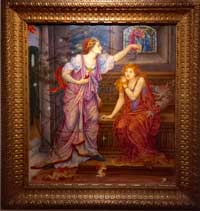
The plot is a variation on the story of the historical figure of Rosamond de Clifford, Henry II's mistress. The picture on the right by Evelyn De Morgan shows the traditional story (which has little basis in fact) that Rosamond was hidden in a labyrinth in Woodstock and had left a red thread for Henry to follow so that he could find her. Unfortunately the Queen found her first and offered her the options of a dagger or poison. Taking the poison, she dies. In the opera, Henry II is besotted with Rosamond, daughter of Lord de Clifford, although he is married to Eleanor. He disguises himself as the troubadour, Edgar, in order to carry out his seduction. The opera opens with a birthday celebration for Rosamond organised by her father. He intends that Rosamond should marry Sir Aubrey de Vere who has just returned with De Clifford from the wars, where he had saved him. |
De Morgan Foundation |
Edgar excites de Vere's jealousy but is allowed to remain after Rosamond's intercession. During the celebrations, Rosamond and Edgar run away with the rest of the company in hot pursuit once their absence is discovered. In the next scene [1], Queen Eleanor appears and finds Edgar and Rosamond surprised by Lord de Clifford and de Vere but quells the conflict by saying that Henry, whom she does not recognise is Edgar, will decide whom Rosamond will wed. There then follows the grand spectacle of Henry and Eleanor's coronation. Rosamond is presented and realises that Edgar is Henry. Henry refuses to give up Rosamond and Eleanor swears revenge. In the final act, Henry is about to visit Rosamond in her bower at Woodstock but is called away. The Queen finds out where Rosamond is and confronts her giving her the choice of a dagger or poison to kill herself. However, Henry returns just in time and order is restored with Rosamond going off with her father.
[1] The manuscript divides the opera into three acts but the printed Songs etc. has four. This point in the drama was scene 3 in the former, but Act 2 scene 1 in the latter. From the description in Bell's New Weekly Messenger (Mar. 5, 1837), the opera was performed in a 4 act version.
Reception
According to the London Dispatch (Mar. 3, 1837), the opera's premiere seems to have caused more than the usual interest in a new work because of the success of Barnett's previous opera, The Mountain Sylph. The Observer (Mar. 5, 1837) wrote that the opera did him "infinite credit, and places him in the very highest rank of those who compose or have composed for our English theatres" and commented on his aim "to revive, and to preserve the national character of English music; we do not mean the music of a bye-gone century, but that sang by minstrels of the age of 'Chivalrie' ". It also made the rather startling claim that "there is not a bar to be detected which is not pure Saxon in its melody". However, on the libretto, where it reckoned there was a dispute over authorship, it made the point that there was nothing in the libretto that Mrs Shannon or Mr Barnett "need be very anxious to own".
The general opinion was that while there were things to praise, Barnett had not advanced on his early promise. Bell's New Weekly Messenger (Mar. 5, 1837) noted that Barnett "is evidently a sound musician: his instrumentation is very fine; but consummate skill in blending instruments and combining voices is not the only requisite for a great composer". The Atlas (Mar. 5, 1837) went further complaining of "a grievous want of melody" and describing Barnett as "without inspiration or genius". Bell's concluded its review that it "would advise Mr Barnett to write no more 'grand operas' and beseech him to give us - what English singers can play- another Mountain Sylph".
All reviewers highlighted and agreed that the opera was much too long at nearly four and a half hours, this being at a time when there were other items included in an evening's entertainment. "Further curtailment will, however, be necessary, in order to render the piece popular" (The Spectator, Mar. 5 1837, p.14) and even its most vociferous supporter, The Observer, thought it needed to lose an hour and a half. It was quickly reduced, although the Morning Post (Mar. 20, 1837), which was sufficiently enthusiastic about the opera to review it twice, was not happy with the choice of cuts. It saw its main drawback as the libretto that was "insufferably dull and tedious". The Champion (Mar 12, 1837) was even harsher, " We never sat out such an unconnected pack of rubbish in our lives" while the Sunday Times (Mar. 5, 1837) wrote that " anything more absurd, jejune, and insipid we have not chronicled for a many a day",
The Spectator and others were unhappy with the use of recitative for the dialogue, although quite what it was like is difficult to judge as it was claimed neither to have been sung (as in Italian opera of the time) nor spoken (as usual in English opera). Perhaps it was something like the older secco recitative style. Significantly, Balfe's Catherine Grey, which premiered only 3 months later at Drury Lane, was described as the first through composed English opera of that era so that whatever form they took, Fair Rosamond, as a whole, was not considered through composed.
With the exception of Phillips,The Spectator thought that "of the singers not much can be said in commendation" and The Atlas had much the same reaction, "Miss Romer has a heavy voice, not very certain in intervals, or effective in a bravura". On the other hand, the Sunday Times (Mar. 5, 1837) wrote that "The vocal parts were very ably sustained". As often the staging, particularly the Coronation scene, was praised.
The Morning Post rather grandiosely proclaimed that "Its triumphant success has established the fact that our native composers are not compelled to resort to the flimsy material of the modern Italian school to insure from a British public a patient hearing of an operatic entertainment". The Observer (Mar. 5, 1837) also expanded on this English theme, noting the use of old English tunes and madrigals and claiming that there was "not a bar to be detected which is not pure Saxon in its melody".
A few months before her accession, Queen Victoria saw the opera and left quite a detailed account, which shows a decided, if perhaps a little prejudiced, judgment [1].
At 1/2 p.6 we went to the play to Drury Lane, with dearest Lehzen [Baroness Louise Lehzen, Victoria's governess at this time] and Charles [Prince of Leiningen] &c. It was the opera of "Fair Rosamond" in 4 acts, by John Barnett performed for the 8th time. Taking it altogether, it is a heavy and very long performance. The story is very absurd and stupid, but most of the music is pretty and some of it very pretty though quaint and in some parts much too like tiresome old Handel's dull music. Miss Romer enacted the part of Rosamond very nicely; she sang well and purely, acted nicely and looked well; Giubelei as Lord de Clifford, Rosamond's father, and E. Seguin as Sir Thomas Vaughan, both acquitted themselves very well of their parts. But Phillips as Henry II, and Wilson as Sir Aubrey de Vere did not please me; they are anything but improved either in acting or singing. Miss Betts as Queen Eleanor was as vulgar and disagreeable as usual. The finale to the 1st act (evidently imitated from that of my dear Puritani), as also that of the 3rd act, and several concerted pieces and solos are very good. The whole is much too long.
[1] Queen Victoria's Journal (March 16, 1837). This is from Lord Esher's typescript of the Journal. Princess Beatrice also made a transcription, which is rather less detailed about this incident. The journals can be seen at http://www.queenvictoriasjournals.org/
Comment
The libretto gives the impression of having started out with some ambition and several plot possibilities that proved too difficult to finish satisfactorily leaving several aspects unexplained and inconsistent. The opera was unusual in that there were quite a few discrepancies between the manuscript and the printed Songs etc., which were sold to help the audience follow the musical items. While many were textual, there also seemed to be structural differences including at the start of the opera and dividing the opera into 4 acts and even, according to the London Dispatch (Apr. 23, 1837), with Rosamond eventually marrying De Vere, but this might have just been suggested in the final grouping. Towards the end of the opera, the manuscript has "Dance of Mummers", while the printed Songs, etc. has a "Chorus - Bacchanals".
Charles Kemble only signed the opera off once, 5 days before the premiere, so technically it was performed illegally as it did not follow the agreed script. Perhaps Kemble was a more accommodating Examiner than his predecessor, George Colman, and was happy for changes to be made provided the text and spirit stayed close to the agreed script or perhaps some note of changes, now lost, was sent to him for agreement or parts had already been signed off in a different context. It was only later in the century that any attempt was made to check that theatres kept to their scripts so any differences might well have passed unnoticed.
The Bell's New Weekly Messenger review complained that they were unable to buy a copy of the printed Songs, etc and that there did not appear to be any for sale. One possibility might be that changes were made late on to some vocal items but too late to be printed in time for early performances. Also Figaro in London
The Observer review noted that on its third performance " the audience begin to understand the music better, they are less tardy in recognizing and acknowledging their estimation of its beauties than on the two former occasions". This foreshadowed an aspect of English opera that was highlighted much more keenly in Barnett's Farinelli (1839) between music that relied on melody for its appeal, associated with Italy, and music founded on "scientific" rules of composition and harmony, associated with Germany. The latter was seen as requiring more time and effort from the listener to make its impact as opposed to the immediate appeal of melody.
Scores and librettos
A transcription of the manuscript lodged with the Examiner (British Library, Add MS 42940, ff. 566 - 600) can be found here. It was received on February 21, 1837 and licenced on February 23, 1837. No printed libretto has been found but there is a printed text of the musical items (London: John Duncombe, 1837?) that can be found at Bayerischen Staatsbibliothek, Goethe Universität, Frankfurt and Google books.
There are many differences between the manuscript vocal items and the printed version.
Morning Post mention Drink wine drink - p.37 in print. Spectator quotes end of printed and talks of a book. talks of curtailment. Morning post second review has wreathing canon in last act.
The overture autograph score is available at https://archive.org/details/overturetofairro00barn/mode/2up . The vocal score (actually a collection of numbers rather than a complete vocal score) is in the British Library.
Recordings
None are known
Books, Articles, Online
George Biddlecombe, English opera from 1834 to 1864 with particular reference to the works of Michael Balfe. (New York: Garland Publishing, 1994), pp. 82-84, has a section on the opera.
 |
 |
 |
  |
|
|