  |
 |

|
  Fanny Healy
|
Often referred to as Miss F. Healy or Miss Fanny Healy probably to distinguish her from the older Mary Ann Healey. According to the Globe (July 17, 1834), Healy hailed from Bath, although there seems no other evidence for this and her 1861 census entry gave her birthplace as Shoreditch. She first appeared at a concert in London on July 20, 1831 at Signor Della Torre's evening concert followed up the following year by one organised by her teacher Signor Lanza. Early in 1833 she was taken on, "a young lady of great promise, possessing one of the finest voices, and of extraordinary sweetness and compass"[1], as the prima donna for the Italian Opera subscription season at the Theatre Royal in Dublin, leaving there to considerable acclaim at the end of April [2] and Ireland in the middle of May after a few further engagements. Concerts in London and towns and cities round about occupied the rest of the year. Her singing must have made an impact on at least one person, as a "H. D---o" submitted a poem to the Sunday Times (Dec. 15, 1833) in praise of "Miss Fanny Healy, the Vocalist", which used the image of a nightingale fleeing to Fanny Healy's breast. In July 1834, she became part of Arnold's new company at the English Opera House, making her debut as the lead soprano in a revival of Arne's Artaxerxes. This was followed a few days later by the premiere of Loder's Nourjahad. However, within a month, the Morning Advertiser (Aug. 18, 1834) reported that the Lyceum were looking for a new prima |
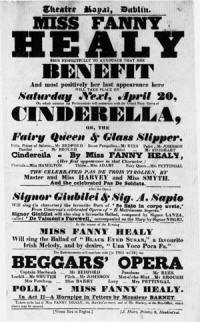 Playbill from April 20, 1833. |
donna, "Miss F. Healy not having accomplished quite what was expected of her". Perhaps this was the reason why she seems to become a pupil of the singer Henry Phillips towards the end of 1834. Despite any shortcomings, she took the lead in the premiere of Thomson's short lived Hermann in October 1834. Early in 1835 she sang at the theatre in Bath and oratorio in Bristol before returning to London and the premiere of Balfe's The Siege of Rochelle at Drury Lane in October 1835, shortly after her marriage to George Grosvenor, a Bank of England Clerk. She took part in a number of further premieres including Balfe's The Maid of Artois (1836) and Diadeste (1838) and of Barnett's Fair Rosamund (1837), although never as the lead. She did take the lead in a revival of The Mountain Sylph in November 1836 at the English Opera House but it does not seem to have been a success, "neither the voice, grace, or alertness" for the part [3]. On an 1837 revival, she "looked the part of Jessie [the secondary female role] very well, but her power of voice is hardly adequate to the music of that part" [4]. She joined Drury Lane for the 1837-1838 season. However, it is clear that she had not fulfilled her early promise and essentially Healy did not reappear again on the London stage after Diadeste and a small part later in the run of Benedict's The Gipsy's Warning, both in May 1838. She had already had one child in 1837 and went on to have at least eight and possibly twelve more.
Unless she was the Miss F Healey who appeared at the Marylebone theatre in 1849, nothing more was heard of her for around 15 years until, as Mrs F. Grosvenor [5], she resurfaced in September 1853 in a lecture tour of the West Country when she was described as "of London, said to be one of the First Vocalists of the day" [6]. Later in the month, she lectured on "The Italian School of Music as compared with the Melodies of the United Kingdom with Illustrations" at the Southwark Literary Institute, the lecture "sufficiently slight - little more than a thread on which she strung her vocal pearls" [7]. It is not clear why she resumed her career, as she still seems to have been living with her husband and thus not obviously having to have an income out of necessity at his demise or estrangement but possibly there was a problem there. The lecture/concert format was seen as more respectable than the stage or concert platform plus her voice was probably not what it had been, particularly given the comments earlier about its failing power. She seems to have accompanied herself on the piano when necessary. She mainly offered two programmes:- "Rare Old Songs and Ballads" and "Irish Melodies and Scotch songs". However, at Royston in 1855, she gave what sounds an altogether more serious lecture on "The Moral Influence of Music over the Human Mind".
She pursued quite an arduous schedule, much of it in the depths of winter and while giving birth in 1854 and 1857. Places visited included Birmingham in 1853, London, Bristol, Yarmouth, Royston and Chelmsford in 1854 [8], Wisbech [9], Leicester (as a substitute for a Henry Phillips lecture [10]), Brighton [11] and Royston again in 1855, Exeter, Oxford, Clare and Cambridge in 1856 and Barnsley and Ipswich in 1857. The Cornish Telegraph (Dec. 7, 1853) wrote of her Penzance engagement that "with all deference to Mr. H. Phillips she is not 'the greatest vocalist of the day'", which would imply that her former colleague and possibly teacher, the singer Henry Phillips, was, at the very least, providing introductions to potential organisations and possibly had helped her to hone her programme. In mid 1857, she joined forced with Phillips for the next three years in a joint lecture/concert tour and in a brief revival of an old operetta, Auld Robin Grey, at the Surrey in 1858. There is no trace of her after May 1860 and she died in October 1862..
Kurt Gänzl has a detailed description of her life entitled, Fanny Healy: the Shoreditch songstress
[1] The Morning Post (Feb. 23., 1833)
[2] The New Theatrical Observer (Apr. 22, 1833) described the powerful impression of her last evening at the Theatre Royal in Dublin. The Dublin Observer (Apr. 20, 1833) was of the opposite view, "Miss Healy's attainments are not sufficiently conspicuous to impart any attraction to [works that people were already familiar with]".
[3] New Monthly Belle Assemblée (Dec. 1836), p. 326
[4] Charles Rice, The London Theatre in the Eighteen-Thirties (London: Society for Theatre Research, 1850), p.16. Rice was an attendant at the British Museum and an avid theatre goer, who wrote about what he saw.
[5] Edward Fitzball. Thirty-five Years of a Dramatic Author's Life, Volume 2 (London: T.C. Newby, 1859), p. 360. Sometimes titled Mrs. F.E. Grosvenor.
[6] Western Courier (Sep. 7, 1853) in an advert for her lecture at the Plymouth Mechanics Institute on September 7 and 9. She had already appeared in Exeter on September 5, 1853.
[7] Daily News (Sep. 29, 1953)
[8] Essex Standard (Apr.7, 1854). An article in the same paper noted that a lecturer costing £7 3s was too high for their means. At Royston in 1855, she and another speaker donated £7 6s to the building fund (Cambridge Chronicle, Jan 13, 1856), which, assuming they were paid expenses, seems to suggest a fee in the area of £4-£5.
[9] Cambridge Independent Press (Jan. 6, 1855) - "an agreeable evening's entertainment may be confidently anticipated". She was hired for two evenings and on the first of them was not properly introduced but just left to get on with it, which she seems to have done successfully (Cambridge Independent Press (Jan. 6, 1855) .
[10] Leicestershire Mercury (Jan. 13, 1855) . This was only around a week later than the Wisbech engagement. The article talked of her being "a rising star in the musical world, besides being a lecturer of no mean abilities".
[11] Sussex Advertiser (Dec.11, 1855). She was said to have sung with great taste and ability.
 |
 |
 |
  |
|
|