  |
 |

|
  The Gipsy's Warningsometimes titled The Gypsy's WarningMusic by Julius BenedictLibretto by George Linley & Richard Brinsley Peake
Theatre Royal, Drury Lane, London
|

|
Cardinal Orsini The Burgomeister of Steinbach Wilhelm (his adopted son) Wagner (Steward to the Burgomeister) Ludovico (surnamed Lo Scellerato) Gasparo (a Bravo)
Micheletto (Retainers of
Ludovico)
First Student Marie (Daughter of the Burgomeister) Dina (a Gipsy) Bertha (Attendant on Marie) |
- Mr Baker |
History
Julius Benedict had the most impressive pedigree of any English Romantic opera composer having studied with Hummel and Weber and having met Beethoven. He conducted first in Vienna and then in Naples, where he composed two operas. On Malibran's advice, he came to London in 1835 and remained there for the rest of his life. In 1838, he took over as conductor at Drury Lane and took the opportunity to write and perform his first English opera, The Gipsy's Warning, with creditable success. The opera was performed almost daily for the first three weeks and then less often until the end of the 1838 season. It was revived again in early 1839 and, on January 24, Queen Victoria came to see it, although she appeared to be more interested in another show, that of Van Amburgh's lions (both the opera's and the lions' final appearance was on March 21 - see playbill below). Alfred Bunn [1] stated that it was given 23 performances but it is not clear what years were covered. The opera was planned to be given in both France and Germany in the early 1840s [2]. On April 20, 1841, it was given at the Park Theatre in New York but was badly rehearsed, widely hissed and did not survive beyond its second performance [3]. Numbers from the opera were occasionally being given in concerts until the close of the century.
The Times (May 11, 1838) listed Anne Seguin in place of Emma Romer and Fanny Healy for Harriet Cawse. This was probably because Romer was scheduled to sing in the premiere of Balfe's Diadeste on May 17, 1838, at Drury Lane, although Cawse does not seem to have been involved. By June 11, they were both back singing in The Gipsy's Warning.
Although the opera was comparatively successful, Drury Lane was not doing well and the Theatrical Observer (Apr. 30, 1838) reported that the singers had only received two thirds their salaries over the previous two weeks.
[1] Alfred Bunn, The Stage: both before and behind the curtain. Vol. 3 (London: Richard Bentley, 1840), p. 244.
[2] German versions of the libretto and vocal score can be found in the Scores and Librettos section. The Morning Post (Feb. 23, 1841) reported a successful production in Wiesbaden. There is no trace of a French performance although Benedict was said to have gone to Paris to work on a French translation ( http://www.hberlioz.com/London/BLfriends.htm [accessed Dec. 20, 2021])
[3] Vera Brodsky Lawrence, Strong on Music, Vol. 1. (New York: Oxford University Press, 1988), p. 134.
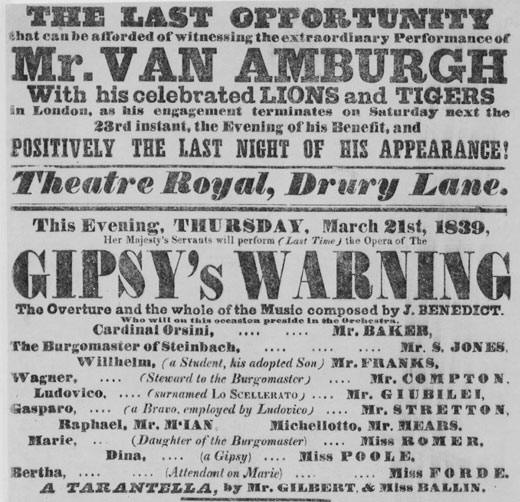
British Library Playbills
Plot
The plot is rather a muddle with inconsistencies and loose ends. The Observer (Apr. 23, 1838) wrote:
The plot of the piece is so involved, and the incidents so numerous and complicated, that we find it impossible, in any reasonable compass, to give an intelligible account.
Below is an attempt at a short summary:
Some 20 years previously in the town of Steinbach in Germany, Duke Aldobrand (sometimes Aldobrando) had been murdered by Ludovico, who then forced the widowed Duchess into marriage and seemingly took over the Duke's lands (although this is all rather vague). The Duke's abandoned son, Wilhelm, had been adopted by the Burgomaster of Steinbach (it is unclear whether he was known to be the Duke's son). On reaching maturity he has become engaged to the Burgomaster's daughter, Marie (the question of an adopted son marrying his sister does not seem to have been a problem). The Duchess, on her deathbed, had confessed all to Cardinal Orsini in Rome. Ludovico, on learning this, had come to Steinbach with the aim of getting Wilhelm to come back to Italy and take up his ducal responsibilities (quite why is again rather vague) and then to kill him. Wilhelm, on the promise that Ludovico will show him his father's murderer, leaves Steinbach for Rome just on the point of getting betrothed. In parallel with all this, Ludovico is planning an uprising against the government in Rome, partly to enable him to hold onto the ducal lands he's hoping to usurp.
The Gipsy, Dina, whose mother had helped Ludovico with his crimes, is trying to make amends. Marie, Dina and Wagner, the Burgomaster's steward, set off for Rome to find Wilhelm. A letter, dropped by Ludovico, outlining the plans for the rebellion is found by Bertha, Marie's maid, and she and the Burgomaster set off for Rome to apprise the Cardinal of the plot. Wagner is hoping to marry the much younger Bertha and the pair provide a comic subplot. Wagner also has a son, Gasparro, by a previous relationship. Gasparro is Ludovico's deputy. He is sent to kill Wilhelm but finds instead Wagner, who has been substituted, and the shock of almost stabbing his father puts him back on the straight and narrow. Through the wiles of Dina and the Cardinal's awareness of the planned uprising, Ludovico's various machinations come to naught and he is killed after donning a poisonous mask given to him by Dina. The subplots are left hanging in the air but Wilhelm and Marie are finally married by Cardinal Orsini.
For some reason, just before the end there is an extended dance and mime act completely at odds with the rest of the drama involving Pulcinello (presumably the commedia dell'arte character, Pulcinella), Harlequin and Columbine. Its central theme was the rejection by Harlequin of Columbine trying to pass off her black son as his. This seems more in the way of a ponderous joke than having racist intentions but one has to wonder, given its elaboration, if it could be taken as referring to some current dispute or controversy and whether a black child played the part.
Reception
As has been pointed out, the libretto was poor even by English opera standards. The Observer (Apr. 22, 1838) claimed that story was invented by Benedict. Benedict had only been about three years in England and one has to wonder whether his English was sufficient to appreciate whether his ideas had been satisfactorily rendered in the libretto or to understand what a slapdash effort it was.
The Observer (Apr. 23, 1838) although despairing of the libretto thought Benedict's music was "of the highest order - worthy of a friend and former pupil of Weber". It contrasted his word setting and the "richness and variety of the German harmony and instrumentation" with the "insipid baldness of the present Italian school". The choruses were particularly praised and something positive said about all the soloists, the dancers, the orchestra and the scenery. However, it found the mime at the end "protracted to a wearisome length" and went on that "The piece, indeed, is altogether too long, though we are by no means desirous that any of M. Benedict's charming music should be cut out". It concluded by noting that "the success of the opera was most triumphant".
The Standard (Apr. 20, 1838) was of much the same opinion: the libretto was "utterly unintelligible to those who, previous to the performance, were not initiated into the secrets of the author". It noted that it occupied "the somewhat unreasonable space of more than three hours and a half" but "of the music ... our notice must be highly laudatory". It went on "It is extremely dramatic throughout - the instrumentation, in general, managed with great judgment; but in some few instances rather too charged for the human voice", noting that Phillips had been "almost drowned in the instrumental clangour". They also found much to praise in the singers, dancers and scenery and, in contrast to The Observer, found the mime "exceedingly laughable".
The Naval and Military Gazette (Apr. 21, 1838) thought it "unquestionably the finest work brought out on the English stage since Oberon". Again it criticised the libretto judging it being built on "the worn-out stories of decayed melodrame" but suspected that the author had "laboured against time". It talked of the frequent errors in time and tune of the orchestra in the overture and more generally thought greater familiarity by both orchestra and singers should improve the opera's execution. It might be that the opera had been rushed out onto the stage in view of Drury Lane's fading fortunes, referred to above. However, this would not seem to fit with Benedict's clearly well constructed music unless he already had the music and just adapted it to the new text.
The News (Apr.22, 1838) was altogether more cautious:
the music ... is not to be suddenly dismissed; it is respectable, in spite of the quackery about it"... The character of the airs in general is a sort of monotony that neither sings nor says, but chants the words; the melodies don't flow, but rather proceed droppingly".
It thought the libretto "not ill written" but "the dialogue not printed is sad stuff" [1] while the scenery and decorations were "truly magnificent".
The Analyst (Apr. 1838), p. 310 thought that the opera "would, in all probability, have retained a longer reign of popularity, had its plot been more interesting and less confused".
The Examiner (Apr. 29, 1838) not only agreed with The Times (Apr. 20, 1838) that the drama was incomprehensible but also found a "want of merit in the music". In a rather laboured comparison with the "great master" Rossini and his imitator Bellini, Benedict was consigned to the same distant lower level as Balfe, an interesting choice in that Benedict was usually counted as a Germanic composer in contrast to the Italianate Balfe. Emma Romer was heavily criticised for copying the "fashionable tremulous mode of singing" - presumably some form of vibrato - and of not being able to cope with the finale.
Davison in The Musical World (Apr. 26, 1838, p. 289) was a little more positive about the libretto that "if not very clear and connected in its plot, yet affording as it does many situations for musical display, and considerable scenic effect". On the whole, he was very positive about Benedict's music, "we have praised liberally, but not more so than justice demands".[2]
[1] He was obviously reading the booklet of the musical numbers' words.
[2] Thanks to Philip Carli for suggesting this reference.
Scores and librettos
The libretto is at British Library manuscripts Add MS 42946, ff. 2-29b. A transcript can be found here. There does not appear to be a printed English libretto but the words for vocal numbers can be found at Google Books. Differences from the vocal items shown in the manuscript are footnoted in the transcript. There are several minor differences. Leeds University claim to have a full score of Act 1. The Royal College of Music, London, has a full score but listed as The Gipsies' Warning (5037 a&b) [1]
Piano scores of "Oh, do not give way to this doubt and despair", "When a pretty girl", "Bless'd be the Home", "Glide on Sweet Streamlet", "Rage, thou Angry Storm", "He Comes Not Yet", "Scenes of My Youth", "From Our Rocky Tow'r on High", "Tis Pleasure Shall Crown the Day", "If Yet Thy Soul One Spark of Feeling Share", "Her Form the Past Recalling" and "Tis sad thus to fall"are available.
|
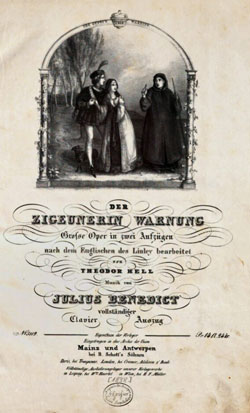
The libretto by Theodor Hell for its German version, Der Zigeunerin Warnung, can be found at the Library of Congress and at MDZ Munich, which also includes the vocal score [2]. The Bayerische Staatsbibliothek, Munich has physical copies of the libretto and complete opera vocal score as well as of individual numbers, many of which are available digitally from the MDZ Munich. These editions show a fairly literal translation with only minor changes except for the final two scenes. The business of poisonous masks was probably not thought a good idea in Germany and instead Ludivico is masked but his mask is torn off by Dina enabling Wilhelm to recognise him and stab him to death. The libretto as shown on Google, is the same edition as the Munich one above. However, it makes clear that more extensive changes were made before the performance which tie up with a different version of the vocal score from MDZ Munich. In this, Ludovico's name has been crossed out in pencil and "Ber" written next to it. This is a reference to Berengar, who, according to the vocal score, is a discontented Roman Count with Gasparo as his confidant. There is no Ludovico or Cardinal Orsini. Clearly major changes to the action were made, particularly after Act 2, scene 4, the point at which the libretto in the Google example finishes with a much marked vocal score then being attached. No dialogue was given from that point, so full reconstruction is not possible, and the list of numbers in the later German vocal score differs from both the earlier German vocal score and the English version. The German version was advertised to be given in a season of German opera at the Prince's (St James's) theatre in April 1840 |
 |
Parts for the German version of the opera's overture can be found at IMSLP
[1] Thanks to Philip Carli for the information.
[2] The Goethe University, Frankfurt, are shown as having a copy of the libretto but it is actually a translation of Balfe's The Bohemian Girl.
Recordings
There is a 1916 recording of Robert Radford singing "Rage, thou angry storm" from the opera available on Internet Archive. Four different stylii were used to realise the recording together with some other changes. Take 4 is probably the most successful [1]. No other excerpts are known.
[1] Thanks to Philip Carli for the information.
Books, Articles, Online
George Biddlecombe's, English opera from 1834 to 1864 with particular reference to the works of Michael Balfe. (New York: Garland Publishing, 1994), p. 144 has a few remarks on the influences found in the opera and some detail on one of its songs (for Ludovico).
 |
 |
 |
  |
|
|