
 |
 |

|

 The CrusadersMusic by Julius Benedict
Libretto by
|

| Conrad (King of Jerusalem) | - Mr Howell |
| Bohemond (Prince of Tarnetum) | - William Harrison |
| Raymond (Count de Toulouse) | - Conrad Borrani |
| Amaury (Count of Champagne) | - Henry Horncastle |
| Sanserre | - Mr S. Jones |
| Martel | - Mr Morgan |
| William (Archbishop of Tyre) | - Willoughby Weiss |
|
Hassan (Prince of the Assassins,
surnamed "The Man of the Mountains") |
- George Stretton |
| Ismael (a Young Fedavi, or follower of the Sect of the Assassins) |
- Donald King |
| Melech (one of the same Tribe) | - Tom Matthews |
| Officer | - Mr Burt (John Birt) |
| Horald | - Mr Henri |
Crusaders, Saracens, Fedavis or Assassins, Knights
Hospitallers of
St John of Jerusalem, Heralds, Pages, Guards,
Soldiery, Pilgrims, Populace, etc.
| Alméa (a Sumnite Girl, of the Sect of the Assassins) |
- Miss Romer |
| Iseult (Daughter of the Count de Toulouse) | - Miss Rainforth |
| Bertha (her Attendant) | - Miss Fitzjames |
Ladies of the Court, Bridal Attendants,
Sumnite Women, Alméos,
Waiting Maids, Populace of Jerusalem etc.
Conductor - Julius Benedict / Francesco Schira [1]
[1] Benedict would have conducted the first few performances and then Schira, the Drury Lane Music Director, would have taken over.
History
Alfred Bunn seemed to have a profusion of attractions at the start of 1846. Wallace's Maritana continued its popularity, Macfarren's An Adventure of Don Quixote seemed initially to promise great things but even so Bunn had begun rehearsing Benedict's The Crusaders, said to have been "long in preparation"[1]. Perhaps he was anxious to bring it forward as it promised to outstrip all earlier operas in its spectacle, something always dear to Bunn's heart [2]. The Spectator (Mar. 7, 1846) recognised this, writing that it "better satisfied the managerial wants of the house" than either Wallace or Macfarren. The plot seems to have been an invention of Jules-Henri Vernoy de St Georges, which Bunn turned into English and then added the songs. The manuscript submitted to the Examiner entitled it The Betrothed: A Tale of the Crusades but this was changed to The Crusaders for some reason.
It had a successful debut and continued to be staged for much of March and early April. However, on April 16, 1846, Anna Thillon began a month's run at Drury Lane in an English version of Auber's The Crown Diamonds and The Crusaders' appearances were reduced to some of the so-called off nights when she wasn't singing. Even so, it notched up its 50th performance on June 12 and rounded off the season on June 23. The opera also began the next season with a performance on October 3 but was only given three times in October, partly because Anna Bishop was starring in a revival of Balfe's The Maid of Artois. Thus it was reasonably successful with around 60 performances but was never revived. Benedict took a leaf out of Wallace's book in adding a violin obbligato to one of the numbers.
As with other Benedict operas, it was translated and revised for performance in Germany as Die Kreuzfahrer or Der Alte vom Berge. According to Alfred Loewenberg, Annals of Opera. (London: John Calder, 1978), p. 854, it was more popular there than in Britain and was given in 7 cities including a revival in Hamburg in 1868, around 20 years later.
[1] Daily News (Feb. 27, 1846)
[2] In particular the audience had been told to expect 500 people on the stage at one point, The Sun (Feb. 23, 1846).
Plot
De St Georges concocted the plot from episodes in the first and third crusades as well as taking a lead from Torquato Tasso's poem, Gerusalemme liberata.
The opera opens with a banquet organised by Conrad, the recently elected King of Jerusalem, who is about to be crowned. The knights get increasingly intoxicated and disorderly as Sumnite girls dance for them. The Archbishop of Tyre enters and scolds them for their excesses. Hassan, the Prince of the Assassins, also known as The Man of the Mountain, has vowed to assassinate anyone rash enough to become King of Jerusalem.
Conrad and his men consent to banish the Sumnite girls but one of them, Almea, has captured the attention of Bohemond even though he is betrothed to Iseult, daughter of the Count of Toulouse. Almea is in fact an agent of the Assassins but, in the absence of Conrad and the Archbishop, the knights decide that she can stay. Bohemond and Almea left alone swear their love. Bohemond is called away to the coronation and they agree to meet the next day. Conrad is killed by the Assassins and the Archbishop orders a ballot to decide who will
|
be the next king. The choice falls on Bohemond. Almea meets with Hassan, who has been told of her relationship with Bohemond. She says that she will try to get him to renounce his religion when they meet. Bohemond enters the forest to meet Almea but finds himself in an enchanted garden whose spell is only broken when Almea appears. Even so he is impervious to her requests. Hassan on learning of Bohemond's accession to the throne orders his execution but Almea has already organised his escape. Bohemond has arrived outside Jerusalem waiting to be joined by the Count of Toulouse in order to lay siege to the city. The Count is bringing his daughter, Isuelt, who rekindles Bohemond's love for her. Hassan and some of his men have entered his camp disguised as crusaders. They make an attempt Bohemond's life but are thwarted by Almea. In the confusion, Almea is thought to be responsible and imprisoned. The siege commences and is successful and is followed by a procession. Almea is about to be executed choosing not to explain because she has become aware of Bohemond's relationship with Isuelt. However, the actual would-be assassin confesses and Almea is freed. |
Illustrated London News (March 7, 1846) |
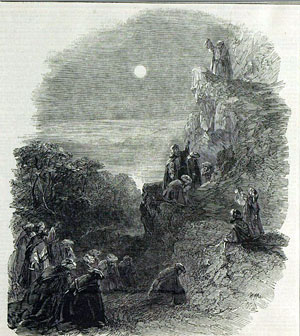
Hassan, disguised as a pilgrim, tells Isuelt of Bohemond's bad faith and she breaks off her betrothal to him. Hassan offers to give himself up to Bohemond if he promises to marry Almea seeing this as a way to seriously weaken the crusaders' cause. This is agreed but then Almea reveals that she has converted to Christianity much to the dying Hassan's rage. Almea realises how much Bohemond and Isuelt love each other and decides to enter a convent leaving them to get married.
Reception
The Examiner (Feb. 26, 1846) noted its reliance on "those favourite mysterious ladies of the modern French opera" but that Benedict's "combination of the scientific and the popular has been successful". It made little comment on the singing apart from contrasting Romer and Rainforth, "the former all passion and enthusiasm, the latter all neatness and finish" but noted that "The mise en scene is gorgeous".
The staging came in for much praise from all quarters. The Illustrated London News (Mar. 7, 1846) wrote that "As a spectacle, it will bear comparison with the greatest scenic achievements", several scenes, including Hassan on his mountain (picture) were "enthusiastically applauded". "The choral singers [displayed] an energy in their acting, unexampled in our operatic annals". It was generally positive about the music, citing both instrumental and vocal examples and that it "will gain on every hearing". However, it complained that "the voices cannot contend with the accompaniments" and that the matching of music to situation was not always correct, a Scottish tune being used in one instance. "The beauties of the opera are, nevertheless, so manifold, that criticism is quite disarmed".
Davison at The Musical World (Mar. 7, 1846) picked his way through the opera numbers highlighting pretty much all of them, the unusual finale with its duet for the two sopranos being hailed as "novel and brilliant". He even went out of his way to praise Bunn's lyrics for Harrison's ballad "Ill-gifted ring" betting that Punch magazine, who were running a campaign of ridicule against the "Poet Bunn", could not do as well. The staging, the choral training, the acting and the orchestra were all praised and the prediction made that the opera "is likely to have a long run, and will no doubt enrich the treasury".
The Morning Advertiser (Feb. 27, 1846) summed up
The music is of a high order, abounding in sweet and pleasing melodies; the vocalists were enthusiastically received; the choruses went admirably for first performance; the orchestra was nearly all that could be desired; the scenery was splendid, and dresses brilliant, and the stage effects truly magnificent
John Bull (Feb. 28, 1846) praised both staging and performance and that
of Mr Benedict's music, indeed, it is impossible to speak too highly; it is in every respect worthy of this accomplished and highly-gifted composer, and if it have elasticity enough to bear up under the leaden weight of the drama to which it is joined, it will indeed achieve a triumph almost beyond example"
While it thought Bunn's contribution in rendering the libretto into English and providing the song texts was "creditably executed", the drama itself was a "tissue of absurdities and puerilities, which set commonsense at defiance". "It is really melancholy to see the genius of a man like Mr Benedict wasted upon stuff like this".
The Era (Mar. 1, 1846) was less condemnatory: the libretto is "at times heavy in its march, is reasonably theatrical, and contains situations for the effective display of scenery, appointments and dresses". Benedict was pronounced "an honor to his instructor", Carl Maria von Weber, with "his mastery over orchestral means, and his aptitude for the expression of dramatic passion". But it identified "His great fault is the want of spontaneity, and a sort of groundless fear of producing what are foolishly called 'vulgar melodies' ". It highlighted several scenes: the transformation "from gloomy forest to enchanted garden is exquisite", "A still lake, bathed in moonlight... is a positive triumph of scenic art", the siege of Jerusalem... is a marvel of another kind". The end of the second act with the crowning of Bohemond and the victorious procession all formed "the most splendid tableau ever seen within the walls of an English theatre". Of the singers, it judged Donald King feeble in his first act number but that he "acted and sang with dramatic energy and feeling" in the second. "The style of William Harrison is so stereotyped", "the same eternal nasality, the same eternal recurrence of the closing cadence". Both women soloists were complemented.
The October revival "was received with much fervour" according to the Morning Chronicle (Oct 5, 1846), although it was none too happy about the quality of some of the singing. The Daily News (Oct 5, 1846) assessment that the opera was "thoroughly worn out" and "caused very little excitement in the audience" seems a more realistic view given its short subsequent history.
The German performance in Stuttgart was reported (The Era, Feb. 13, 1848)
a most complete success. The music reveals an original and classical style. The melodies are new and piquant, at the same time agreeable and delicate; the harmonies rich and recherché, the modulations various, and the contrast between the orient and occident is characteristically maintained throughout. The instrumentation is that of a great master...The scenery and decorations were magnificent, and nothing was neglected to ensure a triumph.
Comment
Critics
The Daily News (Feb. 27, 1846) complained of "the railway speed at which the public have been taught to expect that everything shall be done". The result was that the critic has "before he sleeps, to scribble a string of crude and hasty remarks, to be ready for breakfast next morning". This was particularly a problem when "fatigued with a long-continued effort of attention in a crowded theatre" and an opera whose qualities "require repeated hearings to be fully understood and properly appreciated". He contrasted this with the greater time available to Parisian critics whose newspaper reviews were "in general, much more solid and trustworthy than in ours". While such sentiments might account for some poor judgment in assessing the worth of an opera, as can be seen in the initial positive reactions to many English operas, some critics, e.g. Davison of The Times and Musical World, had axes to grind that coloured their reporting.
John Bull (Feb. 28, 1846) also complained that "It would be ridiculous, on a single hearing, to make detailed remarks on such music" as did The Examiner (Feb. 26, 1846), the opera being "a multifarious heap, that resists ... efforts to combine it into unity" and "present the hearer with a plain to wander over than a point to fix upon, until frequent repetition has afforded him some landmarks".
Taste
Criticism of Benedict often centred on his "scientific" musicianship, which was appreciated by the knowledgeable musician, as opposed to a reliance on melody, which appealed to the general public. In its review of the October revival, the Morning Chronicle applied this dichotomy elsewhere complaining about singers having "a silly desire to propitiate the favour of the vulgar uninitiated, instead of appealing to the judgment and taste of the cultivated listener".
Scores and librettos
|
The manuscript submitted to the Lord Chamberlain can be found at Add MS 42992, ff. 3-74b. The printed libretto, dated 1846, is available online from Goethe Universität, Frankfurt, the Library of Congress and Google books. The latter two include a list of the vocal numbers. The manuscript and printed librettos are almost identical, although the latter has, as might be expected, much more detailed stage directions. There appear to be printed scores of only five numbers in the British Library:- "On, Chieftains on", "They little know the charms", "What-e'er thy lot in life may be" from Act 1 and "I am thine, only thine" from Act 2 and "Ill-gifted ring" from Act 3. The Library of Congress has an online score for "The Heart's First Dream of Love" (Act 1). Connecticut College has an online score for "I am thine, only thine"(Act 2). Glasgow Libraries has the printed score of "I am thine, only thine" (Act 2). The score for "Whate'er my lot in life may be" (Act 1) is available for sale from the Sheet Warehouse. The German libretto of Die Kreuzfahrer can be found at Google books, MDZ, Munich and Goethe Universität, Frankfurt. There is a physical copy of performance material at the Bayerische Staatsbibliotek but it is not clear how complete it is. |
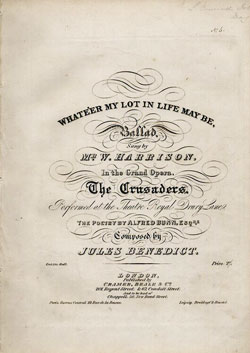 |
Recordings
There is a recording of the overture at https://www.youtube.com/watch?v=nQKcUYANDRY
Books, Articles, Online
There are no books or articles with any significant discussion of the opera. However, Marianne McLeod Gilchrist, "The Evil Genius of the Third Crusade’: Conrad of Montferrat, stereotype and scapegoat" gives some background on the events and the characters involved and mentions some of the dramatic and literary works that have used them as a starting point.
 |
 |
 |

 |
|
|