  |
 |

|
  The Siege of RochelleMusic by Michael William BalfeLibretto by Edward Fitzball
Theatre Royal, Drury Lane,
London
|

|
Marquis de Valmour Michel Montalban Count de Rosemberg
Clara Marcella Euphemia Cynthia |
1835
|
1843
|
Conductor - M.W. Balfe / Tom Cooke [1]
[1] Balfe conducted the first few performances before turning it over to Tom Cooke, the Drury Lane Director of Music, on November 4, 1835 (Morning Post, Nov. 4, 1835)
History
The opera was originally prepared for the English Opera House but for some reason Arnold did not want it. Instead, Alfred Bunn, the manager of Drury Lane, seized the opportunity and began what was a very fruitful collaboration with Balfe that lasted around a decade. Balfe was to become the mainstay of English Opera for almost the next 30 years with a succession of popular operas.
| The opera ran for 70 nights on its initial run [1] and was revived in the following three seasons. Balfe sand the role of Michel from the start of the 1836 season [2] including when Queen Victoria came to see the opera on November 15, 1837, her first state visit to a theatre of her reign. In 1836, the opera was reported as staged in Leeds, York, Sheffield, Manchester, Liverpool, Bath and Dublin with Miss Betts as Clara. John Wilson, who sang in the initial run of the opera, also sang in, at least, some of these. [Quite how much of the opera would have been staged is a moot point - possibly it would have been some abridged version that included the most popular numbers]. Madame Balfe chose the opera for her benefit in 1841 and Bunn opened his 1843 season on September 30 with it. Emma Romer used it to open her 1853 season at the Surrey Theatre, although it was being described by then as "somewhat hacknied" [3]. October, 1875 saw a revival by the Carl Rosa Company at the Princess's Theatre and it was then included in the company's repertoire that toured to Manchester in 1875, Liverpool in 1876, Birmingham in 1877 and Dublin in 1879. The Turner Company toured it in 1893. This may well have been its last performance until the Wexford Festival performances in 1963. |
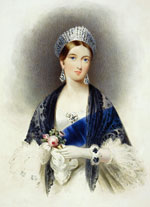
Queen Victoria's |
The overture and songs from the opera, such as "When I beheld the anchor weigh'd" continued to retain a place in the concert hall and the home into the 20th century. In 1838, the opera was performed by the Caradori Allan troupe at the Park Theatre in New York but failed although it appears to have been retained in the repertory [4]. In 1839, it was performed again in Dublin with Balfe as Michel and in Sydney in 1848.
The opera's production sparked an acrimonious argument between a correspondent in The Examiner [5] accusing Balfe of plagiarism from Luigi Ricci's 1832 opera, Chiara di Rosemberg, and, in defence, Frederick Beale, from Balfe's publishers, and Balfe. The matter is discussed in comments below.
Balfe was said to have been paid £5 a night by Bunn and 400 guineas for the score by the publishers Cramer, Beale and Co.. In 1871, the Bury and Norwich Post (April 11, 1871) reported that the copyright had sold for £156 and just over 10 years later the Aberdeen Evening Express (May 8, 1883) noted that the copyright had been sold again for "£20 odd" adding "So much for Balfe's 'popularity' ".
[1] Basil Walsh, Michael William Balfe. (Dublin: Irish Academic Press, 2008), p.192. Alfred Bunn, The Stage: both before and behind the curtain. Vol. 3 (London: Richard Bentley, 1840), p. 244 stated that it was given 73 performances but it is not clear what years were included.
[2] The Examiner (Oct. 2, 1836) claimed that it was Balfe'sdebut on the English stage.
[3] "The Drama, Music &c", Reynold's Newspaper, (May 22, 1853).
[4] Vera Brodsky Lawrence, Strong on Music, Volume 1. (New York: Oxford University Press), pp.44 & 57.
[5] Letters from Observator (The Examiner, Dec. 20 and 27, 1835). On January 31, 1836, Observator was happy to accept an arbitrator.
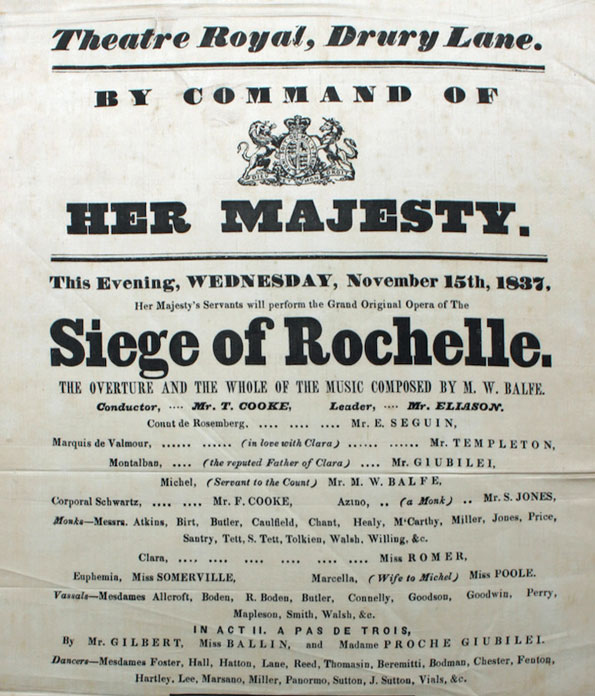
Part of the playbill advertising Queen
Victoria's visit on November 15, 1837
Michael Kemp Bookseller
Plot
The plot was based on Madame de Genlis's novel The Siege of Rochelle (1808) that had already been made into an opera libretto by Gaetano Rossi for Luigi Ricci's Chiara di Rosemberg in 1832 and led to charges of plagiarism by Balfe discussed below.
There is a rather tortuous backstory before the opera begins. The Count de Rosemberg and Princess Euphemia, the Emperor's (or Elector's) daughter, are secretly married and have a child, Clara, who is entrusted to Montalban to bring up as his own daughter. She enters the service of the Marquis de Valmour and they fall in love. He is a widower with a small son. Montalban kills the child but Clara seems him escaping. However he extracts an oath from Clara not to betray him, whom she thinks is her father [his reasons for this seem to be so that Clara cannot marry but will eventually inherit the Marquis' fortune, which he can then plunder]. Instead she is accused of the murder, and, refusing to clear herself, is sentenced to life in a convent from where she is reported as having drowned when trying to escape.
|
As the opera begins, Clara is living under the name of Olympia in the cottage of Michel, a follower of the Count, in the neighbourhood of Rochelle. The siege brings together the Marquis de Valmour, the Count de Rosemberg and Montalban. Valmour recognises Clara and believes her innocent but is unable to help because of her silence. Others including Montalban arrive and denounce her. Rosemberg has repudiated her as his daughter and Montalban now plots how to get her out of the way to ensure his secret. Clara escapes and arrives at Rosemberg's castle but is again discovered and rejected. Montalban plans to put her aboard a ship to the West Indies but his plans are thwarted by Michel and Clara escapes again and eventually ends up in Rochelle. Montalban, in the meantime, has turned traitor and betrayed the Count of Rosemberg, who is captured by the defenders of Rochelle. When Rosemberg remonstrates with him about his treachery, Montaban accuses him in turn of abandoning his daughter. On overhearing this, Clara rushes out and, after establishing that Rosemberg is her father, accuses Montalban of the murder of Valmour's son, as she is now absolved from her oath when she realises that he is not her father. Montalban orders the garrison to kill them but an attack by the French forces under Valmour prevents this. Montalban is buried when |
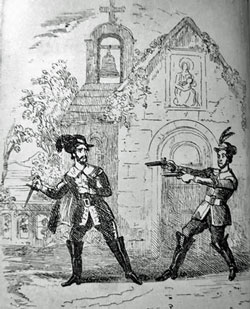
Confrontation between Michel and Montalban |
a shell hits the wall, Clara's innocence is explained to Valmour and the opera ends happily.
Reception
Although writing many years after the event, the librettist, Fitzball, captured some of the excitement of the first night [1].
It was a glorious night… - one to wish your whole life long the first night of a new play or a new opera. The cram there was, the fashion, the delicious music, the enthusiastic applause, the double encores – never had I witnessed anything like it. …The applause was so unanimous - so really applause – for, those who understand it can always tell the real approval from the clacqueur – no knocking behind slips by boxkeepers. ... So carried away were even persons of the highest consequence by the enthusiasm created by this beautiful music, (thought by many still to be Balfe’s best composition,) that people bent over, and nearly threw themselves from the side boxes, next to the orchestra, to congratulate and shake hands with the young composer. They crowned him with a wreath of flowers, and I question, amid all the numerous and brilliant successes of this great artist (Balfe) if he ever felt such a delighted heart on the first night of The Siege of Rochelle.
The Times (October 30, 1835) was enthusiastic and predicted a bright future for Balfe even though
The story of the opera is somewhat feeble, and the poetry (save the mark!) a degree below the style of the bellman’s verses; but this is not uncommon with such pieces, where everything is subordinate to the music. It has, however, been prepared with pains and taste, and acted with surprising effect.
The Observer (November 2, 1835) was in agreement:
In Mr Fitzball’s drama [the tale is] worked up with tact and stage effect. The music is, however, the best part of the opera. It is masterly and excellent on the whole and in detail". All the singers were commended and it continued that "We have scarcely ever known an opera to be so well performed on a first night at one of our English theatres
Observator writing in The Examiner (November 13, 1835), before he became obsessed with Balfe's supposed plagiarism, was generally very positive about the opera and offered no criticism about its possible derivation.
There are throughout the opera various faults in accentuation, which, until the music is published, it is impossible to particularize, but which strike harshly on a musical ear; however, there are quite sufficient good points to be found to enable me to agree with the opinion, that since Dr Arne, it is the best opera composed by an Englishman [sic] – far more original than The Mountain Sylph, and highly creditable to Mr Balfe.
Conditions in opera houses at this time can be judged from the Morning Post (Nov. 4, 1835) comments when Cooke took over conducting the opera from Balfe. It thought that "A conductor ought to be present on all occasions" rather than leaving it to the leader and that it was glad that "the use of the baton is not to be given up". It also noted that the "singing is now perfectly smooth and finished", this being the sixth performance.
However, the Sunday Times (Oct. 17, 1875) was baffled as to "Why Mr Carl Rosa should have singled out so worthless a work for revival". The article expanded on this bafflement at some length:
... we cannot affect surprise that English opera, founded on such a pernicious model, has fallen from her throne, or that a nation commencing to hold sound views respecting musical art should refuse longer to endorse the verdict of nearly half a century since. The Siege of Rochelle as a work of art is not only flimsy and trivial, it is simply and absolutely ridiculous. How on earth our forefathers could have called up sufficient spurious interest to tolerate such a farrago of nonsense during its initial run of seventy nights, we will not presume to understand; if they really could feel any sympathy with characters whose raison d'être is none of the clearest, and whose actions, one and all are outrageous, the circumstance does not redound highly to their intellectual perception.
The fact that Rosa revived it over several years would seem to show that audiences did not agree with his caustic conclusions.
[1] Edward Fitzball, Thirty Five Years of a Dramatic Author's Life, Volume 2 (London: T.C.Newby, 1859), pp.25-26.
Comments
The charge of plagiarism against Balfe, mentioned above, seems to have been settled in Balfe's favour when the score of Chiara di Rosemberg was displayed at Cramer's so that people could compare the two for themselves [1]. While Fitzball probably used Ricci's libretto as the basis for his, it does not seem to have been a straight translation, as some alleged, but similarities would have helped to feed the accusations of plagiarism, bolstered by the Italian training and approach of both composers and the fact that Balfe had sung in Chiara di Rosemberg in Italy in 1834 [2].
One of
these comparisons, which judged in
Balfe's favour, was written up in
"The Siege of Rochelle - Charge of
Plagiarism against Mr Balfe" in
The Morning Chronicle, (Jan.
27, 1836). The Musical Library
Monthly Supplement, (Feb.,
1836) also carried a long article on the
controversy. Naomi Matsumoto,
Plagiarism versus "A Pleasant
Reminiscence to our Ear" ,
available at
https://research.gold.ac.uk/id/eprint/18502/1/Matsumoto
%20Plagiarism%20Article%20.pdf, goes into the matter in detail as
well as considering accusations of
plagiarism in the development of an
identity for English Opera.
In his opening song, "Travellers of every station", Michel describes the different countries he has been to with each dismissed in a line, including his own country, France, except for a paean to England, "the garden of lovely women ... Parks, squares, streets, all gravelled with gold.. The land of the brave and the free". Fitzball, disregarding any dramatic sense, took the opportunity to whip up some patriotic enthusiasm despite it being rather incongruous and unlikely coming from a Frenchman describing his travels to other French people.
[1] "Theatres", The Musical World, (Jan. 27, 1837), pp. 94-95.
[2] Basil Walsh, Michael William Balfe. (Dublin: Irish Academic Press, 2008), pp.42 & 56.
Scores and libretto
The manuscript submitted to the Examiner can be found in the British Library, Add MS 42931 ff.408-438. The covering letter was dated September 16, 1835 and the manuscript was signed off on September 23. The Lord Chamberlain's Day Book titled it Clara or The Siege of Rochelle. No printed libretto from 1835 has been found. The earliest one is that published by John Duncombe in London, probably in 1843 to coincide with the revival as it includes the 1843 cast list. The one published by Thomas Hailes Lacy in London in 1872(?) can be found at the Hathi Trust and the Library of Congress[1]. It is a copy of the earlier Duncombe edition.
The most immediate evidence of what was actually performed originally are the printed Songs, Duets, Trios, Chorusses, etc. from the opera (W. Wright, 1835). This has several items that were not part of the manuscript including possibly the best known, Michel's "When I beheld the anchor weighed". All these vocal items are also found in the printed librettos. In addition to these differences in the vocal items, the printed librettos also have dialogue difference, particularly towards the end of the opera. However, the plot remains roughly the same. Thus, as already seen, this opera like other English operas around this time does not stick to the approved libretto. Given that signoff was over a month before the premiere there would have been plenty of time for more informal approval.
Different scans of the vocal score, edited by J. Pittman (London: Boosey & Co, 189-), are available at http://imslp.org/wiki/ and http://archive.org/details/siegeofrochelleo00balf. The Carl Rosa Archive have hand copied orchestral parts.
Various publications, e.g. The Musical World (January 27, 1837) p.95, claimed that it was an almost literal translation of Ricci's Chiari di Rosenberg, which can be found at Google Books. Comparison shows that the relationship was quite loose, certainly not a near literal translation.
[1] Advertisement on p. 39 has an 1871 date. The Library of Congress libretto has pages 37 and 38 missing
Recordings
Michael W. Balfe, The Siege of Rochelle. John Lewis Partnership Music Society, Derek Carden. Balfe Archive,1987. LP/CD. Available on youtube.com: part1 and part2. An amateur performance with orchestra.
Michael W. Balfe, The Siege of Rochelle. Recording from the 1963 Wexford Festival. Available on youtube.com: part1 and part2. It is only with piano accompaniment.
Two individual numbers have been recorded:-
"'Twas in that Garden Beautiful", Deborah Riedel, Australian Opera and Ballet Orchestra, Richard Bonynge, Melba 301082, CD (2000)
"When I Beheld the Anchor Weigh'd", Campbell Russell, John Talbot, British Music Society BMS 422, CD (1998)
Books, Articles, Online
William Tyldesley, Michael William Balfe: his life and his English operas, (Aldershot, UK: Ashgate Publishing, 2003), pp.44-60, carries an extensive description and analysis of the opera. There are also sections giving more background to the opera in the books on Balfe by Walsh, Kenney and Barrett (see book list).
George Biddlecombe, English opera from 1834 to 1864 with particular reference to the works of Michael Balfe. (New York: Garland Publishing, 1994), pp. 103-106, has a section on this opera.
Articles on the plagiarism controversy are mentioned in the Comments section above.
 |
 |
 |
  |
|
|