  |
 |

|
  The Maid of ArtoisMusic by Michael William BalfeLibretto by Alfred Bunn
Theatre Royal, Drury Lane, London
|
|
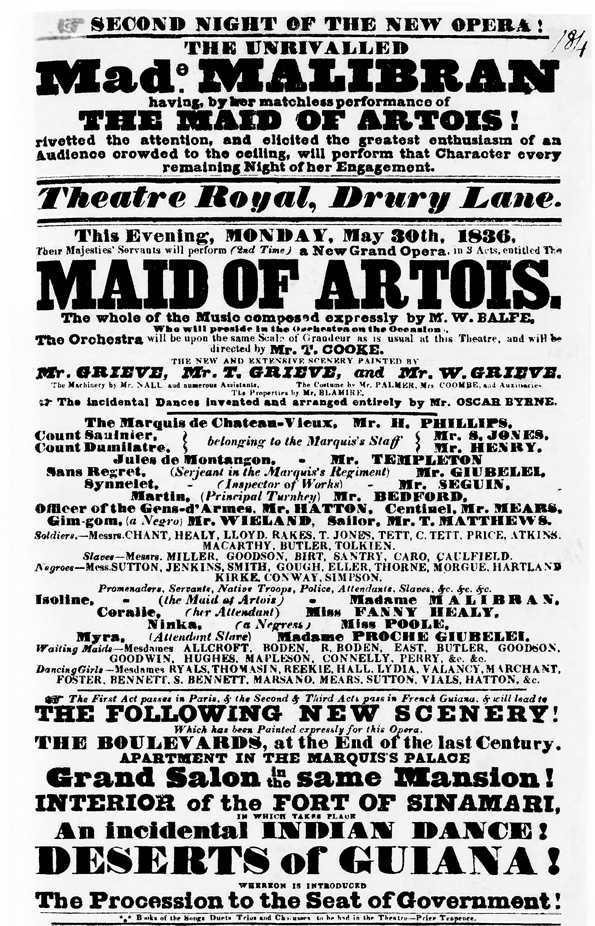
Jules de Montangon The Marquis Synnelet Sans Regret Martin Count Saulnier Count Dumilatre Centinel Officer Sailor
Isoline Coralie Ninka Myra |
1836 original - Mr Henry - Mr Mears
|
1846 revival -? - Mr Hodges *
|
Conductor (1836) -
Michael
William Balfe
Conductor (1846) -
Francesco Schira
* Although it was denied, it seems most likely that this was Coplestone Coward Hodge(s)
History
The Maid of Artois' libretto was written by Alfred Bunn. Bunn had written a few plays up to this point but his main preoccupation was theatre management and at this time he was managing both Drury Lane and Covent Garden. It was his first opera libretto. Balfe had much faith in Bunn as a stage lyricist, but analysis of his books shows that he was not particularly gifted: he often provided lyrics of unbalanced syllabic length, which would clearly have hampered Balfe's composition. The opera opened at the Theatre Royal, Drury Lane on May 27, 1836 to considerable public and critical acclaim. Arias were encored as was the overture. The Morning Post (July 18, 1836) reckoned that revenues totalled over £60,000, although outgoings were heavy including £125 a night for Malibran, if Bunn is to be believed [1]. Bunn [2] claimed that it was given 20 times but it is not clear what years were included.
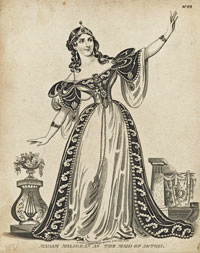
Much of the opera's initial attraction resulted from the engagement of Maria Malibran, who enjoyed an enthusiastic following all over Europe ensuring box office success wherever she appeared. Malibran had been a friend of Balfe since their appearance together at the Paris Opera and he wrote The Maid of Artois partly as a vehicle for her, shortly before her untimely death, aged only 27, in Manchester following a riding accident. It is reported that Malibran's singing compass was remarkably wide and judging from the characters she played she would have been classed as an alto with soprano reach as she managed three octaves. Where alternative phrases of coloratura are shown in the score it is likely she sung the lower version. She had died before the score was printed, and so Balfe decided to set brighter higher versions of coloratura without fear of upsetting her. This would allow the music to be more in keeping with the youthful character of Isoline. He also seems to have adapted it for Anna Bishop in 1846 [3]. The opera was revived at Drury Lane on April 10, 1837 with Emma Romer as Isoline and again with Romer on January 29, 1839 when Queen Victoria came for at least the second time [4]. It was performed |
 Harvard Theatre Collection |
in several places for around the next ten years with its last London performance with Anna Bishop on October 8, 1846 at Drury Lane. Her company then took it on a provincial tour, including Edinburgh, Dublin, Birmingham and Liverpool in early 1847. The opera was given in New York and Philadelphia in 1844 and again in late 1847 by Anna Bishop's company. The last known performance that has been found is in Hull in 1849 for Miss Rainsforth's benefit (Hull Packet, June 8, 1849) although Bunn chose the last act for his benefit on July 14, 1856. Pauline Viardot sang it, a poignant reminder that it was her sister who premiered it (Morning Post, July 11, 1856). The overture and the ballad "The light of other days" continued to be performed well into the 20th century.
The Musical Library Monthly Supplement. No. 28 (July, 1836 ), p.108 claimed that Balfe was paid £800 for the copyright while The Standard (June 6, 1836) reckoned that Cramer, Addison and Beale paid 1000 guineas for words and music. In 1871, the Bury and Norwich Post (April 11, 1871) reported that the copyright had sold for £171 10s and just over 10 years later the Aberdeen Evening Express (May 8, 1883) noted that the copyright had been sold again for "£16 odd" adding "So much for Balfe's 'popularity' ".
[1] Alfred Bunn, The Stage: both before and behind the curtain. Vol 2, (London: Richard Bentley, 1840), p. 38.
[2] Bunn, Op.Cit. Vol 3, p. 244
[3] Morning Chronicle (Oct. 8, 1846), Lloyd's Weekly Newspaper (Oct 11, 1846) also wrote that new songs had been introduced
[4] It is not clear whether her main aim was to see Van Amberg's lions. She had first come to see the opera as Princess Victoria on June 17, 1836, according to The Standard (June 18, 1836).
Plot
|
The story is principally a 'Manon Lescaut' plot set in the time of Louis XV in which a girl in love is seduced by a rich Marquis. Events unfold leading to the lovers ending their days in the wastes of the desert, although, in this version, an unexpected rescue comes. In Act 1, Jules is searching for his lost love, Isoline, whom the Marquis has installed in his apartments, but he is tricked by Sergeant Sans Regret into enlisting. Sans Regret tells the Marquis about this new recruit and his connection to Isoline. The Marquis shows Jules' enlistment paper to Isoline so that she knows that Jules is in his power. Jules escapes and finds Isoline but is captured, although not before wounding the Marquis. He is sent off to prison in French Guiana. |
|
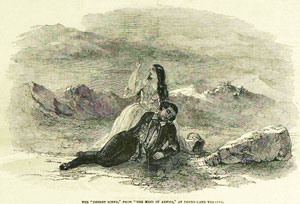
The Desert scene |
In Act 2, the scene switches to the prison, where a new governor, the Marquis, is expected. Some sailors disembark, with them Isoline enters disguised as a man. She recognises Jules and the two meet and plan their escape helped by the slave, Ninka. They escape, imprisoning the supervisor, Synnelet, who has attempted to seize Isoline, in Jules' place. In Act 3, they are in the desert, Isoline tends the wounded Jules. Resigned to die of thirst they hear the distant sounds of a band and a procession of the Marquis and his retinue appears on the horizon. The couple are rescued and pardoned by the Marquis after Ninka's testimony about Synnelet and the opera ends happily with Isoline singing of her rapture. |
Reception
The Examiner (June 5, 1836) took a very dim view of the opera judging it worse than The Siege of Rochelle and purely a vehicle for Malibran and not a very original one either. Malibran was damned with faint praise for showing "her usual excess of energy" while the rest of the cast, except for Phillips, got fairly short shrift. However, The Times (May 28, 1836) was of the contrary opinion declaring that "it is, upon the whole, the most successful and the most deserving production of the season". The Morning Post (May 28, 2016) saw it as "an unequivocal success of a native composer" even if it took some qualities on trust by noting "the natural timidity of the performers and the undisciplined state of the orchestra" on the opening night before they had gained full confidence. It thought "the first act especially tedious and the pruning knife must be unsparingly used" and was unenthusiastic in general about the text but pronounced the music an improvement upon The Siege of Rochelle. The Standard (June 16, 1836) was more concerned with the details of the visit to the theatre by Queen Adelaide than an appraisal of the opera but did talk of Malibran's "magnificent display of vocalisation". A shorter appraisal dated May 31, 1836, had confined itself to praising Malibran
The Morning Chronicle (June 30, 1836) reviewed the opera again a few weeks later and seemed to be settled in its opinion that it was "a work of great but unequal merit" and hoped for better things from Balfe in the future including "more care, more simplicity, more dramatic propriety, and a style more decidedly original" as well as greater fastidiousness in the choice of text.
Charles Rice made some insightful remarks about how the opera differed from what had gone before [1].
The character of Isoline appears to me to be the most difficult in the whole range of English opera; the exceedingly dramatic situations in which she is placed, and the requisition of vocal display throughout their performance, exhibit at once the power of voice which its representative must necessarily possess. Isoline is not one of those sentimental heroines who form the leading features in the ballad operas of Dibdin and Pocock, but a village maiden who, instead of strutting to and fro to be woo'd and won by some methodistical swain, is thrust into a variety of action the proper development of which requires histrionic ability of more than minor pretensions.
[1] Charles Rice, The London Theatre in the Eighteen-Thirties (London: Society for Theatre Research, 1850), p. 39. Rice was an attendant at the British Museum and an avid theatre goer, who wrote up a journal about his visits. He was commenting on a revival on the opera in April 1837 with Mrs Wood singing Isoline.
Comment
Three of Balfe's operas include black characters: The Maid of Artois (1836), Diadesté (1838) and The Bondman (1846). Each of them showed a quite different picture of attitudes to black characters. Michael William Balfe, an unwitting cultural bellwether examines these differences in more detail.
What finale did Malibran sing?
Tyldesley raises the question as to whether Malibran sang the published finale or reverted to a Manon Lescaut -type finale, i.e. dying rather than rescue [1]. Certainly the opening night reviews support that she sang the published, rescue, version.
[1] William Tyldesley, Michael William Balfe: his life and his English operas, (Aldershot, UK: Ashgate Publishing, 2003), pp. 62-64,
Scores and libretto
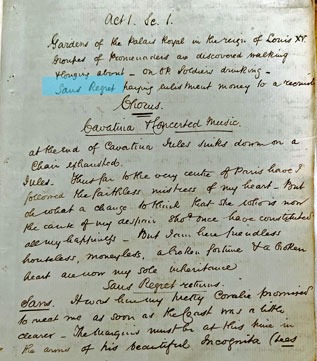
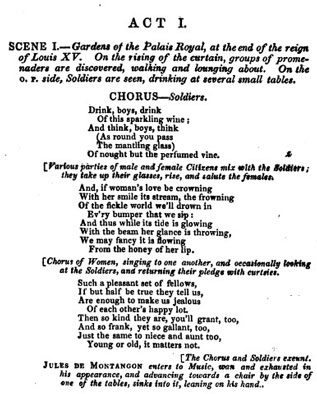
The manuscript of the libretto sent to the Examiner is split between Add MS 42936 ff.627-643 for the dialogue and Add MS 42939 ff.880-893b, for the vocal items. The former was signed off on May 27, 1836, the day of the premiere and probably that included the latter. The latter was a printed text from W. Wright, which formed the basis of the published vocal items (London: W. Wright, 1836) that is available at Google Books. Essentially some items were omitted from the published version, presumably because of timing problems.
The libretto of the 1846 revival published in London by W.S. Johnson (London: 1846) is available at Google Books, Library of Congress and Hathi Trust. Although the plot is largely unchanged there are quite a few differences between the manuscript and its associated vocal items and the 1846 printed libretto. For example, in the manuscript, Sans Regret is there at the outset and has a cavatina, which was included in the 1836 printed vocal items, but is missing from the 1846 libretto. In the latter, Sans Regret does not appear until the second page, sans cavatina. The manuscript has a scene for Sans Regret and Coralie towards the end of Act 2 that is not included in the printed libretto. On the other hand Coralie is part of a trio in Act 1, Scene1, in the printed libretto whereas she does not sing at all in the original manuscript and thus the trio may well not have been signed off..
 |
 |
The British Library has a vocal score dated 1837 as does Liverpool City Council. The vocal score and the 1836 vocal items do not always agree. The Carl Rosa Archive have hand copied orchestral parts. The libretto and vocal score (based on the 1846 materials), edited by Valerie Langfield, are available for hire from Retrospect Opera. This was used in the recording made by Victorian Opera Northwest .
Recordings
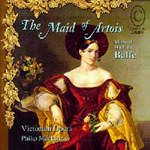
The opera has been recorded by Victorian Opera Northwest and released on Campion Cameo 2042-3. Details and extracts can be found at http://www.victorianoperanorthwest.org/Recordings/MaidofArtoisrecording.htm.
Five numbers have been recorded separately:
Cecila Bartoli can be seen singing "Yon moon o'er
the mountains" at
https://www.dailymotion.com/video/
x7w1p5a
"The Rapture Dwelling in my Heart" and "Yon Moon o'er the Mountain", Deborah Riedel, Australian Opera and Ballet Orchestra, Richard Bonynge, Melba 301082, CD (2000)
"The Heart that Fondly Teems", "The Light of other Days", Kay Jordan, Peter Dempsey, Guy Rowland, Victorian Opera NW, WRW 204-2, CD (2008).
Books, Articles, Online
William Tyldesley, Michael William Balfe: his life and his English operas, (Aldershot, UK: Ashgate Publishing, 2003), pp. 61-69, includes a description and analysis of the opera. There are also sections giving more background to the opera in the books on Balfe by Walsh, Kenney and Barrett (see book list).
Benjamin Walton's paper, "Malibran's Favourite Aria, Balfe 'With Rapture Dwelling (Isoline)', The Maid of Artois, Act III", Cambridge Opera Journal, July 2016, pp. 161-165.
William Spark, Musical reminiscences : past and present. (London: Simpkin, Marshall, Hamilton, Kent & Co., 1892), pp.16-23, has his memories of it, although most of it taken up by quoting the Times review and retelling the tale of Malibran demanding a glass of porter before starting the final scene.
Victorian Opera Northwest has pages on the opera and its recording
 |
 |
 |
  |
|
|