  |
 |

|
  The CovenantersMusic by Edward J. LoderLibretto by Thomas John Dibdin
English Opera House,
London
|
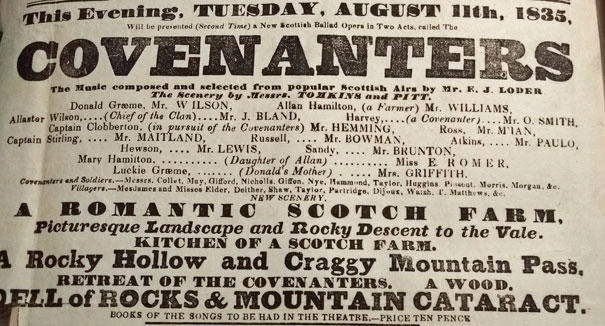
Donald Graeme Allan Hamilton Allaster Wilson Sampson Harvey Captain Clobberton Ross Captain Stirling Atkins Sandy Hewson
Mary Hamilton Luckie Graeme |
|
History
After a period of some uncertainty ahead of the new season during which it was rumoured that Arnold was trying to give up the lease on the theatre. According to The Spectator (Aug. 15, 1835, p.777) he actually did so leaving the performers out of work and so deciding to open the house on their own account. They hastily staged this piece loosely adapted from part of Sir Walter Scott's Old Mortality (Volume 2 of Tales of my Landlord) by Thomas Dibdin. Edward Loder took much of the music from, predominantly, Scottish ballads, 10 of the 17 numbers having ballad titles attached, according to the Duncombe (1835?) edition of the libretto. It is not clear to what extent music for the other 7 numbers was Loder's own and thus it must be seen as marginal as whether to list it as a genuine English opera. The libretto reckoned that it only lasted 65 minutes, which would make it more of a subsidiary than a main piece. The work continued to be given until October 6, 1835, the day before the end of the season. Charles and Elizabeth Martyn [1] gave the opera as part of their benefit night on March 11, 1837, perhaps hoping that it would attract given that Bath was Loder's home town. It was revived for a few performances at the English Opera House in August 1837 but does not seem to have been given since.
The manuscript of the libretto submitted to the Examiner had originally entitled the piece, The Trooper or The Lowther Mountains.
[1] formerly Elizabeth Inverarity, a noted singer from the earlier 1830s.
Plot
According to the Morning Post (August 11, 1834) the plot ran:-
Allan Hamilton, whose daughter, Mary, is betrothed to Donald Graeme, a young soldier, has sheltered a mad Covenanter, Harvey. This subjects him to a domiciliary visit of Captain Clobberton, whose dishonourable intentions against the old man’s daughter having been discovered had excited his hatred and desire for revenge. Harvey, though discovered in the guise of a pedlar, manages to escape; but from certain inferences on the part of Donald, between the Gallant Captain, one of whose soldiers he is, and Mary, and for other reasons, he is made prisoner. He is desired to shoot at his intended father-in-law, who has been blindfolded, and, on the word being given to “kill the villain,” Donald, acting upon the order of his Officer, shoots through the heart or the head - it matters not which - the Captain, whom, in his opinion, he considers the only villain of the company. The clan to which he belongs having been informed of his being made prisoner hasten to his rescue, and an officer of William the Third making his appearance with a flag of truce the usual union of the lovers take place. |
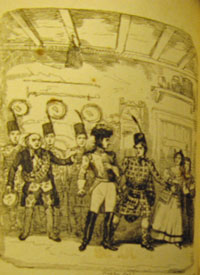 From the Duncombe edition |

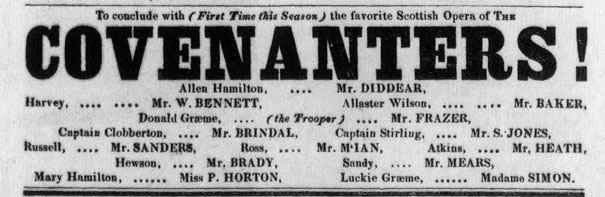
Playbill for its revival on August 10, 1837
British Library Playbills
Reception
The hurried creation of the opera was further hampered by the leading lady, Emma Romer, pulling out on the day and Priscilla Horton, who took her place, having to read the part as she went along. Thus the Morning Post (August 11, 1835) mentioned the prompter, "whose zeal cannot be too highly praised". It also praised Horton for how she carried off her part at such short notice. It thought that
if some of the situations had been what is called acted up to, it is easy to conjecture that they would have produced much greater effect upon the audience, prone as they were last night to be over-indulgent and merciful. The music requires but little notice; it is an adaptation of several well-known Scotch airs, and one or two of English origin, to new words, by Mr Loder, whose greatest labour in connection with the opera seemed to be to wave a large baton in front of the orchestra
The Observer (Aug. 17, 1835) was at least able to say that "the scenery is very good" but otherwise had little to commend it except to note that the "performers exerted themselves with great success" and that the opera "was not likely to obtain a perennial existence but will no doubt last for a season".
The Morning Chronicle (August 11, 1835) commented that:-
instead of being a regular opera, it was a sort of drama, or rather melodrama, containing a collection of Scotch ballads. ... The piece was well received, but is too slight a character to have a long run, It is an agreeable trifle, and as such is worth seeing, but it has no claim to the title of opera.
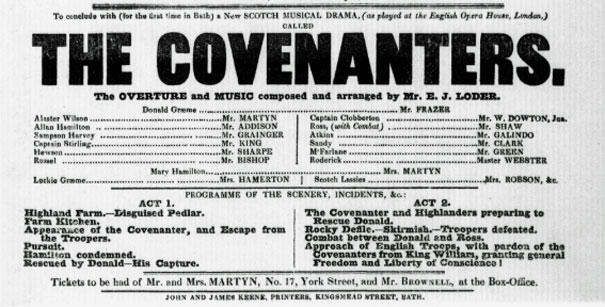
Part of the playbill for the Martyn's
benefit night at the Theatre Royal,
Bath, on March 11, 1837.
British
Library Playbills
Scores and librettos
The manuscript submitted to the Examiner is available in the British Library, Add MS 42930, ff.303-335b. The covering letter was dated June 27, 1835 and it was signed off on July 3, 1835. The printed libretto (London: J. Duncombe & Co. edition, 1835?) is held in the British Library at General Reference Collection 2304.a.9. A transcription is available here. There are also scans at the Library of Congress and Google Books. The printed and manuscript librettos are very similar. In one song they disagree as to what Scots ballad tune to use while the printed libretto includes an additional song for Donald in Act 1 (p. 6/7). There is a concerted piece for Harvey, Donald, Ross and Chorus in Act 2 that is omitted from the printed libretto, which also has a shorter and simpler finale.
No copies of the score of the opera or any numbers have been found.
Recordings
There are no known recordings of the opera or of parts of it.
Books, Articles, Online
No articles, books or websites on the opera are known.
 |
 |
 |
  |
|
|