|
A CD of Victorian English Opera
overtures has been released on
SOMM CD 0123 : British Opera
Overtures, perhaps slightly
unfortunately titled as two of the
English Opera House, August 10, 1835 are Irish, but providing a
valuable recording of works many of
which have not been heard in modern
times. Below is a short description
of its content. The overtures are
played by the orchestra of
Victorian Opera Northwest
conducted by Richard Bonynge.
The Mountain Sylph (John Barnett, 1834)
The opera premiered at the
English Opera House (Royal Lyceum
Theatre), on August 25th, 1834
achieving such success that in 1863,
George Alexander Macfarren was
to write that it "opened a new
period for music in this country,
from which is to be dated the
establishment of an English dramatic
school"[1].The Mountain Sylph
was followed by Fair Rosamond and
Farinelli, neither
of which managed anything like the
same success. In 1841, Barnett moved
to Cheltenham where he became a
successful singing teacher.
The Siege of Rochelle (Michael
William Balfe, 1835)
The Siege of Rochelle was Michael
William Balfe's first English opera
and his first major success as a
composer. The libretto was by Edward Fitzball based on the novel
Le Siège
de La Rochelle by Madame de Genlis,
which had already been used by Luigi
Ricci as the basis for his
opera Chiara di Rosembergh. The
opera opened at Drury Lane on
October 29th, 1835 to great acclaim.
For political reasons, Count
Rosemberg had placed his baby
daughter, Clara, with Montalban,
whom she believes is her father.
Clara is due to be betrothed to a
widower, Count Valmour, and
Montalban with an eye to Clara's
future prospects murders Valmour's
infant son. Although Clara sees him
do it, she does not want to betray
the man she thinks is her father and
instead is convicted of the crime
and imprisoned. She eventually
escapes to St. Rochelle where events
come to a climax with Montalban
denounced, Rosemberg admitting to
being her father and Clara and
Valmour united.
Balfe went on to a highly
successful career as an opera
composer, following The Siege of
Rochelle with The
Maid of Artois (for Malibran)
and, a few years later, the most
popular English opera of the 19th
century,
The Bohemian Girl
.
Le Puits d'Amour (Michael
William Balfe, 1843)
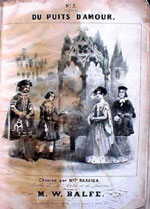
Title sheet of
Mlle. Darcier's
song from the opera.
With thanks to Basil Walsh
www.britishandirishworld.com
|
Although
Balfe's composing career centred
on English opera, he continued,
on occasion, to write for the French
theatre particularly when English
opera was in one of its periodic doldrums. In
1843, he had the opportunity to
write Le Puits d'Amour to
a libretto by the doyen of French
librettists of the time, Eugène
Scribe, and Adolphe de Leuven. The
opera opened in Paris on April 20th
at the Opéra Comique in Paris with
great success. The opera used some
of the music initially earmarked for
The Bohemian Girl, which
had then to be replaced when that
opera was given later in 1843.
The
plot concerns Edward III and one of his companions,
Salisbury, who, under a false name, has
been courting a young woman called Geraldine.
She has given him a ring as a token. Edward
is determined to marry Salisbury off to someone
else and so Salisbury returns Geraldine's ring. In despair
Geraldine throws herself down what is known
as the Love Well but which, in fact, leads to
an underground room where Edward and his boon
companions are feasting. After a number
of diversions during the during the course of which Edward
gets arrested as an imposter, everything is
straightened out and Salisbury gets permission
to marry Geraldine.
|
An English version of Le Puits d'Amour
entitled Geraldine, or The Lover's
Well was given at the
Princess's Theatre on August 14th, 1843,with
some success, although it was never revived.
Balfe's
success both with this opera and his English
operas shows that his style was essentially an international
one, although his talent for the ballad played
particularly well in English opera, both in
the theatre and in supplying scores for the rapidly
burgeoning domestic music market.
The Night Dancers
(Edward
James Loder, 1846)
Edward James Loder's
The Night
Dancers (or The Wilis) opened at the
Princess's Theatre on October 28th,
1846 to popular acclaim and was
revived a number of times. The
opening night almost ended in
tragedy when the lead soprano,
Madame Albertazzi's, dress caught
fire when she brushed one of the
lamps. Fortunately, it was promptly
put out and she gamely finished the
duet wearing what remained of the
dress. The libretto by George Soane
was based to some degree on the
ballet Giselle, which had enjoyed
recent success.
"Wilis" are young girls who die
before their wedding day but who
rise up at midnight to dance.
Giselle is to be married to Albert,
a forester, and he serenades her the
night before the wedding. As the
serenade ends she goes to sleep and
has a dream during which doubts are
raised about Albert's identity and
in which she believes she dances
with the "Wilis". The following
morning, Giselle's father announces
that the wedding will need to be
postponed because the priest is ill.
The Duke of Silesia arrives with a
party and it turns out that Albert
is the Duke's nephew and already
betrothed leading to Giselle's death
and her joining the "Wilis". However,
in line with the usual run of
English opera of the time, a happy
ending was engineered by the whole
business having been an extended
dream and the wedding going ahead as
planned.
The Night
Dancers was Loder's most
popular opera in his day, although
later scholarship has preferred his
Raymond and Agnes.
Lurline (William
Vincent Wallace , 1860)
This is the
overture from Victorian Opera
Northwest's 2009 recording of
Lurline. See
here for details.
The
Amber Witch (William
Vincent Wallace , 1861)
William Vincent
Wallace had two short periods of
opera writing, the first beginning
with his best known opera Maritana
in 1845 and the second with
Lurline in 1860. The Amber Witch
followed and was successfully
premiered at Her Majesty's Theatre
on February 28th, 1861, conducted by
Charles Hall . It transferred later
to the Theatre Royal, Drury Lane and
was revived a number of times but
never achieved the popularity of
Maritana, even though Wallace
considered it his best opera.
The libretto was
by the Athenaeum's critic Henry F.
Chorley and based on Lady
Duff-Gordon's translation of Wilhelm
Meinhold novel, Die Bernsteinhexe
Maria Schweidler. The opera is set
in Germany during the Thirty Years
War and tells the story of Mary, the
"Amber Witch" of the title and the
daughter of the local pastor. She
has discovered a vein of amber in
nearby mountains, which she uses to
buy food and clothes for the
starving villagers, but tells no one
of the source of her apparent
wealth. Count Rudiger falls in love
with Mary and woos her disguised as
a peasant. However, the local
Commandant is also in love with her
and, when Mary spurns his
affections, he contrives with the
aid of his jealous servant Elsie to
have Mary accused of witchcraft and
imprisoned. However, Count Rudiger
manages to rescue her as she is
about to be burnt at the stake.
Chorley, rather
ingenuously, wrote a review of the
opera in which he complained that
the composer had not followed the
librettist's instructions but had
introduced a sprightly rondo into
what was meant to be a tense
situation. Like Balfe, Wallace also
worked on the continent and was very
much at home there and with
continental styles.
The
Lily of Killarney (Julius
Benedict, 1862)
The Lily of
Killarney was based in Dion
Boucicault's play The Colleen
Bawn, itself based on a true
story. Although Boucicault, the
leading dramatist of his day, was
credited with part authorship of the
libretto, in practice it seems to
have been down to John Oxenford,
creator of the libretto for
Macfarren's
Robin Hood, as well as
a good many other opera texts and
plays. The opera opened on February
10th, 1862 at Covent Garden with
great success, one of a number of
premieres between 1858 and 1864 by
the Pyne-Harrison company (Louisa
Pyne and William Harrison, who also
usually took the leading roles).
The opera is still occasionally
performed, most recently in Dublin
in 2007.
Hardress Cregan
has recently contracted a secret
marriage with Eily O'Connor.
However, his family's lands are
under threat of being confiscated
for debt and as a solution, his
mother arranges for his marriage to
the heiress Ann Shute. This leaves
Cregan in a predicament which he
tries to solve by asking Eily to
give up the marriage contract, which
she refuses. Cregan's boatman,
Danny Mann, then proposes that
he should murder her and asks Cregan
to send his glove should he want
that. In the event, Cregan's mother
unwittingly sends the glove but
Danny is killed while in the act of
drowning Eily. Cregan is arrested
for conspiracy to murder but
eventually all is sorted out, Cregan
admits his marriage to Eily and Ann
Shute rather generously stumps up
for his debt. Although Benedict's
compositions leant heavily on his
German background, in this opera he
successfully wove Irish tunes and
musical allusions into his score.
Benedict was one
of the most versatile of Victorian
musicians, composing oratorios and
concertos as well as conducting and
organising events.
Love's Triumph (William
Vincent Wallace, 1862)
This comic opera
was premiered at Covent Garden on
November 3rd, 1862 by the Pyne-Harrison
Company. The libretto was written by
J.R. Planché, best known as the
librettist of Weber's Oberon.
Love's Triumph was his last
opera libretto. Although well
received on the opening night, the
opera was not a great success.
Planché claimed that the reason was
that its opening shortly before
Christmas meant that it was soon
given in a shortened form with some
music removed in order to
accommodate the traditional
pantomime. However, Charles Santley
felt that Covent Garden was too
large a stage for the nature of the
piece.
The libretto was
based loosely on a play of some 20
years before, Le portrait vivant, by
Mélesville and Laya. Set in the
early 1700's, Adolphe is employed at
the court of the Princess de Valois
and is in love with Therese, whose
father is insisting that she wed
another. Therese and the Princess
look very much alike (both played by
Louisa Pyne), which sets the scene
for confusion and cross purposes
until, as usual, all works out well
in the end.
Wallace was to
write only one more opera, The
Desert Flower, before his death
in 1865 but never recaptured the
success of Maritana or
Lurline.
She
Stoops to Conquer (George
Alexander Macfarren, 1864)
The libretto was
written by Edward Fitzball and based
on Oliver Goldsmith's play. By this
time, George Alexander Macfarren had
gone blind and relied on an
amanuensis to write down the score
as he dictated. The opera premiered
at Covent Garden on February 11th,
1864 to an enthusiastic reception,
"the event of the season"[2],
but it was unlucky in that it opened
less than six weeks before the Pyne-Harrison
company folded, although they toured
the opera shortly after that."
There do not appear to have been any
further revivals.
Compared to the
play, the main characters were
reduced in number and the role of
the bemused but openhearted Squire
Hardcastle fused with that of the
scheming Mrs Hardcastle leading to a
rather confused character for the
Squire." It used dialogue and
song, although most of Goldsmith's
dialogue had to be replaced in order
to fit in the musical items
including a scene of a village green
with a cricket match, "one of the
gayest and most animated" to have
been seen on the opera stage[3].
Such tinkering
with a classic of the English
theatre inevitably invited
unfavourable comparisons but many
reviewers felt that Fitzball made a
reasonable job of the libretto."
The "thoroughly English"[4]
music was generally praised with the
orchestral and ensemble items,
including the usual unaccompanied
partsong, preferred to the solo
items. Macfarren became identified
with trying to introduce a
distinctive English element into his
music, although it was confined to
the use of English tunes or forms,
such as the partsong, into the
currently accepted musical
structures and harmonic ideas rather
than a more radical rethink.
The
Golden Web (Arthur Goring
Thomas, 1893)
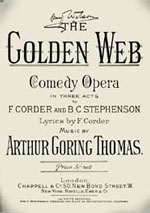
The Golden
Web was premiered by the Carl
Rosa Company at the Royal Court
Theatre in Liverpool on February
15th, 1893 and then at the Lyric
Theatre in London on March 11th,
1893 with considerable success. The
libretto was by F. Corder and B. C.
Stephenson and used the older
English opera style of
 songs
and dialogue.
The comic plot
is based on the old tradition of the
Fleet marriage, the area close to
the Fleet prison being one of the
best known for facilitating
clandestine marriages. Both Lord
Silvertop and Geoffrey Norreys are enamoured
of Amabel but Norreys is heavily in
debt. Silvertop to rid himself of a
rival connives to offer to relieve
the debt provided Norreys marries a
masked woman that he will provide
and Norreys agrees. However, when
Amabel hears of it, she disguises
herself and takes the place of the
intended wife and thus marries
Norreys in a pub called "the Golden
Web". Norreys then comes into a
title and money and regrets his
previous decision. After suitably
chastening him for his ill faith,
Amabel reveals that she is, in fact,
his wife. In the meantime,
Silvertop goes through with a
marriage to a woman whom he supposes
to be Amabel but who turns out to be
her old spinster aunt.
Goring Thomas
never saw the opera performed, as he
had committed suicide the previous
year.
|


