  |
 |

|
  The EnchantressMusic by Michael William Balfe
Libretto by
|

|
Ramir Nuguez Forte Bracchio Pacheco Sacripanti Zambrillo Lazarillo Theobaldo Pietro |
- Mr S. Jones [1] - Mr Barker [2] - Mr Morgan (Mr J. Morgan) [3] - Mr Miller (Mr Simpson) |
Main Opera
|
Duke d'Aquila (Regent) Galess (First Minister) Seneschal Chief of the Senate Don Silvio Doctor Mathanasius
Ramir Nuguez Forte Bracchio Chief of the Assassins Jose (a Peasant) First Officer / Second Officer
First Pirate / Second Pirate / Third
Pirate
First Peasant / Second Peasant
Stella (The Enchantress) A Black Domino A Blue Domino Child of Juan Telles |
- Mr Jones - Mr Morgan / Mr Simmond
-
Mr Heath /
Mr Priorson /
Mr Birt
-
Mr Johnson / Mr Chapino
- Miss Norman (Miss Collett) [4] - (Miss Norman) |
Conductor - Michael William Balfe / Francesco Schira[5]
[1] The May 19 playbill has Mr Jones singing two parts in the main opera, while Mr S Jones is listed in the prologue but not in the main opera. Looking at the May and September performance librettos, it seems likely that Mr Jones played the Chief of the Senate in the main opera while Mr S. Jones played Forte Bracchio in both prologue and the main opera
[2] Pacheco is included in the libretto published by W.S. Johnson for the original May 1845 performance ( LoC ) but is not listed on the May 19 playbill or the September 1845 revival libretto, although he is included in the text.
[3] The people in brackets are as listed in the May 1845 libretto where they differ from the playbill. Both Mr Morgan and Mr J Morgan are named on the playbill so that were two different people.
[4] The libretto has Miss Collett as the Black Domino and Miss Norman as the Blue Domino, a character not mentioned in the playbill. The September revival libretto does not list them although they have small speaking parts in the text.
[5] Balfe conducted the first few performances and then Schira, the Drury Lane Music Director, took over.
History
The success of Le puits d’amour in Paris and the comparative success of The Daughter of St Mark no doubt encouraged Bunn and Balfe to look for more St Georges' librettos. He obliged with a text intended for an English opera by Balfe even though he wrote it in French and came over to supervise its production[1]. Bunn translated what was titled The Enchantress. The success of Le puits d’amour had partly hinged on its prima donna, Anna Thillon. As she was English, singing in English was no barrier and so it was hardly unexpected that Bunn should bring her over to premiere the opera.
She proved a great success with critics and the public but unfortunately the auspicious opening night was followed by Thillon getting ill. As the playbill above shows, the plan was to recommence on May 19 but that was pushed back to May 23 and then to May 26 [2]. Things seem to have run smoothly after that until July 3, 1845, the end of the 1844-1845 season, when Thillon went back to France. Emma Romer, in place of Thillon, together with Harrison and Borrani took the opera to Ireland in July followed by Liverpool, Birmingham, Bath and Bristol. The opera was revived at Drury Lane with Romer and much the same cast as in May on September 27, 1845 but shorn of its prologue. It continued to run until November 14 but probably as much as a stopgap until Wallace's Maritana than because of its popularity. The first act was given in early 1846 at Drury Lane and later that year Romer, Harrison and Borrani took the opera on a provincial tour. It was given at the Surrey Theatre as part of a short season managed by James Tully in July, 1847, and then in Emma Romer's short season of opera there in early November 1847 and again in 1851 and 1852. Pyne and Harrison's performed it for Pyne's benefit at Sadlers Wells on July 19, 1852 and then in Liverpool in 1853. Balfe chose to include the third act (with Lucy Escott as Stella) for his benefit on July 14, 1856, probably its last British revival, although numbers from it appeared in concerts throughout the rest of the century. In August 1882, "Stella" wrote to the Freeman's Journal (Aug. 11, 1882) expressing disappointment that Carl Rosa and others had not seen fit to revive it.
The opera had fair success outside of Britain. On July 11, 1845, was given in Dublin and then in Cork with Romer singing the lead supported by Harrison and Borrani. They returned to Ireland in 1846. The US premiere was in Philadelphia on February 21, 1846 by the Walnut Street Theatre stock company [3]. The Seguin company gave it in New York on March 25, 1849 and then in Philadelphia in the April. Anna Thillon and company performed it fairly regularly during their 1851-54 tour including giving its first performance in San Francisco. Pyne and Harrison gave it in New York in December 1854 but do not seem to have performed it elsewhere. The original Richings company first performed it in 1859 in Buffalo and Caroline Richings toured it between 1866 and 1869 [4]. The Alfa Norman Company toured it in 1885 [5].
It was first given in Australia in Sydney on June 23, 1851, where it made "a decided hit" notwithstanding the Bell's Life in Sydney (June 28, 1851) critic's wish that "Balfe had not repeated himself - toujours perdrix is too much of a good thing". The Carandini company toured selections from the opera in the late 1860s in New Zealand.
[1] The Times (May 15, 1845)
[2] Morning Chronicle (May 28, 1845)
[3] W.G. Armstrong, A Record of the Opera in Philadelphia. (Philadelphia: Porter & Coates, 1884), p.52
[4] Katherine K. Preston, Opera for the People (Oxford: Oxford University Press, 2017), p.94
[5] New York Clipper (Dec. 19, 1885) announced that they were performing it in Chicago the next week. Kurt Ganzl, Onstage Profiles - Henry Hallam, 2020
Plot
The plot has echoes of The Bohemian Girl with a prologue giving the history of its female protagonist and a chorus of people on the margins of society, in this case pirates as opposed to gypsies. The Spectator (May 17, 1845) pointed out its parallels to Auber and Scribé's 1844 opera La Sirène.
Prologue
The heroine, Stella, is the young daughter of a pirate captain. He dies but in his last will and testament he asks that they accept her as their leader and that when she is 18, she can decide whether to continue as leader or to disband them.
Main Opera (18 years later)
Stella is now of age living in the Abruzzi mountains. She is looked on by the locals as an enchantress. Mathananius comes to the Hermitage to enquire about his ward, Sylvio, who was mysteriously handed to him by a stranger many years before. The Hermit, Fra Antonio, is actually the pirate leader's lieutenant, Ramir, and the pirates are hiding out in the hermitage. A shot is heard and Sylvio is found thrown from his horse. The peasants blame the Enchantress for his fall. She appears and Sylvio thanks her for saving him. She goes before the peasants can catch her but leaves Ramir to drug Sylvio and take him to a secret grotto. Later Ramir and others try to persuade her to leave the country but she refuses and demands obedience. Stella goes to the grotto and wakes Sylvio. He realises that he is in love with Stella while Ramir realises that she loves Sylvio.
Sylivio is in an army encampment in Sicily with other officers. He finds it difficult to comprehend his history and why he has been suddenly promoted. A further promotion to general arrives brought by a page, who is Stella in disguise. Sylvio confesses his love for Stella to the page. The army are restless as they haven't been paid. Stella provides gold and the soldiers go off into battle under Sylvio's command.
The Regent of Sicily plans to become King. He has been governing badly and people are starving. He is also enamoured of a beautiful stranger, Stella, who promised to destroy the Neapolitan fleet in exchange for a commission for a general, the one she had then handed to Sylvio. Sylvio has returned victorious but the Regent is jealous of him and, urged on by an anonymous note, plans to kill him. Stella and others using domino masks work to save Sylvio. The Regent and his henchman, Galeas, plan Sylvio's death using hidden assassins. Stella overhears but deliberately allows herself to be found. The Regent tries to get her to agree to marry him. Sylvio arrives having been summoned by Stella. Stella reveals that Sylvio is Don Paul, the rightful heir and places the insignia of office on him. The Regent calls for the assassins but their instructions are to
|
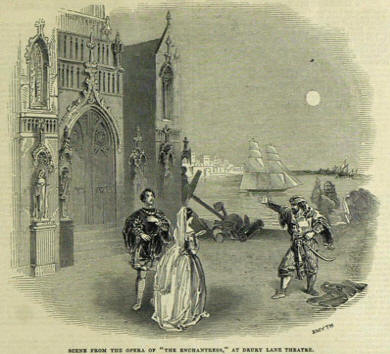
Illustrated London News, (Oct 4, 1845) |
kill a man without a decoration, which is now the Regent. The populace rejoice at Don Paul's appearance but there are doubters who want proof. Stella sends the proof, a letter, to Don Paul (Sylvio) using three trusted men but they fail and Galeas gets hold of the letter. Ramir offers to get the letter back but his price is Stella's hand, which she has to agree to. In the palace, Don Paul waits for the letter to arrive but instead he is told that a deputation is arriving to declare him an imposter. They agree to wait an hour for the proof, which arrives just in time. Don Paul goes out to meet the people while Stella meets Ramir who was wounded getting back the letter. Stella confirms that she will marry him but in the end he realises how deep her love for Don Paul is and gives up his claim. He sails away with the pirates.
|
Reception
The appearance of Thillon was much anticipated. For The Spectator (May 17, 1845) it seemed that "half England had arrived by special train to support a native composer". The Morning Chronicle (May 15, 1845) commented on the theatre being "crowded to suffocation" and the difficulty of finding a place. As a result of the discomfort and not helped by the opera's "inordinate length" of around four hours, the critic felt that they could not give a definitive verdict. However, they did go on to state that "there are striking and effective incidents and situations; and the dialogue, on the whole is well written and spirited". It was less sure of the music, "A great deal of it put together at very little expense of invention" but did praise the three main singers and note that "the great quantity of beautiful scenery, and the whole mise en scene is rich, splendid , and in excellent taste". This last point would have gratified St Georges and Bunn who went to great length to include detailed staging instructions to set each scene and to describe Thillon's dress and setting.
The Times (May 15, 1845) dwelt on its French characteristics calling it an opera comique and drew parallels with librettos that Scribe had provided for Auber.
"The story is truly French ... in which the whole intrigue seems brought about by a mysterious personage, who is substantial flesh and blood, and yet seems to have supernatural attributes".
There was much praise for Thillon, for Balfe, who "has exerted himself most creditably, as he has caught much of the dramatic spirit of the genre, and has introduced some of his happiest melodies", and for the staging. Only the length of the opera came in for criticism as "not only does this create weariness, but want of compression gives a kind of straggling effect to a dramatic work, and conceals the ingenuity of its construction".
The Examiner (May 17, 1845) was of much the same opinion as The Times, although it had more to say on Thillon, see here and criticised Bunn's translation, "remarkable for their utter worthlessnes". Punch (May 31, 1845) had much fun at the expense of the "Poet Bunn" devoting a page to mocking his text and his rhymes in the opera.
The Morning Post (May 15, 1845) after an analysis of Balfe's faults in resorting to "hasty manufacture , and has abandoned that arduous composition in which a gifted man awaits the happier hour of inspiration" thought that the opera might be saved from an early death by timely improvements and curtailments. It also pointed to the "many striking situations which have done duty [at] the Opera Comique" as well as the musical "reminiscences" of several Auber operas. It was also very taken with Thillon, "her every motion and every look is fraught with grace and elegance", although "as a singer she is not so perfect".
The Literary Gazette (May 17, 1845) rather wearily summed it up: "If we say that this new work is an average specimen of the composer's pleasing music, and the manager's experienced putting on the stage, it gives a general idea of it". Thillon did, however, fire their enthusiasm:
The singing and fascinating manner of Thillon contributed mainly to the success of the opera. Her great rapidity of execution is remarkable, and astonished the audience: in the cavatina, A Youthful Knight, she was encored three times [1].
It concluded that there were "two grand faults":
deficiency in recitative, with a redundance of speaking [2], and by far too great a display of stage effect, with its necessary accompaniment of crashing and braying brass instruments.
The revival on September 27, 1845 at Drury Lane met with modest success. The cast was essentially the same except that Emma Romer replaced Thillon and the prologue was omitted, presumably in response to the criticism of the opera's length [3]. It also showed that its success was not totally dependent on Thillon. The Standard (Sept. 29, 1845) wrote that Romer
acquitted herself extremely well - not sufficient so to obliterate the recollections of Thillon, but with a skill creditable to her emulation and industry"
Her acting, throughout, was spirited - as different, however, as possible to that of Thillon. The latter won the heart by her mignon graces and irresistible witchery of manner, aided by dazzling feats of a lovely and penetrating voice. Miss Romer has but few of these adventitious gifts; she is a coarser kind of 'enchantress', but she has allurements of her own, and they do not fail her. .
[1] The Times (May 15, 1845) said that "it was encored twice, and narrowly escaped another repetition
[2] Presumably meaning that they would have preferred it much more through composed as in Balfe's previous The Daughter of St Mark (1844) as well as less dialogue.
[3] The Illustrated London News (Oct, 4, 1845) complained that it was still three and a quarter hours long, "a terrible affliction"..
Comment
Claquers
Claquers were probably as much a phenomena here as in France but perhaps less organised and acknowledged. In this case, though, the Morning Chronicle (May 15, 1845) commenting on the applause from the beginning to the end of the piece attributed it in large part to claquers. It drew a distinction between French ones who sensed and amplified the general mood of the audience and the English ones, "clumsy fellows", who clapped and cheered indiscriminately. What was more openly admitted was that people were paid by publishers to get certain songs encored with the aim of boosting their popularity and hence sales of their scores.
Rehearsals
The premiere of The Daughter of St Mark had suffered from soloists being tired from rehearsals and, ahead of The Enchantress, it seems that Balfe took steps to rectify this to judge from a memorandum that he appears to have prepared but not necessarily sent:
If I compose the opera for Madame Thillon on the first of May, Bunn must give me the book on the first of February. Mr Balfe must have 5 orchestral rehearsals, and no rehearsal for the principals on the day of production. [1]
Relations between Balfe and Bunn were strained at this time because Bunn had stopped paying Balfe a fee for each night his operas were performed [2]. This was a continuation of Bunn's practice that he had started with The Siege of Rochelle, in that case £5 a night. Balfe's demand for more and better planned rehearsal time would only have exacerbated any friction.
Accidents
On June 25, while Thillon was on stage, "a quantity of the heavy machinery immediately in her vicinity fell with a tremendous crash, knocking down two of the scene shifters", for one of whom the event seems to have proved fatal. Such mishaps were hardly rare but perhaps the most interesting point to modern practice was the claim that "Not the slightest blame attaches to anyone in the theatre".
Seating
The Illustrated London News (May 17, 1845) wrote that the box keepers claimed that the third tier was filled when actually it was not. This was, presumably, to get customers to take more expensive seats or to make sure that the more visible seats were filled. The price of seats in the third tier was sixpence or one shilling.
[1] Quoted in Eric. Walter White, The History of English Opera. (London: Faber & Faber, 1983), p.282
[2] White, Op.Cit., pp. 281-282
Scores and librettos
The libretto manuscript is at Add MS 42984, ff 421-476b. It was received by the Examiner on April 27, 1845 and signed off on April 29, 1845. The printed libretto for the original May 1845 performance can be found at LoC and for the later September 1845 revival at Hathi Trust [1]. They are identical even though the prologue was not included in the September revival. The manuscript and printed librettos are very similar except that the printed librettos miss out a few songs and choruses, presumably to reduce the long running time.[2] The manuscript always refers to Stella as the "sorceress" whereas the printed libretto uses both "enchantress" and "sorceress".
There are a number of shortened printed versions without the prologue, e.g. for Thillon's appearance at the Chestnut Street Theatre, Philadelphia, in October 1852 at Google books and the version for Pyne and Harrison's 1854 tour of the US, here. The latter also misses out some vocal items and adds some dialogue, presumably to clarify the action.
The essentially complete manuscript score is available in the British Library (Add MS 29344-29345). A vocal score is in the British Library (System number: 004191012 ) as is the score for the trio "The love almost sublime, I felt". Scores are available for "Let all obey" , "Woman's Heart", "My presence still in calm or storm" and for "I love her". Liverpool City Council has a copy of the vocal score
[1] The difference is in the cast list page but clearly they used the same print setup except for that.
[2]For example Nuguez's solo together with supporting chorus in Act 1 Scene 1 is omitted.
Recordings
There is a rather noisy cylinder recording of "Let all obey" but otherwise there are no known recordings of the opera or of numbers from it
Books, Articles, Online
William Tyldesley, Michael William Balfe: his life and his English operas, (Aldershot, UK: Ashgate Publishing, 2003), pp. 124 - 132 goes into the history, influences and structure of the opera.
There is a little information in Biddlecombe's book (p. 118) and Walsh's book (p.102 and pp. 197-198) but almost none in the books by Kenney and Barrett (see book list).
 |
 |
 |
  |
|
|