  |
 |

|
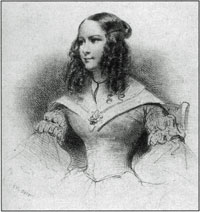
  Madame Anna Thillon 1817-1903 [1] Thillon was born Sophia Ann Hunt in London to wealthy parents. Her father was listed as a broker on her
James Hudson, "an entirely new Musical and Dramatic Entertainment" in the Willis's Rooms that consisted of songs and sketches. The Morning Post (Nov 27, 1850) wrote that "Mdme Anna Thillon is looking aas fascinating as ever and sings with all the point and finish for which she is deservedly celebrated". They spent the first half of 1851 taking the entertainment to a number of provincial cities as well as London dates[9].
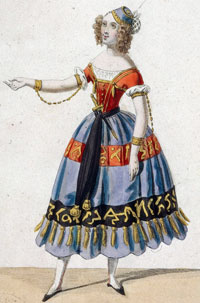
her looks, personality and acting as for her musical talents. Even in her first Parisian role in Albert Grisar's Lady Mervil, Le Corsaire[12] was enthusiastic and envisaged a great career: Mais les honneurs de la soirée ont été sans aucun doute pour Mme Anna Thillon qui nous a montré ce que l'on devait attendre de dispositions naturelles aidées d'un travail long et consciencieux. Il y a huit mois à peine, Mme Anna Thillon n'était encore qu'une femme charmante, pleine de grâces, et qui devait à sa figure les trois quarts de son succès: aujourd'hui, c'est une chanteuse; demain ce sera, si elle le veut, une véritable prima donna. The Examiner (May 17, 1845) wrote of her performance in Balfe's The Enchantress (1845): Madame Thillon is the same fascinating creature as ever; curls her hair in the same fashion; smiles with the same engaging smile; and astonishes her hearers with the same wonderful roulades and chromatics as last year. She appears in five different dresses, and in each is sufficiently bewildering. But then, in a large theatre, her fascinating countenance is plainly visible to a small part of the audience alone; something of the charm of manner is lost in the distance; and the voice, which is not remarkable for power, does not sound to such advantage as in a smaller space. Rejoicing, as we do, to see Madame Thillon anywhere, we would rather see Madame Thillon at Oxford Street [Princess's Theatre] than at Drury Lane. The Spectator (May 17, 1845) came to a different conclusion: A small tone it appears at Drury Lane; but it is the most silvery, clear and penetrating, that can be imagined - not a note is lost; her shake is rapid and even, and voluble execution tells as well in this great theatre as at the Princess's. The Illustrated London News (May 17, 1845) thought the same that she "can accommodate herself to any arena". The Manchester Weekly Times (Aug. 22, 1846) was altogether less of a believer with a whiff of anti French feeling. After claiming her 1846 Drury Lane stint had been a failure because of the size of the theatre, it then went on to comment after her visit to Manchester: To give her the title of prima donna is unfair, it is a position she can never obtain, and those who go to the theatre under the impression of witnessing great musical powers, come away, consequently, disappointed. ... She belongs to a school which we have not in England, and which we do not care to have, for it is but a step beyond vaudeville. But though she may want intellect and heart, she still contrives to be an attractive singer and actress, and the French art of saying pretty things by a glance, contrives to draw money to the treasury. Towards the end of her US tour, the American Press[13] widely quoted the New York Day Book's dismissive verdict that "the secret of Madame Anna Thillon's success, is her lovely face and certain affectation of manner and pronunciation, which our highly illuminated snobbery mistake for piquancy". In his Reminiscences of Balfe (p.26), Heywood J. St. Leger wrote that in 1848 [14]: Madame Anna Thillon made her debut in Auber's melodious opera, The Crown Diamonds, and created a furore seldom witnessed in London by the beauty of her person, the excellence of her acting, and the brilliancy of her singing. ... I never recollect such long-continued enthusiasm for any artiste during my long operatic experience. It is a salutary lesson on fame that, when Thillon died in 1903, the only tributes seem to have been in the local press. [1] According to records on Ancestry.co.uk she was born on March 10, 1817 and died in Devon on May 5, 1903 aged 87. The latter would give her an estimated birth year of 1816. The 1881 census gives an estimated birth year of 1822 whereas the 1891 and 1901 censuses give an estimate of 1817. Grove Music Online has her birth year as 1819. It also says that she might have been born in Calcutta. The Alexandria Gazette (Sep.4 1851) also claimed this in its article heralding her stay in America but given the voyage from India to Britain took something like six months, she would not have been back in Britain by June 22, when she was christened given the birth date on the baptism record is correct. In her census entries she always put London as her birthplace. [2] The Observer (May 11, 1845) claimed that her father had been "a singer of some celebrity...at Covent Garden some fifteen or twenty years ago". This was obviously a rumour doing the rounds for the Musical World (May 30, 1844), p.183, had already asserted that it was completely untrue. It's possible that the rumour got him mixed up with a different Joseph Hunt, an accomplice in a notorious 1823 murder, whose brother was said to have been be a principal singer at Covent Garden in the early 1820s (Pierce Egan, Recollections of John Thurtell. (London: Knight & Lacy, 1824), pp. 42-43) . [3] This history is essentially that offered by the Musical World, (Sept. 17, 1840), The Illustrated London News (May 18, 1844), The Theatrical Times (July 4, 1846) and The Daily Director and Entracte (June 22, 1859). It is more coherent and plausible than that given in the obituary in the Torquay Times (May 17, 1903), which claimed that her father was a vicar in the Midlands and the family were strongly opposed to her singing in public so she ran off to France. The Grove Dictionary (1900) (https://en.m.wikisource.org/wiki/A_Dictionary_of_Music_and_Musicians/Thillon,_Anna ) says that she was 14 when she went to France, which would mean that she was married almost immediately if the 1819 birthdate, which both it, Grove Online and the Torquay Times give, was correct. The Musical World history was also included a story that Carl Maria von Weber heard her sing as a child and tried to convince her mother to let her go for proper training, only to be told that their social position and wealth made that unnecessary and impossible. Their later misfortunes meant that Anna was able to be trained. [4] Ancestry.co.uk holds the marriage record. They married first under French law and then in an British church in France. He was described as a Professor of Singing in the 1881 UK census. [5] The Morning Chronicle (Apr. 17, 1846) was very dismissive but gave a brief description on them [6] For example, the Daily News (Apr. 17, 1846) and The Standard (Apr. 17, 1846) [7] The Era (Sep. 13, 1846) [8] The Morning Post (Nov 4, 1847) carried an advertisement that "Monsieur and Madame Anna Thillon have the honour to announce their arrival in London for the season", an interesting change from the usual formal naming of the husband but an accurate reflection on their relative public importance. [9] Their itinerary shows the increasing influence of the railways on performance schedules. On one occasion, their last night in London was December 10, 1850 and their first in Liverpool, December 12, 1850. [10] The Charleston Daily Courier (June 30, 1854) claimed that the Thillons made $25000 from their Californian tour. Katherine K. Preston, Opera on the Road: Traveling Opera Troupes in the United States, 1825-60. (Urbana and Chicago: University of Illinois Press,1993). pp. 237-243, has more details of her US tour. George Martin, Verdi at the Golden Gate (Berkeley: University of California Press, 1993), pp. 59-60 has a short section on her San Francisco stay. [11] Brighton Gazette (February 8, 1870) [12] August 8, 1839. Quoted in Candida Billie Mantica, "From Lucie de Lammermoor to L'Ange de Nisida, 1839-1840: Gaetano Donizetti at the Théâtre de la Renaissance" , : Revue belge de Musicologie / Belgisch Tijdschrift voor Muziekwetenschap, 2012, Vol. 66, La critique musicale francophone belge au xixe siècle dans une perspective internationale / Nineteenth-century Belgian Francophone Music Criticism in International Context (2012), p. 173. The article can be found at https://www.jstor.org/stable/ 23339197 [13] For example, the Richmond Dispatch (Mar. 18, 1854) [14] St. Leger was out on his dates. Although Thillon was at the Princess's in 1848, the events he alludes to were in 1844 and 1845. His story of Maddox outwitting Balfe to sign her up for the next season is not correct either as she was hired by Drury Lane the following season. Hopefully, his memory of Thillon's impact is more reliable. [15] Les diamants de la couronne,
opéra-comique d'Auber, Scribe et Saint-Georges : costume de Mlle Anna
Thillon (rôle de la Catarina)] - 1841 - National Library of France,
France - No Copyright - Other Known Legal Restrictions. [16] Charles Vogt, (1810?-1890?). Lithographe. Anna Thillon / dessiné par Bourgarel ; lith. par Ch. Vogt. 1840 |

 |
 |
 |
  |
|
|