  |
 |

|
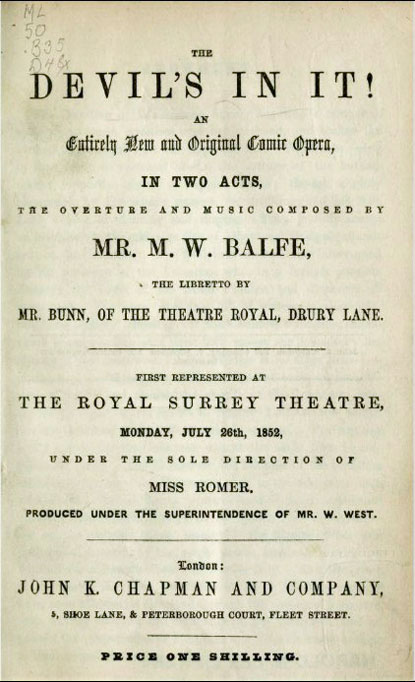
  The Devil's in it!
|
|
Count Wallenberg Albert (his State Porter) Hermann (a Basket Maker) Lunastro (a Magician) Music Master Huntsman Butler Footman Coachman Valet Guest Genius Gnome Fiend
Countess of Wallenburg Letty (Wife to Hermann) Bridget (Countess's Lady's Maid) Nymph Naiad |
- Mr Travers (Thomas Romer) - Mr Young - Mr Moelder
- Miss Day |
Conductor - Wilhelm Meyer Lutz
History
On May 31, 1852 and for the next three years, the singer Emma Romer, took over managing a summer season of opera at the Surrey Theatre. Balfe's The Devil's in it was one of two new English operas that she premiered during that time. It was Bunn and Balfe's final collaboration.
The libretto of the opera had a long pedigree. Its first stage manifestation seems to have been Thomas Jevon's play The Devil of a Wife or a Comical Transformation of 1686 at the Queens Theatre, Dorset Gardens[1]. In 1731, Charles Coffey and John Mottley used it as the basis of their ballad opera, The Devil to Pay or Wives Metamorphos'd at Drury Lane. An Adolphe Adam ballet, Diable à Quatre, followed in 1845 at the Paris Opéra and, as usual, shortly afterwards by English versions at the Adelphi, Princess's and Drury Lane theatres, which reverted to the title of The Devil to Pay. This must have been the starting point for Bunn's libretto. The result was Balfe's only comic opera and, perhaps unexpectedly, a successful one, even being advertised as "The Greatest Triumph Ever Achieved" in The Times (Sep. 3, 1852). It ran for most if not all days, except Sundays, until the end of the season on September 13, 1852, and so achieved something around 40 performances or more in total. Romer revived it at the Surrey in August 1853 for a run of two weeks and, at least on the opening night, filled the house (The Era, Aug. 7, 1853). It was given at Niblo's Gardens, New York, in December 17, 1852 as The Basket-maker's Wife with Anna Thillon (presumably as Letty), but did not make much of an impression, lasting only three performances [2].
No other contemporary performances have been found elsewhere. presumably because, according to The Era, the Surrey had the exclusive rights of performance. It was not until June 15, 1871, that it was revived at the Gaiety Theatre under the title Letty, the Basketmaker with a revised text by Palgrave Simpson and supposedly some new sections that Balfe had added at some point before his death[3]. That ran for 13 nights, ending on June 30. It was revived at the Gaiety Theatre, Dublin, on June 9, 1873 with Julia Mathews as Letty [4] and was also given in the U.S. by the Richings company in the spring of 1876 [5].
Thomas Egerton Wilks's musical play, The Devil's in it, of 1843 staged at the Princess's Theatre was based on Eugène Scribe's libretto for Daniel Auber's opera La Part du Diable. Despite what some commentators claim[6], it is a totally different plot and has no connection with the Bunn libretto.
[1] The Morning Post (June 16, 1871). It claimed that "The germ of the idea came from Sir Philip Sidney's Arcadia", which had been written towards the end of the 16th century. The paper also claimed that Letty, the Basketmaker was Balfe's original title for the opera and this is supported by observations in William Tyldesley, Michael William Balfe: his life and his English operas, (Aldershot, UK: Ashgate Publishing, 2003), pp. 162-163.
[2] Internet Broadway Database - https://www.ibdb.com/broadway-production/the-basket-makers-wife-412334
[3] John Hollingshead, the Gaiety manager, was reported by the Pall Mall Budget (June 23, 1871) stated "The opera is called 'new' because the late Mr Balfe rearranged it, adding several pieces of music which have never been performed, and the author of the libretto [Simpson] has reedited it" The Pall Mall Budget added that Simpson "has not merely re-edited, but has absolutely rewtitten".
[4] Freeman's Journal (June 5, 1873), Irish Times (June 10, 1873)
[5] The Courier-Journal (Apr. 7, 1876)
[6] For example, Charles L. Kenney, A Memoir of Michael William Balfe. (New York: Da Capo Press, 1978), p. 220.
Plot
The printed libretto included the
following summary labelled "argument":
The Countess of Wallenberg having acquired a
temper of extreme violence, tyranises (sic) over her husband,
and makes the victims of her caprice all who approach her. Whilst the
castle is thus made a wretched abode, the cottage of the basket-maker,
opposite, shows a happier scene; though slightly chequered by
Hermann's passion for drinking, and his wife Letty's love of dancing
and singing. They joyfully accept an invitation to the marriage fête
of Albert and Bridget (attendants on the Countess). The festivities
are suddenly interrupted by the presence of the Countess, who, in a
furious passion, destroys the violin of the Blind Fiddler, and
disperses all assembled. The poor musician, full of sorrow, is alone
left; but Letty, taking advantage of the Countess's absence,
endeavours to console him with what little money she possesses; her
charity is well bestowed, for the Fiddler is no other than Lunastro,
a powerful magician, who, determined to repay the kindness of Letty,
and punish the cruelty of the Countess, cornmands his supernatural
agents to remove Letty to the castle, and the Countess to the
basket-maker's cottage. For one day Letty passes for the Countess, who
at the same time is mistaken for Letty.
The ill humour and idleness of the Countess calls forth the anger of Hermann, even to the discipline of a wicker rod (Illustration above). While Letty, overwhelmed with astonishment, curiosity, and delight, enjoys all the luxuries of the castle - her simple manners being unsuited to the dignity of her new position - Lunastro, by his magic power, suddenly endues (endows) her with all the accomplishments of a noble lady. At a fête given at the castle, the spell, by virtue of which all these changes have been effected, is dissolved through the agency of Lunastro, who, having checked the arrogance of the Countess, and reproved the propensities of Hermann and his wife, restores them to their respective homes. |
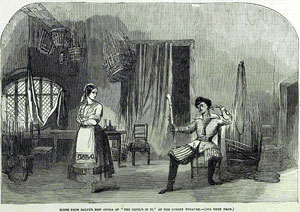
Illustrated London News (July 31, 1852) |
Reception
This opera, Bunn and Balfe's final effort, brought them both critical and public praise. The Illustrated London News (July 31, 1852) wrote of the libretto being " one of the best books on the lyric stage" and the music is generally in Balfe's happiest vein - light, gay, elegant, ever grateful to the ear, often sparkling, and, in some instances, rising into greatness". It noted how the prospect of the new opera had brought "almost every professor and amateur of note in the metropolis, including the principal members of Her Majesty's Theatre" to the Surrey despite its rather lowly reputation. And they were not disappointed for "A more decided triumph was never witnessed on any boards".
The Daily News (July 27, 1852) felt the incantation scene, "à la Freischutz", and the troops of demons and spirits "out of keeping with so gay and playful a subject".
But we must submit to such things because the opera stage is thought to demand them. Setting this aside, the opera is delightful. The libretto is very cleverly written, and the music is pretty, sparkling and comic.
It went on to compliment the singers: Travers (Thomas Romer) whose singing was very good although his acting "somewhat stiff and inanimate", Elizabeth Poole's part "admirably acted and sung", Emma Romer never seen or heard to greater advantage, Henry Corri "very funny but his fun often overcharged and boisterous". "The orchestra was very good indeed" but the strings needed strengthening, the chorus "strong and effective" and the scenery and costumes "in excellent taste".
The Morning Advertiser (July 27, 1852) was also very positive including that "the opening 'incantation' ...is novel and characteristic". It remarked that the concerted pieces and choruses were "remarkable for their clever construction". All the singers were praised and that "it would be difficult to speak in too high terms of praise as regards the manner in which the opera was put on the stage". Meyer Lutz was also mentioned "for the able manner in which it was conducted".
Unusually, given the drubbing librettos usually got, The Times (July 27, 1852) wrote how Bunn had turned the main "incidents to excellent account". Balfe's music was "tuneful, sparkling, natural, and full of life and vigour", although it noted that "the audience were not equally enthusiastic about the clever incantation music of the first act". Considering the resources of the Surrey,, the performance was "remarkably effective". The orchestra was "small and incomplete, but by no means inefficient", the chorus "rather deficient in numbers than in quality". Again the performers were all praised and the performance summed up as "A more unequivocal success could hardly have been achieved".
The Morning Post (July 27, 1852) while noting that the opera was "brilliantly successful" spent most of a long review lamenting the neglect of music and particularly English music and praising the Surrey's efforts to address this by staging English opera.
The 1853 revival seems to have also gone well according to the Era (Aug. 7, 1853), although it felt that Priscilla Horton was not so well suited to the role of Countess as Elizabeth Poole, the other main singers being as before. It also thought that the orchestra under Lutz was now excellent, "the brassy virus of which we have had to complain is nearly spent out".
The 1852 New York performance was harshly criticised: "The music has scarcely one redeeming feature... There is not an air or melody throughout the piece that fixes itself upon the memory. [It] will not, we think, add to the fame of the composer; nor do much to enrich the treasury of any theatre"[1].
[1] Quoted in Vera Brodsky Lawrence, Strong on Music. Vol. 2 (Chicago: University of Chicago, 1995), p.317.
Comment
It is curious that the only singer with her first name listed in the libretto was Clarisse (Clarissa) Doria, who was a comparative newcomer to the stage and who was playing a very minor part. Emma Romer, a singer of around twenty years experience, with a considerable reputation and manager of the opera company, still stuck to the rather prim "Miss Romer". That title had in its day excited considerable controversy when she retained it after her marriage. Although not the first to use her first name, Doria seems to have been done for no other reason than to emphasise her name and, presumably, give what today we would call "name recognition". It was a style that became more prevalent in the 1860s, see What's in a Title.
Scores and librettos
The libretto manuscript is available in the British Library (Add MS 52933 J). It was received by Willian Bodham Donne, the deputy Examiner, on July 14, 1852 and the licence sent on July 15, 1852. The cover letter claimed that it was to be performed on July 21.
An online libretto (London: John K. Chapman and Company, 1852) is available at Archive.org and Hathi Trust. There is also an edition (London: Perry, Davis, and Company, 1852?) available at the Library of Congress. They are identical. Probably Chapman did the original printing, as he was an established libretto printer and publisher and Perry, Davis then did a copy, either with or without Chapman's permission. The printed and manuscript librettos are identical for much of the opera, the main difference being in the finale of the opera where an ambitious ensemble in the manuscript was replaced by dialogue in the printed libretto. Perhaps the former was too difficult or, more likely, the company were pushed for time. The Examiner, Donne, had stipulated that the phrase "this must be Heaven, and I've got into it at last", spoken by Letty in Act 2 Scene 2, must be omitted [1]. However, it was retained in the printed librettos.
There does not seem to be an edition of Palgrave Simpson's updated libretto and it is not clear whether permission was sought or given by the Examiner given its admitted major differences from Bunn's original. No record has been found of a second submission.
Tyldesley (p. 163) notes that the full score is in the British Library, Add MS 33356 and that there is a vocal score of the 1871 version by Hutchings and Romer.
[1] Lord Chamberlain's Day Books, 1852-1865, Add MS 53703
Recordings
None are known
Books, Articles, Online
William Tyldesley, Michael William Balfe: his life and his English operas, (Aldershot, UK: Ashgate Publishing, 2003), pp. 162 - 166, has his usual brief history and discussion of musical aspects including some of the differences with Letty the Basketmaker.
 |
 |
 |
  |
|
|