  |
 |

|
  Little Red Riding HoodMusic by Mary Ann à BeckettLibretto by Gilbert à Beckett
Surrey Theatre,
London
|
|
Surrey Theatre August 8, 1842 |
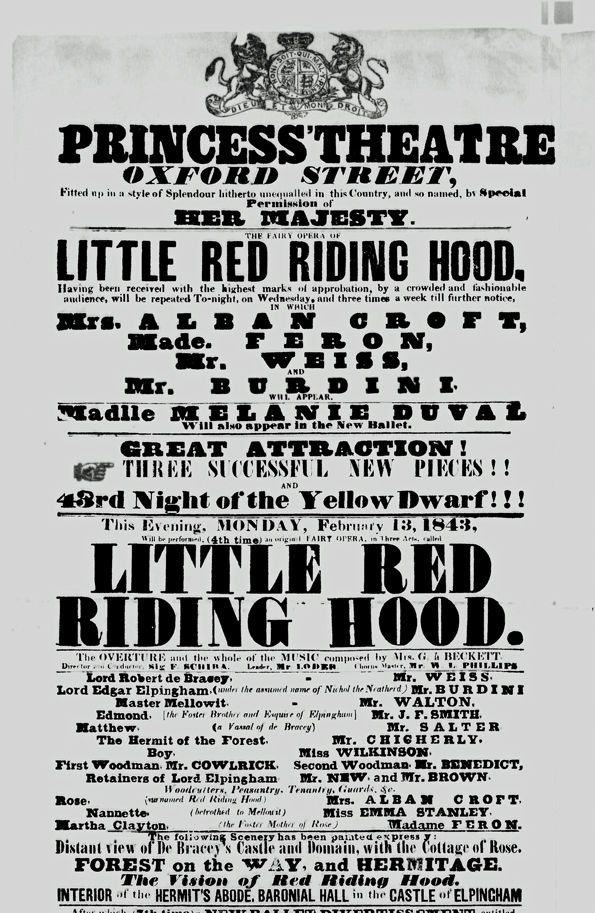
Princess's Theatre February 6, 1843 |
|
|
Nichol Lord De Bracy Bailly Mellowit Hermit First Woodman Second Woodman Retainers of
Boy Rose adopted daughter Martha Clayton Nanette |
- ? - Cecilia Serle [2] |
-
William Oxberry
|
Conductor - George Stansbury (Surrey) / Francesco Schira (Princess's)
[1] Sunday Times (February 12, 1843) wrote that the part was played by Oxberry, who was listed in the playbill for February 8 so that it appears for some reason that Walton took over, either temporarily of permanently, between then and February 13.
[2] Some publications list her as Mrs Searle. This misspelling of Serle was not infrequent. There was a Mrs Searle active in the London theatre but she was primarily a dancer and her appearances seemed to have ceased by the later 1830s.
History
Although the Surrey Theatre became best known for its melodramas, it staged a considerable amount of opera over several decades, mainly continental opera in English and some older established English operas. Little Red Riding Hood was only its second original English Romantic opera. It was also Mary Ann à Beckett's second opera following her Agnes Sorel (1835) and, once again, to a libretto written by her husband, Gilbert à Beckett [1]. There were at least 16 performances, it being given every night for the first two weeks. The opera was revived at the Princess's Theatre on February 6, 1843 for over a month of performances. No revival has been found after that. In June 1844, the Royal Grecian Saloon put on François Adrien Boieldieu's original version, whose libretto had been the starting point for à Beckett's libretto.
[1] Arthur William à Beckett, The à Becketts of "Punch" (London: Archibald Constable and Co. Ltd., 1903), p.56
Plot
As this was at the Surrey Theatre, an "illegitimate" minor theatre situated outside Westminster and before the Theatre Act of 1843, no manuscript had to be lodged with the Lord Chamberlain. Reviewing its 1843 revival, The Athenaeum (Feb. 11, 1843) claimed that it was a translation of the opéra-féerie, Le Petit Chaperon Rouge, set by Boieldieu to a libretto by Emmanuel Théaulon. This had been first performed in Paris at the Opéra-Comique in 1818 and revived in 1832. Judging by the similarity of the lists of protagonists, this was essentially correct, although one would not be surprised if some of the smaller parts had been omitted or merged in view of the Surrey's slimmer resources.
The Odd Fellow (Aug. 20, 1842) gave the following synopsis:
Baron De Bracy has formed a great admiration for Little Red Riding Hood, who is beloved by a young lord, who, however, has hitherto been known only as the humble Nichol, the neatherd [cowherd]. De Bracy goes to the Hermit, for the sake of gaining his concurrence in the carrying off of the village belle. He is followed by her, and having divested herself of a charmed garment, she is about to be submitted to the advances of De Bracy, when her more honourable wooer arrives. There is an exceedingly humorous underplot in which a provincial mayor, called Mellow-wit, and a coquette appear to great advantage.
The Sunday Times (Feb. 12, 1843) has a much longer synopsis.
Reception
On the whole, the opera met with a favourable reception. The Odd Fellow (Aug. 20, 1842), unusually for an English opera at this time, liked the libretto:
The dialogue as well as the libretto of the airs are of a very superior stamp, while the music itself is of an order to make us earnest in our hopes and expectations of the fair composer soon attaining great celebrity.
It then told of how no piece was "allowed to pass without approbation". All four main singers were judged never to have been in better voice and Romer was singled out that her acting matched her singing. This was in contrast to the two men "whose really impassioned singing met with a contrast in the coldness of their speaking".
The Era (Aug. 14, 1842), although uncertain about the wisdom of adapting the fairy tale, was quite positive about the music and its performance saying that à Beckett had built on the promise of her Agnes Sorel.
The music of the present work is in the ultra-Italian school, without, however, any servile succumbing to the glaring error of its continued con strepitos [sic - noisiness]. The music is unambitious, its melodies fresh and natural, and the instrumentation bears ample testimony of care and scholarship.
It concluded that "The theatre was very crowded in every part, and the result triumphant".
The Morning Chronicle (Aug. 10, 1842) wrote that it received "great justice from the performers" and that
The story of the piece is simple and pleasing, and the music... deserved the favourable reception it met with. It contains many elegant and expressive melodies, and some of the concerted pieces are ingenious and effective.
The Morning Post (Aug. 9, 1842) was less enthusiastic. "The libretto was conceived in an amiable spirit of uniformity with preconceived models". Of the music, à Beckett "enjoys a fine memory and a highly commendable impartiality ... by the delightfully indiscriminate appropriation of all sorts of ideas from all sorts of sources - English, Scotch and Italian". It also talked condescendingly of her possessing "high characteristics for becoming eminent in the line of Surrey opera", a swipe at the lower status of the Surrey across the river from Westminster and the main theatres and known for its more popular repertoire..
The revival at the Princess's Theatre in February 1843 met with much less sympathy even though less than six months later; perhaps the production and cast were less convincing or its Surrey origins were held against it. The Athenaeum (Feb. 11, 1843), presumably Henry Chorley, was very dismissive: "The musical ideas are none of them new: neither is there construction or science to make amends for want of novelty". He used the opera as an example to wonder why there had never been a successful woman composer. The Morning Post (Feb. 7, 1843) was as unenthusiastic as on the initial production asking why "It has again been raked out from the oblivion to which it had been properly consigned". The Argus (Feb. 11, 1843), although also lukewarm about the opera's revival, thought that it "went off tolerably well" and had praise for the staging, the orchestra and the performers, particularly Mrs Alban Croft. The Sunday Times (Feb. 12, 1843) damned it with faint praise. Having complained of it being made up "of shreds and patches from every opera that has been on the stage for the last twenty years. Yet have these fragments been collected with great taste, and ingeniously woven into a perfect three act opera".
The Atlas (Feb.11, 1843) spent almost a column and a half mainly picking holes in à Beckett's compositional skills and including some particularly patronising comments, for example:
For while, in this country, men are now severely censured who venture to pen down and publish the unlicked cubs of their imagination, women have not, as yet, advanced much further into the mystery of sounds than a superficial perception of their effects; and indeed scientific acquirement in art is not expected of them.
We cannot reasonably expect of Mrs À Beckett's music those features of refinement and scholarship which she has never cultivated, and of the very existence of which she is most probably ignorant.
Comment
Perhaps the only surprise here is that Mary à Beckett was courageous enough to compose a public work given the scant respect given to women composers in many quarters and the self serving criticism
Scores and librettos
As this was at the Surrey Theatre, an "illegitimate" minor theatre situated outside Westminster and before 1843, no manuscript had to be lodged with the Lord Chamberlain. No published libretto has been found either.
The British Library has a set of Quadrilles by à Beckett based on themes from the opera that were published some years later (Music Collections i.309.tt.(6.)). They do not appear to have any numbers from the opera, although some were published by Chappell and Co..
Recordings
None are known
Books, Articles, Online
None are known.
 |
 |
 |
  |
|
|