  |
 |

|
  Agnes SorelMusic by Mary Ann à BeckettLibretto by Gilbert à Beckett
St James Theatre, London
|
|
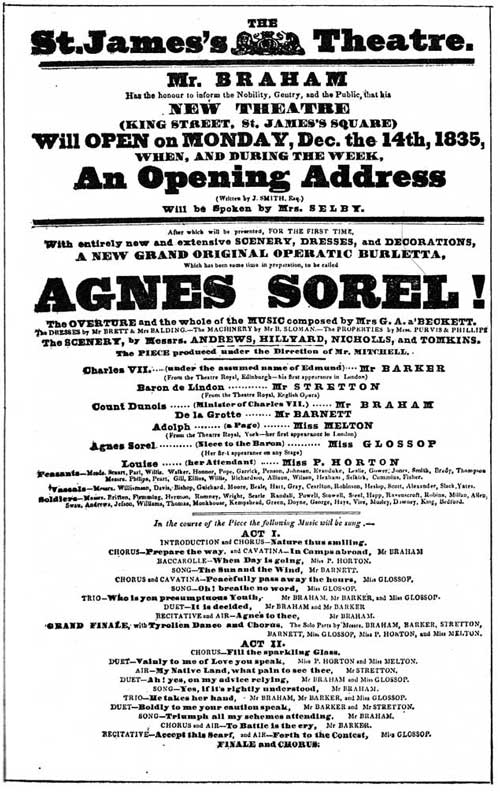
Charles VII Baron de Linden Count Dumois De La Grotte Adolph (a page)
Agnes Sorel Louise (her attendant)
Conductor |
|
HistoryThe Morning Post (December 15, 1835) complained that, although titled an operatic burletta, Agnes Sorel should have been designated an opera. It was entitled a grand opera on the manuscript submitted to the Examiner but an operatic burletta on the St James's playbill. It was the main work that opened John Braham's newly built St. James's Theatre and possibly he might have not wanted to give too serious an impression to his potential audiences. The text shows that it was intended as a comic piece. The theatre staged little opera subsequently. From newspaper reports the theatre was still being finished off almost up to the raising of the curtain. The libretto submitted to the Examiner is in several hands but with the musical items mainly in one hand and dialogue in a different one. Some scenes and songs are missing, which may have been sent separately as they were advertised on the playbill. Thus there is an impression of hasty construction rather in line with the building's history. George Stanbury, the conductor, may have orchestrated the opera [1]. Despite Braham's popularity, the opera was given for little over a month and there appear to have been no performances since. Miss Glossop, the Agnes Sorel, was Mary à Beckett's sister, Frances. The librettist, her husband Gilbert, was acting manager at the St James around this time[2]. |
Plot
Agnes Sorel was an historic figure, the mistress of Charles VII of France. She appeared in other plays and operas at this time, including Balfe's Joan of Arc. Charles VII of France has seen and fallen in love with the beautiful Agnes Sorel, the niece of Baron de Linden. The king in disguise and under the pretext of having fallen from his horse is received into the Baron's home, where he soon wins the affection of Agnes. However, Count Dunois, another suitor, turns up. The king promises to not pull rank and asserts that the best man should win. There then follow various manoeuvres as each attempts to outwit the other and in which the king comes off worse. A third suitor, De la Grotte, also complicates the comic proceedings. However, a report of the English outside the walls of Paris means that the whole business has to be broken off and thus the delicate question of Agnes Sorel's future relationship to the king does not need to be raised.
Reception
Reviewing the opera seemed to have caused a certain amount of ambivalence because the composer was a woman, quite possibly the first in Britain to compose an opera (although not in Europe, as was claimed [3]). She was seen to have stuck too close to Italian models and that they "had made too deep an impression upon her memory ... There is deficiency of originality ... which is, however, compensated for by several well arranged and striking musical situations. Her opera is a work of considerable talent, and we have no doubt she will improve as she proceeds ..." [4]. The singers were all thought to have done well but the chorus and orchestra were criticised, "It required more power than Stansbury possesses over them to keep his unruly band in order upon several occasions".
Observator in The Examiner, already embroiled in his criticisms of Balfe's The Siege of Rochelle, also noted her over reliance on existing Italian operas but also tried to belittle her achievement by questioning whether she had done the instrumentation. Given her youth and inexperience of the stage there would no doubt have been some assistance. Others were more positive. " Melody is the composer's aim and forte ... The words are set with judgment, as far as it relates to their meaning; but their accentuation is often very faulty indeed. .. our gallantry has not blinded us to the fact that newness of thought is not the leading feature of Agnes Sorel; but there is much elegance in several of the pieces, and as a whole it is pleasing"[5]. Within the à Beckett family it was viewed it as "not a complete success"[6].
As usual, the libretto came in for considerable disparagement. The Standard (December 15, 1835) left the reader in no doubt: "The plot of the opera, ..., as a literary production, is below zero, cold, and dull and comfortless".
Scores and libretto
The manuscript of the libretto can be found in the British Library at Add MS 42933, ff.197-230. A transcription, which is not complete in all details, is available here. There does not appear to be a printed libretto. The score of one duet "Vainly to me of love you speak" is available in the British Library.
Recordings
There are no known recordings of any of the opera.
Books, Articles, Online
Apart from the reviews, there are no known publications or web sites discussing the opera in any detail.
[1] Kurt Ganzl's blogspot on Stansbury - http://kurtofgerolstein.blogspot.com/2021/06/
[2] A letter from à Beckett dated March 19, 1836 is mentioned in H.F.Lloyd's The Life of an Actor, Chapter 8, available at http://www.arthurlloyd.co.uk/HoratioBiog/HoratioLloydAutobiographyChapter8.htm [accessed March 4, 2014]. Acting manager referred to the person who managed the actors :- recruited them, discussed terms etc. and who was probably deputy to the theatre manager.
[3] Supplement to Musical Monthly. (January, 1836), p.36
[4] The Morning Post. (December 15, 1835)
[5] Supplement to Musical Monthly. (January, 1836),
[6] Arthur William à Beckett, The à Becketts of "Punch". (London, Westminster: Archibald Constable & Co., 1903), p.55
 |
 |
 |
  |
|
|