  |
 |

|
  An Adventure of Don QuixoteMusic by George Alexander MacfarrenLibretto by George Macfarren
Theatre Royal, Drury Lane, London
|
|
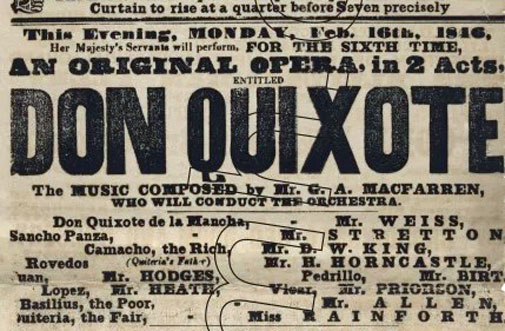
Don Quixote de la Mancha Sancha Panza Camacho, the Rich Rovedos (Quiteria's Father) Juan Pedrillo Lopez Vicar Basilius, the Poor
Quiteria, the Fair |
- Mr Heath
|
Conductor - George Alexander Macfarren
History
The success of Macfarren's The Devil's Opera led to a new commission, An Adventure of Don Quixote, which was completed in 1841 but failed to be produced when Balfe's National Opera Company at the English Opera House went bankrupt. In 1843, Alfred Bunn reformed a company at Drury Lane and later took up the opera and staged it in February 1846, immediately after the immensely popular Maritana of William Vincent Wallace. However, despite being advertised as "an immense success" and the Morning Herald (Feb 23, 1846), only the day before its run finished, claiming that the theatre was "as crowded as ever", it only ran for 11 nights until February 24.[1] The lack of further performances might partly have been due to the considerable success of Benedict's The Crusaders, which opened on February 26.
Don Quixote was promised for April 14, 1845, but did not materialise. On May 5, Drury Lane substituted it for Benedict's The Crusaders when Emma Romer was ill and performed it again on May 7, presumably for the same reason.[2] Elizabeth Rainforth included the second act ("for this night only") in her benefit on May 11.[3] It does not seem to have been revived since although numbers from the opera were included in concerts for some years and Macfarren composed a concert fantasia on its themes.
[1] Assuming it ran on the evenings that it was advertised. The Times (Oct.29, 1849) stated it in its review of Macfarren's King Charles II that it only ran for 9 performances.
[2] The Sun (May 6, 1846) and The Sun (May 7, 1846)
[3] Morning Post (May 6, 1846)
Plot
The plot is an adaptation of an episode from Miguel de Cervantes' Don Quixote [1]. Felix Mendelssohn had used the same episode in his very short-lived opera Die Hochzeit des Camacho (1829), although his libretto by Friedrich Voigt was rather more ambitious.
|
Camacho the rich is serenading Quiteria, whom he is due to marry, although she does not want to marry him but rather Basilius the poor. Sancho Panza, Don Quixote's servant, stumbles in on the scene and a quarrel ensues, which is interrupted by Don Quixote. He, on learning of Quiteria's unhappiness, challenges Camacho. Rovedos (Quiteria's father) enters and manages to calm things down and they all enter for the wedding feast. Basilius the poor enters lamenting that he loved Quiteria long before Camacho. Quiteria joins him and they plan their escape together. Don Quixote is outside looking at the stars and he and Sancho stumble into the escape causing much confusion and ending up with Don Quixote tied up and Sancho in the water trough (scene above). The commotion rouses the household and the escape is thwarted. |
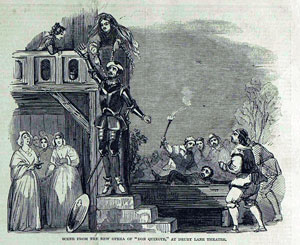
Illustrated London News (February 7, 1846) |
Rovedos chastises his daughter who asks him to spare Basilius, which he says he will do if she marries Camacho. Don Quixote makes a triumphant entry egged on by the crowd as all go off to the marriage ceremony. Quiteria and Camacho are on the point of being married when Basilius reappears and stabs himself. Quiteria faints in Don Quixote's arms. As Basilius's life ebbs away, he asks that he and Quiteria should be married. Camacho and Rovedos agree as he is dying. Once married Basilius makes a rapid recovery. Outraged at the deception, Camacho, Rovedos and their supporters advance on the newly married pair and their supporters. Don Quixote stands between them and declares that "in love, as in war, stratagems are all allowable". All ends in harmony.
[1] An English translation can be found here
Reception
The opera drew strong opinions. The Daily News (February 4, 1846) thought it a great success and did
not hesitate to say, in general, that though we have heard music that is more brilliant and florid; more calculated to catch a vulgar popularity, yet that since Barnett's Mountain Sylph, we have not heard any English dramatic music which so strongly bears the impress of a real artist.
Unusually it did a follow up review, on February 17, only a week before the end of its run, that spoke of the opera's success being "confirmed by each repetition" and that it "draws crowded audiences, by whom it is received with undiminished applause; and our most eminent musicians, and most intelligent critics, are unanimous in the approbation of the work".
The Morning Post (Feb. 9, 1848) was another which did a repeat visit following up its fulsome and detailed two column February 4 review with a second review (February 9) that "has strengthened our opinions of its merits" and went on to list the virtues of the individual numbers. Not content, it also reviewed Macfarren's piano arrangement of certain numbers in its April 11 edition and could not resist repeating some of the praise, although it must have been obvious by then that the opera had no future. The Atlas also did two reviews, both very positive and promised a third for February 21, which did not materialise probably because it was clear that the opera was near the end of its run.
The Era (Feb.8, 1846) held that its success afforded "another proof to the revilers of our native musicians" and that Macfarren had "eschewed the brilliant nothings so rife in the present day...The ruling thought is worked out truthfully and symmetrically...the orchestration is graceful and scientific". While they did not deny resemblances here and there to the giant poets of the past, "there is a wide chasm between resemblance and plagiary; it is far easier to censure than to discover".
C.J.[1] in The Connoisseur (Mar, 1846), p.51, was dismissive. "The music may be described in a few words; it is not original; there is not one idea that is not borrowed". "The singers did but little for the music". He also complained at the anachronism of using an Handelian style for Don Quixote when the character was several centuries older, "a vast amount of trouble taken for very little purpose". A more recent critic, Michael Hurd, disagreed praising Macfarren for making such a distinction: "the Don's own melodic lines have a bravura extravagance that differentiates them sharply and very appropriately from those of the other characters in the story"[2].
Charles Gruneisen wrote for both the Illustrated London News and the Morning Chronicle [3] and his attitude was, as might be expected, similar in both. He made his disenchantment with the opera very plain, emphasising it in even stronger terms after his second visit. In the Illustrated London News (Feb. 7, 1846), he rather grudgingly conceded that it "may be pronounced a success" but thought it "too 'clever' for the elements of popularity" and "a lack of inspiration, and an absence of marked originality, that caused the opera to drag". It remarked on the lack of any Spanish element in the music. By the following week, after repeated hearings, it considered it a failure and "awfully dull and tedious". While "the orchestral effects are well managed...the voices suffer frequently from over-instrumentation" and it had never "met with more reminiscences [of other composers]". In the Morning Chronicle (Feb. 4, 1846), he probably summed up the situation.
His opera will no doubt serve its time, but live it will not, for it has not the elements of vitality. We feel proud at the generous treatment it received, but we hope no false conclusions will be drawn from the kindness of a first night. Orchestral writing will never make a popular opera, and for two or three vocal pieces that charm, the fatigue of sitting out an entire representation is dearly purchased; and this test Don Quixote will not stand.
He wrote about the opera a second time on February 16 when he was, if anything, more damning concluding that "Mr Macfarren has made no advance".
James Davison, a long time friend of Macfarren and editor of the Musical World, had a running feud with Gruneisen [4], which was exacerbated further by Gruneisen's dismissal of the opera. Davison had written several articles ahead of the premiere trying to drum up support [5]. He then wrote three long reviews as well as including one of The Atlas's supportive reviews in the February 14 edition and an article attacking Gruneisen from a third party [ftn 2] after the February 21 review. He made some remarks in his February 7 review about Gruneisen's verdict and then returned more trenchantly in his February 21 review, where he "[took] up the gauntlet in defence of our countryman and his work". He then proceeded to take the initial Morning Chronicle critique apart in detail and at length concluding, incorrectly as seen above, that "The entire press, and the most distinguished authorities in the musical world of London, have pronounced Mr Macfarren's opera, not only the work of a great musician, but an inspiration of decided genius". On April 18, he launched a very personal attack on "The New Critic of the Chronicle" accusing him of reviewing things that he had not heard and of denigrating Macfarren's opera because he took umbrage at Davison pointing out errors and knew that Macfarren was a friend of Davison. With hindsight, Gruneisen was nearer the mark in his verdict.
Henry Allen and Elizabeth Rainforth were generally singled out for praise, Willoughby Weiss and Donald King rather less so and George Stretton almost universally dismissed. Even the sympathetic Morning Post thought "the chorus wanted at least a dozen more rehearsals". The Era agreed on the state of the chorus as well as considering that "The orchestra lacks the necessary weight". It thought "the mise en scene most creditable".
[1] Charles Jeffreys who was identified as writing for The Connoisseur in Leanne Langley, The English Musical Journal in the Early 19th Century. (Ph.D. thesis., University of North Carolina, 1983), p. 117.
[2] Michael Hurd, "Opera: 1834-1865", in Nicholas Temperley, ed.. The Blackwell History of Music in Britain, Vol. 5, (Oxford: Basil Blackwell, 1988), p.318.
[3] A correspondent, M.B. (Morris Barnett?), wrote a short article on "The New Critic of the Morning News" in the Musical World (Feb. 21, 1846), pp.84-85, in which he named Gruneisen as their critic.
[4] Henry Davison (ed.), From Mendelssohn to Wagner (London: Wm. Reeves, 1912). These were a collection by his son of and comments on the memoirs of James Davison. On pages 45-55, it gives some of the history of their antagonism. Gruneisen was often referred to as Jenkins, a pseudonym he had used when writing for certain newspapers. Charles Reid, The Music Monster. (London: Quartet Books, 1984), pp.88-93, also gives a history. Eventually Davison and Gruneisen became close friends.
[5] Alison Mero, The Quest for National Musical Identity: English Opera and the Press, 1834-1849. (PhD thesis, Indiana University, 2014), pp. 224 - 233 goes into Davison's efforts in some detail.
Comment
It was hardly unusual for the press to disagree about an opera but here the opinions seemed more strident and polarised suggesting something more fundamental was going on. Further, several papers reviewed the opera twice either to renew their praise or to pick holes in rival reviews. The animosity between Davison and Gruneisen was a factor, many of the other critics being in Davison's personal circle [1]. Possibly Gruneisen also had issues with Macfarren, whom he sarcastically called the "the British Beethoven" [2]. He also referred in the Morning Chronicle (Feb 16, 1846) to Macfarren's relationship with Alfred Day. Macfarren had been recently dismissed from the Royal Academy for teaching Day's unorthodox theory of harmony.
Notwithstanding these personal factors, there were in the musical press at this time several strong undercurrents that often gave a bias to reviews [3]. One, which was not a factor here, was the upper classes frequenting the Italian opera to the dismay and frustration of the politically aspirational middle classes, of which composers and critics tended to be a part. This meant that the upper classes lent little support to English opera, which was constantly under resourced, in danger of collapse and unable to establish a stable presence. This in turn discouraged composers from spending time writing new operas. Associated with this was the belief that continental performers were preferred over native musicians. This view was opposed in some quarters, see the Comment section of Barnett's Farinelli
There was a growing pressure to recognise instrumental music as the highest form of music in the place of vocal music. Germany was the source and mainstay of this idea and German music with its structure and rationality was often contrasted with Italian, which was often reliant on melody. It encouraged the formation of rules for composition and harmony and the idea of "scientific" music, which, unfortunately, easily slid into the idea that, by keeping to the rules, a composer would be producing music of value and which would be valued.
The popular emphasis on melody was manifested most clearly in the demand for English ballads, both as part of operas and as concert items, a demand encouraged by the music publishers. As these publishers were often the main source of revenue for composers, composers found themselves under pressure to provide ballads even though they might not feel them appropriate in their compositional scheme [4].
The main problem, as is clear here, was that often such "scientific" music did not immediately attract the public, who were unaccustomed to the demands that it made, being used instead to the instant appeal of melody. As can be seen from some of the comments above, it was recognised that the music would need to be heard several times to be understood and appreciated by the less musically sophisticated hence the encouragement to hear it more than once; "A first hearing discloses only a part of its beauties", Morning Post (Feb. 9, 1846). It continued, rather patronisingly, that "The second finale is less continuous, but more easily appreciable by the unlearned". Unfortunately, in Macfarren's case, there was little in the way of engaging melody that could initially attract an audience to persevere. His supporters made a virtue of this. The Daily News (February 17, 1846) stated that "it derives no meretricious attraction from the geegaw tinsel and trickery of the style to which English audiences have been so much accustomed", presumably a reference to Balfe's easy melodic appeal.
Later in the century this division became more subtle and sometimes took on a more moral colouring, melody carrying the threat of loss of self control and a softening of the intellect [5]. In 1871, the Revd. Hugh R. Haweis [6] distinguished between German and Italian melody. Taking Beethoven's Adelaide as his example, "We are thrilled; we are not dissolved, we are moved yet without losing our self-control; and we are too much in earnest to be the mere sport of our emotions". On the other hand, emotions in his Italian example "are all upon a low plane. The kind of man who could so express his love is an artificial sentimentalist, his feeling is at once exaggerated and extravagant, but not deep". He castigated the English love of the ballad. "They represent the national music of the English people. The people understand music to be a pleasant noise and a jingling rhythm; hence their passion for loudness and for the most vulgar and pronounced melody"[7].
[1] Henry Davison (ed.), From Mendelssohn to Wagner (London: Wm. Reeves, 1912), p.67 makes clear that many of the critics were part of Davison's personal circle and hence their support for the opera is hardly surprising. Charles Reid, The Music Monster. (London: Quartet Books Ltd., 1984), p87, also mentions some of Davison's "central group".
[2] Davison, Op.Cit. p. 53
[3] The broader role and arguments in the musical press are discussed at length in John Ling, Debating English Music in the Long Nineteenth Century. (Woodbridge: The Boydell Press, 2021), Alison Mero, The Quest for National Musical Identity: English Opera and the Press, 1834-1849. (PhD thesis, Indiana University, 2014) and Alison Mero, "The Climate for Opera in London, 1834-1865" in Nicholas Temperley (ed.) Musicians of Bath and Beyond: Edward Loder (1809-1865) and his Family. (Martlesham, Suffolk, UK: Boydell Press, 2016), pp. 58-73.
[4] Mero (Op. Cit., 2016), pp. 70-73, discusses the role of the ballad
[5] Ling, Op.Cit., pp. 193-197, covers these matters in some detail.
[6] Hugh Reginald Haweis, Music and Morals, 19th edition, (London: Longmans, Green and Co., 1900), p.101.
[7] Haweis, Op.Cit., p. 485
Scores and librettos
The manuscript submitted to the Examiner can be found in the British Library Add MS 42991 ff.271-297. It was received on January 23, 1846 and signed off on January 26, 1846. The printed libretto (London: Chappell, 1846) can be found here. There are only a few minor differences between the manuscript libretto and the printed libretto.
The manuscript score is in the Fitzwilliam Museum, Cambridge, https://idiscover.lib.cam.ac.uk/. The scores for two of the songs are in the British Library
Recordings
No excerpts are known
Books, Articles, Online
Alison Mero, The Quest for National Musical Identity: English Opera and the Press, 1834-1849. (PhD thesis, Indiana University, 2014), pp. 224 - 233 has an interesting section on the efforts of James Davison of the Musical World to drum up interest in Macfarren's opera.
Henry C. Banister, George Alexander Macfarren: his life, works and influence. (London: George Bell and Sons, 1891, pp. 191-194 includes an account of the opera's history. It is available online at http://www.archive.org/.
George Biddlecombe, English opera from 1834 to 1864 with particular reference to the works of Michael Balfe. (New York: Garland Publishing, 1994), pp. 153-154, has a short section on this opera and Macfarren's The Devil's Opera.
Some comments on the opera are included in Russell Burdekin, "Sir George Alexander Macfarren, his life and his operas", The Journal of the British Music Society, Volume 32, 2010, pp. 89-90 or p. 12 in the online version here .
 |
 |
 |
  |
|
|