  |
 |

|
  Fridolin
|
|
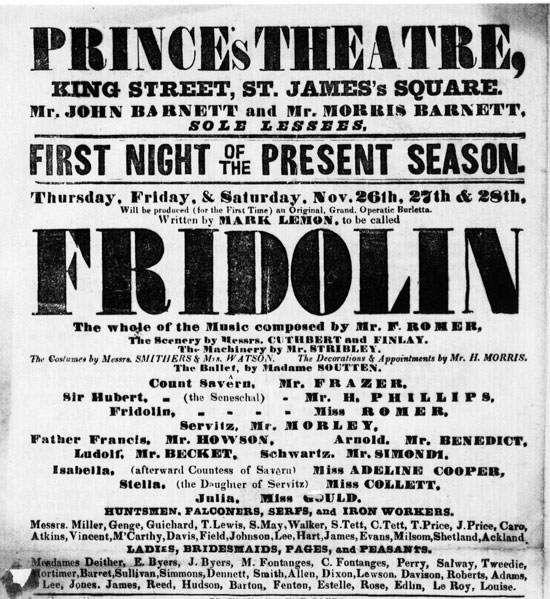
Count Savern Sir Hubert (his Seneschal) Servitz (Steward to the Count) Carl Fridolin (Page to the Countess) Father Francis Arnold Schwarz
( Ironworkers) Chorus - Falconers, Foresters, Ironworkers,
Isabella (afterwards the Countess Savern) Stella (the Daughter of Servitz) Julia (an Attendant) |
- Mr Lewis Serfs, etc
|
Chorus - Bridesmaids, Peasants, Attendants etc
History
With Alfred Bunn in financial difficulties and having to leave Drury Lane in 1839, the English Opera House continuing its precarious existence and Covent Garden showing a lack of interest in English opera, there was little opportunity for new works. This may have been what led the composer, John Barnett, and actor, Morris Barnett (no relation), towards the end of 1840 to take on the St James's Theatre, recently renamed the Prince's theatre,[1] in order to stage English opera. They gathered a good company but their star soprano, Emma Romer, only agreed to join if they opened their season with her brother, Frank's, opera Fridolin.
The enterprise folded in little over a week on December 5. This was usually blamed on the quality of the opera. The Era (Dec 6, 1840), on page 5, wrote that Emma Romer had "positively refused to sing in any opera but the eminently unsuccessful one written by her brother". In particular, she refused to switch to singing in The Mountain Sylph when Fridolin's failure became apparent and so precipitated the company's demise. However, The Era seemed to have forgotten that, on page 2, it had written that the Prince's theatre had "been well attended during the past week, and although we cannot venture to predict any very lengthened career for Romer's opera, it may serve as a stop-gap until Barnett's Kathleen ... is ready for representation". It had also carried an advertisement for it for the following week. However, the Morning Herald (Dec. 7, 1840) claimed that "After the first night, it was played literally to empty benches". The Weekly Dispatch (Dec. 7, 1840) gauged that it had played "certainly not to such full houses as on the opening night". Whatever, the truth of its popularity, the fundamental cause was probably that, as so often, there were insufficient funds to support the undertaking from the outset [2].
The opera was revived for four performances the following year on March 3 when Romer and Henry Phillips went over to Dublin. It was advertised "as performed with brilliant success at the St. James's Theatre". In fact, Phillips was contracted to sing in Balfe's company at the EOH at the time and his failure to turn up was partly to blame for its eventual demise [3]. There were no more revivals, although for a few months numbers were given occasionally at concerts. Lemon and Romer did not attempt another opera either together or separately.
[1] The Lord Chamberlain's Day Book says that it was put on at the Princess's Theatre but that was clearly a confusion with the Prince's Theatre, which had disappeared by the time the list was put together some time after the event. In later years, the lists were filled in at the time the manuscript was submitted.
[2] The Theatrical Journal (Dec 1840), p.438, in an article on the Failure of the Prince's theatre, claimed that it did not begin with sufficient money even to meet a fortnight's expenses. It also mentioned Emma Romer's "intractableness" although not by name.
[3] There was a lawsuit, letters in the press and a pamphlet from Balfe entitled Statement and Correspondence between Mr. Balfe and Mr. H. Phillips, Relative to the Affairs of the Above Theatre (London: W.F.Johnston, 1841) that laid out Balfe's version of events
Plot
The printed Songs etc. claimed that "The Drama of the Opera, is founded on an incident in the life of Saint Elizabeth of Portugal and Schiller's celebrated Ballad of 'Fridolin' ". Elisabeth was married to King Denis of Portugal. The incident on which formed the foundation of the opera [1] was
The King believed a lie told about Elizabeth and one of her pages by another page, who was jealous of his companion. In great anger the King ordered the one he believed guilty, to be sent to a lime-burner. The lime-burner was commanded to throw into his furnace the first page who came. The good page set out obediently, not knowing death was waiting for him. On his way he stopped for Mass, since he had the habit of going daily. The first Mass had begun, so he stayed for a second one. In the meantime, the King sent the wicked page to the lime-burner to find out if the other had been killed. And so it was this page who was thrown into the furnace! When the King learned what had happened, he realized that God had saved the good page, punished the liar, and proven Queen Elizabeth to be innocent.
Friedrich Schiller's poem, Fridolin, oder, Der Gang nach dem Eisenhammer was published in 1797 [2]. It essentially transformed the above into a long ballad, though with a Count Savern the jealous husband. One interesting change was that rather than a lime burner he had an iron foundry, perhaps a nod to the emerging industrialisation.
The Lemon plot for Fridolin was an uneasy marriage of the above and a typical piece of melodrama. Prior to the start of the opera, while Sir Hubert was away, his wife had (willingly or unwillingly) gone off with Count Savern, taking her young son with her. The Count, tiring of the relationship, had then turned them out to fend for themselves. The child had been taken in by another family but the wife had died.
At the start of the opera, Hubert, who has become the Count's Seneschal although to the Count's ignorance of his true identity, learns that there is no news of his son and that he is probably dead. He vows to make the Count feel as wretched as himself. The Count is about to marry and his Countess has a page, Fridolin, whom her family have taken in as an orphan. Fridolin wants to marry Stella but her father, Servitz, the Count's steward, will not hear of it as Fridolin is penniless.
While the Count has gone off to the Court, Fridolin seeks the help of the Countess to intercede with Servitz. When she agrees, he gives her a "bauble" in gratitude that was left to him by his late mother. All this is observed covertly by Hubert and Servitz. Servitz misinterprets what is happening, which Hubert is happy to encourage in order to forward his revenge on the Count. Fridolin goes to tell Stella about the Countess's promise but Stella has had an idea. She will dress up as the Countess and the two of them can elope unchallenged. They meet later and are again observed by Servitz, Hubert and by the Count, who has newly arrived back and has been apprised of the supposed illicit happenings. The meeting seems to confirm that there is a relationship between Fridolin and the Countess.
The Count condemns the Countess and Fridolin to death but lets Fridolin thinks he has been forgiven. He tells him to go to the iron foundry and ask if the Count's commands have been fulfilled. However, previously, he has told the iron workers to throw the next person who asks if his commands have been fulfilled into the flames. In the meantime, Servitz, worried that the Count will regret his actions and blame him, flees the castle with Stella. Elsewhere, Hubert, confident that the executions are going ahead, locks himself and the Count in a room and throws the key out of the window. He confronts the Count about his past history and the Count realises who Hubert is. Hubert gives the Count a letter from the Countess emphasising her innocence and enclosing the "bauble" from Fridolin as proof. The Count is mortified at what he has done but he is unable to get out of the room to rectify the mistake. He will have to live with the pain of it and so Hubert's revenge is complete. However, Hubert recognises the "bauble" and realises that Fridolin is his lost son.
The ironworkers are about to throw Fridolin into the flames when Hubert arrives and gets them to stop. He then questions Fridolin about his mother and establishes that he is his son. The opera then ends rather abruptly with general rejoicing.
Although not described in either the manuscript or the printed Songs, etc., the Morning Post (Nov. 27, 1840) noted that, at the end, "The Countess is also saved and Hubert, with his son restored, returns to humanity and forgives the past. Fridolin has the steward's daughter, the Countess and her husband are reunited in love and confidence, and the opera concludes with strains of jubilee". This was presumably done in dumb show while the final chorus was being sung.
[1] Taken from https://www.catholic.org/saints/saint.php?saint_id=116
[2] An English translation of the poem entitled Fridolin (The Walk To The Iron Factory), can be found at https://www.best-poems.net/friedrich_von_schiller/fridolin_the_walk_to_the_iron_factory.html.
Reception
The History section above shows that there were quite divergent views on the opera's popularity, fueled possibly by other agendas than the size of the audience. The one common factor amongst most of the reviews was praise for Emma Romer's exertions in support of the opera, no doubt conscious that she had been instrumental in having it accepted for performance. In fact, her effort was such that she was close to fainting at the final curtain at the premiere.
The often skeptical Morning Chronicle (Nov. 27, 1840) dismissed the opera as having "no originality, no variety, no character, no expression". Where a song was acceptable, "it is a melody that has been heard a thousand times before". The Examiner (Nov. 29, 1840) wrote that the opera was successful ... notwithstanding its want of originality, and its sacrilegious murder of the simple and pathetic story of Schiller". In line with its view that English opera should revert to the old style ballad opera, it wrote that "the really meritorious part of the opera consisted in some simple ballads, where the melody was pleasing though far from original" and three of which were encored.
Though The Era was later more sympathetic, its initial response (Nov. 29, 1840) was that the opera "is not calculated from its intrinsic merits, to elevate the taste, please the judgment, or bring money to the treasury". While "the words of the songs, generally speaking, are prettily written ... , the story is heavy and, until nearly the close, uninteresting ... the dialogue labours for want of a dash of comicality ... the subject, excellent in itself, is frittered away into empty nothingness, simply because the original story is departed from" . It noted that the first act finished "amidst faint applause" but that the other acts improved with several numbers encored. Overall, it thought that "were the opera considerably curtailed [1], it would be far more likely than it is now to attract public attention". It judged that the music was well sung by both the main vocalists and the chorus.
The Morning Post (Nov. 27, 1840) [2] wrote that the libretto was better than recent operas, "although [the words] do not pretend to any great dramatic force or to the higher sublimities of poetry". On the other hand, "the music was far from excellent: the overture was dull, and wanted melody; it had all the crudities without the beauties of the German school".
The Odd Fellow (Dec. 5, 1840) thought the music "pretty, nothing more ... but throughout there is no scintillation of the quality, genius". The reviewer was very complementary about the "very powerful" libretto, whose "lines are not like the usual run, namby-pamby and unmeaning; but on the contrary, express passion in words which have an office higher than that of merely touching the ear". The article also remarked on the excellence of the orchestra under John Loder.
The Times (Nov. 26, 1840) was not at all happy that they had departed so markedly from Schiller with Fridolin no longer a "simple pious creature" and the moral arc of the piece with its retribution on the false accuser broken. An opera based more firmly on Schiller "would have been one of the most poetical things imaginable". It did applaud the final scene and noted the audience's enthusiasm for it, whereas they had "seemed occasionally impatient during the earlier part of the drama". The ballads were true to Frank Romer's reputation being "not original in idea, but of a kind to arrest and gratify the general ear". "The concerted pieces, on the contrary, moved heavily, they wanted purpose".
The Weekly Dispatch (Nov. 11, 1840) found no fault with the loose adaptation from Schiller's poem "for a literal representation ... on the stage would be tame, if not ridiculous. Poems, beautiful to read, are often the very antithesis of theatrical exhibition". It noted that the "music was very warmly received" and, as other papers did, praised the performers.
On the revival in Dublin, The Freeman's Journal (Mar. 4, 1841), relying on the London critics, had not expected much and the overture and early parts had rather reinforced that. However, Emma Romer's first ballad "carried the house completely with her, and banished all our fears about the mediocrity of the music".
[1] The Theatrical Observer (Dec. 3, 1840) noted that there had been "a judicious, yet slight curtailment".
[2] The same report appeared in The Observer (Nov. 29 & 30, 1840)
Comment
Before the start of the opera, Mrs Selby had read out an address. This was a typical ritual at the start of a season. In this case there was much emphasis on the support of British musicians and the need to repel the invasion by foreign musicians. "The address was a good deal cheered during its delivery, the only symptoms of disapproval falling upon the reproach of the patronage of foreigners to the neglect of native talent" (Morning Post, Nov.27, 1840).
The Morning Chronicle (Nov. 27, 1840) disagreed [1].
But it is quite unsound. The common cry, which it echoes, of 'native genius doomed to cold neglect' is wholly groundless ... on our musical stage, genius and talent, either in composition or performance, have uniformly been cherished by the public ... [Foreign musicians] have long been our models and our instructors; and instead of railing at them and treating them as enemies, we must, if we desire the progress of the art among us, make them our models and instructors still. Let us contend with them in fair and honourable emulation, but not give way to narrow and illiberal feelings towards them.
This defence reflected the free market ideas of competition and the power of the market leading to improvement that underlay the huge economic and industrial changes that were taking place more widely.
In practice, the perception that native musicians and by association, English opera, were less valued was not so easily dismissed. There was a strong element in the press who supported English opera and pressed the idea that it was disadvantaged by the huge resources employed by the Italian opera underwritten by the money of the upper classes. These were believed to attend mainly for fashion and status rather than musical interest. This imbalance was seen to lead to the continuing problems of establishing a firm and continuing foundation for staging English operas, which in turn discouraged composers from creating new ones thus leading to a weakening of interest in English opera. These arguments also played into the politics of the time because of the continuing attempts by the lower and middle classes to demand a greater say in how the country was ruled.
These arguments also impinged on the increasingly bitter argument, mentioned in Barnett's Farinelli and Macfarren's An adventure of Don Quixote, of German music as a higher status, "scientific", pure music as opposed to frivolous melody, seen as the foundation of Italian opera. .
[1] The London and Westminster Review (April 1837), UK edition, pp.33-49, had a lengthy article entitled "British Musicians" by "J.C." contesting these complaints. The Theatrical Journal (Dec 1840), p.438, also had a shorter and rather less strident dismissal.
Scores and librettos
The manuscript is available in the British Library: Add MS 42957, ff. 749-769. It was submitted on November 17, 1840 and signed off on November 22, 1840. The Songs, Duetts [sic], Trios, Choruses (London: James Pattie, 1840) are found at Add MS 42957, 568-583b. It is unusual for printed material to be included in the Lord Chamberlain's plays but this was because the manuscript referred to numbers in the printed Songs etc rather than include them in the manuscript. Thus, the vocal items were created and printed ahead of submitting the manuscript to the Examiner rather than post approval. A transcript of the combined complete libretto is available here. There was no printed libretto to compare against the dialogue in the manuscript
There are vocal scores of four of the numbers from the opera in the British Library. The ballad "The one we love" can be found at Google books.
Recordings
None are known
Books, Articles, Online
None are known.
 |
 |
 |
  |
|
|