  |
 |

|
  Diadeste or The Veiled LadyMusic by Michael William BalfeLibretto by Edward Fitzball
Theatre Royal, Drury Lane,
London
|
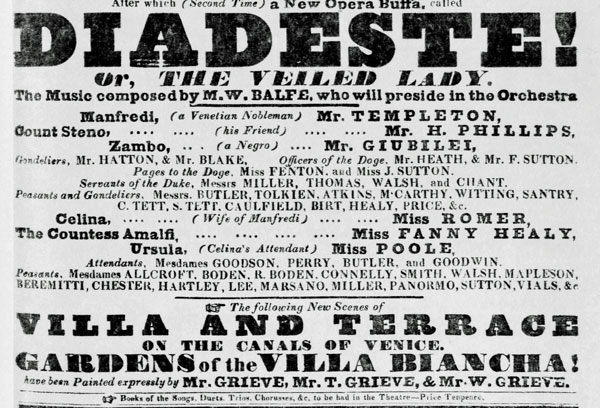
|
Manfredi (a Venetian nobleman Count Steno (his friend) Zambo (a Negro)
Gondoliers
Officers of the Doge
Celina (wife of Manfredi) The Countess Amalfi Ursula (Celina's attendant) |
- Theodore Giubilei [1]
-
John Hatton
|
Conductor - Michael William Balfe
[1] The printed Songs etc ( Google Library), The Times (May 18, 1838) and The Observer (May 21, 1838), whose review was identical, all have Edward Seguin as playing the part but the Theatrical Observer and other contemporary advertisements and press reports list Giubilei. Perhaps his black face disguise made identification difficult.
History
According to the Morning Advertiser (March 26, 1838) Balfe and Alfred Bunn, the Drury Lane manager and librettist of Balfe's The Maid of Artois, became temporarily estranged at the start of 1838 but were then reconciled and signed an agreement for a new opera (actually referred to in the report as a comic operetta) in March, 1838. This was Diadeste with libretto by Edward Fitzball.
Diadeste was, supposedly, an Arabic game [1] which underpinned much of the action of the opera. It seems to have been first mentioned in one of the stories, "The Amorous Philosopher" included in Denis Dominique Cardonne's A Miscellany of Eastern Learning. Trans. Anon. (London: J. Wilkie and B. Law, 1771), pp. 18- 24. The basic idea of the game was a wager between two people in which, over an agreed period, each of them tried to hand over something to the other person that was accepted by the other person without them saying "Diadeste". If they managed to do so then they won.
Samuel Taylor Coleridge used the game in his unfinished play, Diadeste, but with a completely different plot [2]. The game was then used by Amable Villain de Saint-Hilaire and Léon Pillet for their libretto for Jules Godefroid's Le diadesté ou La gageure arabe staged at the Opéra Comique, Paris, on September 7, 1836. Essentially Fitzball transformed this libretto into an English version, although not a literal translation. In particular, he made the servant figure, Dominique, a black servant, Zambo, and adapted the part to take advantage of the enormous contemporary popularity of Thomas Dartmouth Rice’s exaggerated stereotypical Jim Crow act and including a song based on Rice's style.
The opera seemed to have been put together at great speed as the libretto manuscript appeared to have been sent to Balfe in sections, with several sheets having Balfe's address on them. Bell's New Weekly Messenger (July 15, 1838), no doubt, exaggerated in writing that Balfe had "to scramble and botch up,[the opera] at a week's notice" but there might well have been an element of truth as there was probably less than two months between signature and rehearsal. William Tyldesley [3] claimed that Balfe wrote it as a filler to go with the revival of The Maid of Artois with Emma Romer. Certainly, it was coupled with The Maid of Artois for a few performances later in its run in early June, 1838, but Tyldesley offers no supporting evidence and no mention of the link has been found in the press.
The premiere took place on May 17, 1838. The News (May 13, 1838) had advertised it for May 15 claiming that it had been delayed until then by Romer's indisposition. So it had been planned for earlier and was then postponed again, presumably for the same reason, until May 17. It ran for over 5 weeks, although its coupling with The Maid of Artois during early June suggests that its popularity was waning. Alfred Bunn [4] claimed that it was given 16 performances during this run.
In August 1838, it was put on in Cork as part of a short season of opera. Balfe sung the part of Count Steno, which he had done for a few performances at Drury Lane. The Age (Sept. 23, 1838) reported that the the three main singers, presumably with local support, had given the opera in Bristol, perhaps on their way back from Cork by boat, but that it had not "been relished by Bristolians".
Balfe took on the management of the English Opera House (EOH) in July 1839 as nominal head of a consortium of singers and actors {5]. He chose Diadeste as the first opera to be performed on July 22, 1839. A month later Diadeste had to be substituted when Adam Leffler was too drunk to appear in Luigi Ricci's Un'avventura di Scaramuccia. This may well have been its last performance at the EOH.
In March 1840, Balfe organised a tour with a season of opera in Dublin including Diadeste with his wife, Lina, as Celina. This was followed by various towns and cities both in Ireland, including Galway, Limerick and Cork, and England, including Taunton and Southampton.
On December 2, 1842, it was given at the Royal Grecian Saloon, where it continued to be revived occasionally up to April 1848. No full performances in Britain have been found since then, although numbers from the opera continued to be included in concerts almost until the end of the century.
The opera, other than a few isolated numbers, does not seem to have been performed outside of Britain and Ireland except in the US where Caroline Richings toured it in 1864, including Detroit and Buffalo. That would have been a rather odd choice by that time but was possibly due to its modest requirements compared with many operas.
[1] Some reviews referred to it as an Italian game but this was probably because of the setting of the opera
[2] Earl Leslie Griggs, " 'Diadestè', a Fragment of an Unpublished Play by Samuel Taylor Coleridge", Modern Philology , May, 1937, Vol. 34, No. 4 (May, 1937), pp. 377-385, outlined the play's history and plot. He dated it at around 1812-1820.
[3] William Tyldesley, Michael William Balfe: his life and his English operas, (Aldershot, UK: Ashgate Publishing, 2003), pp. 73.
[4] Alfred Bunn, The Stage: both before and behind the curtain. Vol. 3 (London: Richard Bentley, 1840), p. 244.
[4] See English Opera House on the Theatres page.
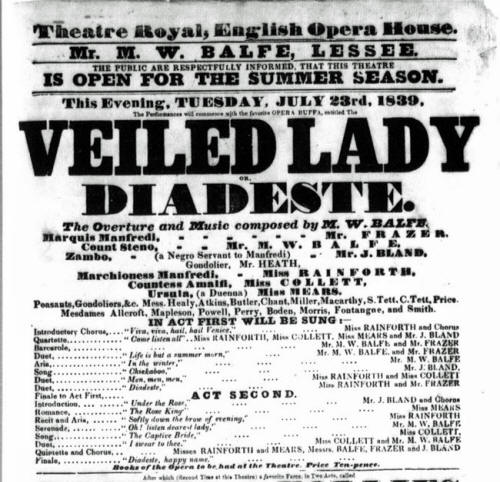
English Opera House performance under Balfe as manager
British Library playbills
Plot
Celina and the Countess Amalfi have opposing types of problems. The former has a jealous husband, Count Manfredi, and the latter a disinterested but roving fiancé, Count Steno. Although Steno is a close friend of Manfredi, Manfredi, aware of Steno's reputation, has never introduced him to his wife. He also mandates that his wife should wear a veil when in public. Celina hatches a plot to rectify both men's behaviour. Steno boasts to Manfredi about a veiled woman he has seen at St Mark's whom he is keen to pursue. Manfredi is convinced that it must be Celina. Celina arranges for the Countess, veiled, to fulfill an assignation with Steno and succeeds in getting his diary of conquests. The Countess entices him back to Manfredi's country villa. Celina has previously engaged in a game of Diadeste with Manfredi, who has come hot foot back from Venice convinced that he will find his wife with Steno. He is so incensed that Steno might be hiding in a locked room that he demands the key from Celina. She hands it over without him say Diadeste, so that he loses the bet. Meanwhile, the Countess has used Steno's diary to thoroughly embarrass him and admit the error of his ways. Eventually, all is explained and the men are, hopefully, reformed characters
Reception
Alfred Bunn, the manager of Drury Lane Theatre at the time of its premiere, spoke of the opera
"though possessing much graceful melody, had better have lain by, than lain in, for a smaller theatre - it is not stirring enough for this huge building - the people can't pronounce the name of understand the game, and the music does not much enlighten them". [1]
Bunn's opinion was supported by The Oddfellow (July 27,1839) reviewing its revival at the English Opera House on July 22, 1839. It wrote that the opera "had ... much greater justice done to its merits than had been rendered to them in the greater theatre". Interestingly, Balfe titled his score Veiled Lady so perhaps he shared the same dislike for the Diadeste title.
As was almost always the case, the libretto was dismissed out of hand. The Crim. Con. Gazette (Sept. 7, 1839) described it as "the worst libretto ever written". The Musical World (May 24, 1838, p.72) thought "the libretto is the most ridiculous one we ever sat out". Further "we question whether the music is of a quality sufficiently redeeming to compensate for the sitting out of so dull an affair".
The Sunday Times (May 20, 1838) was largely sarcastic about the whole opera and the performers. In particular, it accused Balfe of plagiarism from a variety of composers, summing it up that "The overture was rapturously encored, out of a kindly spirit of affectionate greeting to the many old acquaintances assembled in it". The Analyst (Apr. 1838), p. 315, was of much the same opinion talking of it being "brought out in great haste, and being, moreover, little better than a repetition of the composer's reminiscences of modern Italian phrases". It regretted that he should have sacrificed "his interests so far as to scramble together and botch up, at a week's notice, the crudities of a flimsy school, however fashionable".
Others felt differently. The Observer (May 21, 1838) considered that "if not the most elaborate, may certainly be called one of his most happy and agreeable works" while the Evening Chronicle (May 18, 1838) judged that "The excellence of Mr Balfe's music will probably give this piece a longer run than its dramatic merits deserve.
The Morning Post (May 18, 1838) wrote that
We cannot eulogise too highly Mr Balfe's judicious and effective use of orchestral resources in the accompaniments; they were at times of singular beauty and more descriptive evenness than we have remarked in any of his former operas.
The singers and various numbers were also generally praised except that Zambo's Jim Crow type song, sung by Giubilei "albeit well sung by him, was unworthy of Balfe's power".
The Observer also thought that "the curtailment of a negro part...might be recommended; it occasionally borders on the nonsensical". While they may generally have not found the part congenial, one suspects that it was the potential clouding of English opera's claims to serious musical attention by introducing such a populist element, which may have been the stronger driver. On the other hand, the Evening Chronicle thought that Giubilei's hoarseness "consequently spoiled one of the prettiest and most characteristic negro songs we have ever heard".
Henry Phillips failed to appear for some performances and Balfe took over the part and, it was claimed [2], played the part "so well that Bunn was inclined to cancel" Phillips. However, a more disinterested observer, the Revd. Thomas Oldrini [3], who saw Balfe in the part, wrote that " He had not much voice, but humoured it cleverly and acted with vivacity".
The Morning Chronicle (July 23, 1839) held that the revival the following year was more successful than the original performance.
[1] Alfred Bunn, The Stage Both Before and Behind the Curtain. Vol. 3. (London: Richard Bentley, 1840), p. 55
[2] William M. Barrett, Balfe, his life and work.(London: William Reeves Bookseller Ltd., 1883), p.120.
[3] Thomas John Oldrini - My Biography. Online . Available at http://www.beeston-notts.co.uk/oldrini_autobio.shtml , [accessed Oct 6, 2022]
Comment
Three of Balfe's operas include black characters: The Maid of Artois (1836), Diadesté (1838) and The Bondman (1846). Each of them showed a quite different picture of attitudes to black characters. Michael William Balfe, an unwitting cultural bellwether examines these differences in more detail.
Scores and librettos
The libretto manuscript is in the British Library at Add MS 42947, ff. 95-174. A transcript can be found here. There does not appear to be a printed English libretto but the words for vocal numbers can be found at Google Books. Differences from the vocal items shown in the manuscript are footnoted in the transcript. There are several minor differences. The score is in the British Library, Add MS 29333.
Recordings
No excerpts are known
Books, Articles, Online
William Tyldesley, Michael William Balfe: his life and his English operas, (Aldershot, UK: Ashgate Publishing, 2003), pp. 73-75, includes a description and a cursory analysis of the opera. There are also short sections on the opera in the books on Balfe by Walsh, Kenney and Barrett (see book list).
 |
 |
 |
  |
|
|