
 |
 |

|

 Castle GrimMusic by George Benjamin AllenLibretto by Robert Reece
Victoria Hall, Bayswater
|
|
Charles Ravenswood David Death Miss Flora Shipley Mrs Tombs |
-
Elliott Galer / (Elliott Galer) - Mr Lambert / - Mdme d'Este Finlayson / -
Mdme Helen Percy / |
Conductor at the Victoria Hall - George Allen
Conductor at the New Royalty - George Allen [2]
[1] The names in brackets are the cast for the New Royalty revival.
[2] Frederick Kingsbury was the theatre's musical director and would have conducted all the performances bar possibly the first, which traditionally often was conducted by the composer. Both The Era (Sep. 10, 1865) and The Standard (Sep. 4, 1865) said that Allen conducted but The Times (Sep. 4, 1865) that it was Kingsbury. Kingsbury conducted the other musical work on the programme, William Brough's Prince Amabel.
History
This was the first of four new English operas given at the New Royalty theatre by Elliot Galer and Fanny Reeves' company in under a year. All four were lighter works that could and sometimes were characterised as operettas. This change of direction for English opera that marked the end of the English Romantic Opera era is discussed below. Castle Grim was Robert Reece and George Allen's first and most successful attempt at what they termed an operetta but which the press and their advertisements generally listed as a comic opera.
The opera received a muted premiere at the Victoria Hall, Bayswater, London, on May 23, 1865 [1]. The choice of venue seemed to be due to the fact that Allen, a local organist, used to hire it for an annual concert and, on this occasion, chose to produce the opera. There was only one performance.
When Elliot Galer and Fanny Reeves took over the New Royalty in September 1865 they revived the opera as the centrepiece of their opening night and usually this is cited as the premiere, an advertisement in The Era (Sep.17, 1865) claiming that it had been "written expressly for this Theatre". It was the first fully staged production. The opera looks as though it ran continuously until October 20, 1865, i.e. some 42 performances. In January the following year the London Operetta company performed it on a short provincial tour with Susan Galton and George Honey but with Joseph Swift instead of Elliott Galer and Blanche Galton instead of Fanny Reeves. Allen revived the opera during his tours of New Zealand and Australia in 1875.
[1] The Bayswater Chronicle (May 20, 1865) claimed that it had originally been scheduled for February 25, 1865, but for whatever reason it was postponed until May 23, 1865, as confirmed by the Bayswater Chronicle (May 27, 1865). However, its edition the following week, June 3, claimed that it was actually performed on May 24, but this may just have been carelessness. The Musical Times (July 1, 1865) also reckoned May 23 as the premiere but it did not see it and was reporting some weeks afterwards. The Victoria Hall was also referred to as the Bayswater Bijou theatre.
Plot
The Standard (Sep. 4, 1865) described the plot as seen in the New Royalty Theatre revival but it is true to the
the manuscript libretto.
Castle Grim is founded on the freaks of a misanthropic young
gentleman named Ravenswood, the owner of the castle, whose
metaphysical studies had led him to believe in the necessity of
suicide. He had gathered a set of fanatics about him to whom his
gloomy notions had given an impulse of silent madness. Ravenswood shut
himself out of the world, and lived with David Death, his body servant
and factotum, who was struggling between a desire to be grave to
please his master, and a constitutional tendency to mirth, and Mrs.
Tombs, the housekeeper of Castle Grim, a lady not disinclined to
cheerfulness. The time is 1760, and the opening scene, Ravenswood's
study in Castle Grim, a most ghostly looking place, filled with goblin
figures.
The death of an old uncle consigns to Misanthrope
Ravenswood an enormous fortune in trust for a young, beautiful, and
lively girl, Flora Skipley, who is all life and merriment. On the
death of her uncle she leaves school, and is consigned to the care of
Ravenswood, much to his own chagrin. She had scarcely entered Castle
Grim when her presence effected a total revolution in the
establishment. Ravenswood was astonished; Mr. George Honey, as Death,
dropped his gravity, eschewed the name, and assumed a splendid style; Mrs, Tombs threw away spectacles and gravity, and dressed in the
prevailing fashion; Ravenswood was caught by the infection of his
pretty little cousin, and eventually his misanthropic habits were
dissipated, and being still a young man (27), he offered his hand and
affection to his pretty and accomplished ward.
Reception
The Bayswater Chronicle (May 27, 1865) reviewed the first performance at the Victoria Hall. It thought it "a most unqualified success" despite the lack of an orchestra or "the accessories which a regular theatre would command" and when even the costumes were not commensurate with the period the opera was said to be set. The chorus was also deemed poor. However, as [these problems] did not interfere with the execution of the music, the mistake was not fatal". The performers were praised although "Mr Lambert... might have made much more of the song 'Let lovers prize their maiden's eyes' ". For its review the following week, the reviewer had had access to the score and included more comments on the "elaborate and elaborate orchestration" as well as going into more details on some numbers. It judged that "For once we have a libretto worthy of the name. The plot is ingeniously conceived and well worked out, and so artistically, that we can scarcely believe it comes from no 'practiced' hand".
All the other London reviews were of the New Royalty theatre production. The Daily News (Sep. 4, 1865) though it "a light and agreeable trifle, which passes off pleasantly enough by the aid of some capital acting and singing". The performers were all praised, "Mr George Honey being especially noticeable". The reviewer thought that "Mr Allen's music is unpretending in style, being rather in the school of the old English ballad opera than of comic opera" but that he had "thrown too much real seriousness into his work to be quite in keeping with the under-current of the action, although occasionally he shows much aptitude for animated and lively expression". Overall "The opera was entirely successful".
The Bayswater Chronicle (Sep. 9, 1865) decided to review it again in its new guise but added little to its previous thoughts other than to confirm that the opera gained by being given with orchestra and proper staging. The Standard (Sep. 4, 1865) also little to say other than give the plot but it did praise the performers and note that "The piece was admirably put upon the stage, and the music was cleverly performed by the orchestra under the direction of its composer". The Weekly Dispatch (Sep. 10, 1865) related the plot back to the Goethe's Werter and its consequent "mania for suicide". It thought that "the melodies interspersed though [the opera] are fresh, sparkling and agreeable" and that its execution reflected "the highest credit on the singers". The Times (Sep. 4, 1865) considered that
The author, Mr. R. Reece, has hit upon a felicitous subject, and treated it with dramatic skill, and the composer, Mr G. B. Allen, has achieved a number of pieces, all of a light nature, all agreeable, and some of them fashioned with musician-like ambition. We may especially point to the elaborate finale of the first act.
The Daily Telegraph (Sep. 6, 1865) wrote that Allen "has turned a rather lugubrious libretto...into a much livelier two act operetta than probably any peruser of the original manuscript would have thought possible". His "music is certainly not remarkable for its striking originality, but is throughout sparkling and agreeable". "The instrumentation is that of a thoroughly experienced musician", being particularly notable in the finale of the first act as well as the part-writing in the second and "the pretty madrigal effect introduced towards the end".
The Argus (June 12, 1875) reviewed the revival in Melbourne. It commented on the music's "air of old fashioned respectability" with its nods to Shield and other composers of his vintage but "very English, and very nice to listen to". It liked many of the numbers but regretted that there was no book of words and that the singers were sometimes indistinct. The scoring was "full and generally pleasing" although it found fault in the handling of the horns. Overall, though, it was "a dull-coloured piece, and the effect of it is gloomy, and this arises from faults which are inherent in the subject".
Comment
Choice of suicide as a plot subject
It is difficult to imagine a plot with suicide a topic for humour being suggested today but hardly any reviews even referred to it let alone questioned it, The Times going so far as to call it a "felicitous plot". The Era (Mar. 18, 1866) referred to the opera's "peculiar libretto" and the Weekly Dispatch (Sep 10, 1865) wrote that "Bizarre in idea, and unfitted as the nature of the subject in some respects is for comic treatment, the little piece, from the skill with which it is put together, is, nevertheless, unquestionably amusing".
Scores and librettos
The libretto manuscript is available in the British Library, Add MS 53042 M. It was received on May 19, 1865 and the licence sent back on May 22. A transcript by Perri Gellman is available here.
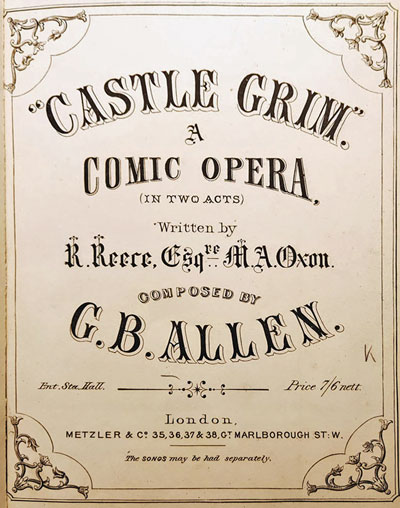
The vocal score (London: Metzler & Co., 1866) is available in the British Library and a scan of it can be found here. The vocal score was almost certainly done in conjunction with the September 1865 revival. Most of the vocal items are the same as in the manuscript but Ravenswood ballad "Pray thee leave me! Mirth is hateful" in Act 2 that was sung at the initial performance, according to the Bayswater Chronicle (June 3, 1865), was replaced by "Ah! Pleasant Dreams". There is no evidence that the change was signed off by the Examiner. No printed libretto has been found so it is not possible to say if the dialogue was unchanged.
Recordings / Streaming
None known
Books, Articles, Online
None known.
 |
 |
 |

 |
|
|