  |
 |

|
  Lord of the Isles
|
|
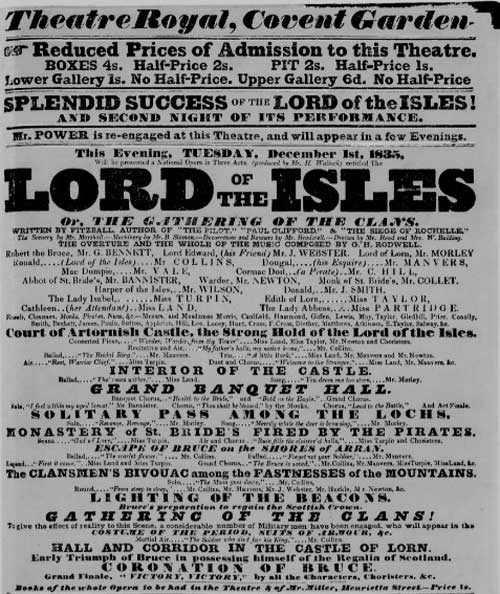
King Robert Bruce Ronald Lord of Lorn Lord Edward Abbot of St Bride's Dougal Monk of St Bride's Cormac Doil Mac Dumple Harper of the Isles
The Lady Isabel Kathleen Edith of Lorn Lady Abbess |
|
History
|
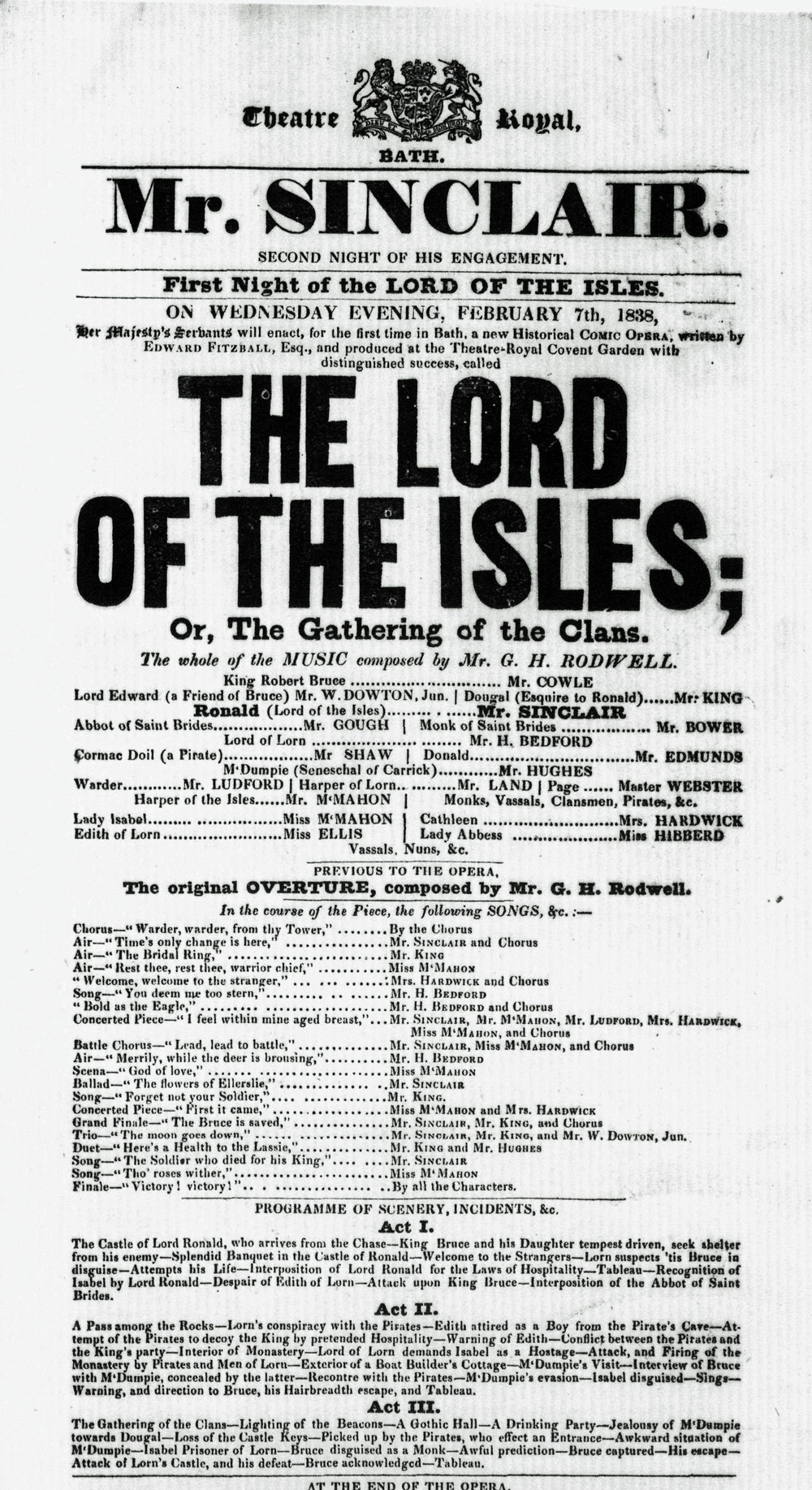
George Rodwell had penned a letter [1] in 1833 urging the establishment of an English Opera house and here was taking up the challenge with a libretto by Edward Fitzball based on Sir Walter Scott's poem. The première was at the Surrey Theatre on November 20, 1834, apparently the first time that the Surrey had staged an opera according to Fitzball [2]. It ran there until December 17, 1834. It then appeared at various theatres on the East Anglian circuit (perhaps a result of Fitzball's connections with the region). A notice in the Norfolk Chronicle (April 18, 1835) mentioned that the season at the Lynn Theatre closed with a performance of the "National Opera of Lord of the Isles" , while the same paper on May 25 advertised it at the Theatre Royal, Norwich on May 27, 1835. It continued to be given in the region throughout 1835. On November 28, 1835, it was staged at the Theatre Royal, Covent Garden, before reappearing at the Surrey Theatre on December 26, 1835. It was revived yet again at the Surrey in February and March, 1837 and in June, 1843 and in Bath in February 1838. Fitzball claimed [3] that it ran for 80 nights, possibly, in the context, the sum of all its various appearances at the Surrey. It was staged in New York in 1839 but with no success[4]. [1] George Herbert Rodwell, A Letter to the Musicians of Great Britain; containing a Prospectus of Proposed Plans for the Better Encouragement of Native Musical Talent and for the Erection and Management of a Grand National Opera in London , (London: James Fraser, 1833). [2] Edward Fitzball, Thirty Five Years of a Dramatic Author's Life, Volume 1 (London: T.C.Newby, 1859), p.270. [3] Edward Fitzball, Op.Cit. [4] Vera Brodsky Lawrence (ed.), Strong on Music, Volume 1 (New York: Oxford University Press, 1988), p.57. |
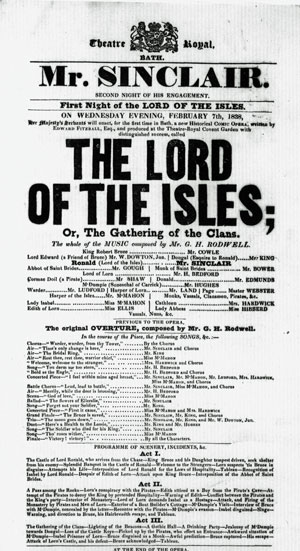
Bath playbill - see here for larger version |
Plot
The plot was based on Sir Walter Scott's poem of 1815, Lord of the Isles, but, although it is reasonably faithful to begin with, it departs from it markedly later with the climactic description of the battle of Bannockburn omitted, no doubt Fitzball judging that it would not go down well with English audiences. Subplots were added and some of the characters' relationships changed.
Jerome Mitchell has provided a detailed description of the opera in his book More Scott Operas (pp. 47-54) [1]. In brief, Ronald, Lord of the Isles, returns to Artornish Castle. He is betrothed to Edith of Lorn but there seems some doubt as to the strength of his feeling because of his attraction to Isobel, Robert the Bruce's ward. Robert the Bruce, his brother, Edward, and Isobel also arrive at the castle but in disguise, The Lord of Lorn, Edith's brother now enters. Not only is he irritated by the delay in Edith's marriage to Ronald but recognises Robert the Bruce, who has killed one of his kinsman. In the ensuing confrontation, Isobel identifies herself and Ronald's feelings towards her become immediately apparent. Edith runs away helped by her servant Cathleen.
The local Abbot has been brought in to pronounce sentence upon Robert but instead prophesises his future kingship. Isobel decides to go off to a convent and the Lord of Lorn decamps with his followers and joins some pirates. The pirates attempt to kill Robert but Edith (in disguise) saves him. The Lord of Lorn having been thwarted then attacks the monastery in revenge upon the Abbot and where Isobel has taken shelter. Isobel escapes and tries to find safety in Cathleen's grandfather's cottage. However, the pirates abduct her and take her to the Lord of Lorn, who decides to marry her. Robert turns up disguised as a monk but is again captured and sentenced to execution the next day. However his followers attack and free him. Lorn, rather surprisingly, is pardoned, Ronald is reconciled to Edith and together with Robert and Isobel and Dougal (a Fitzball invention) and Cathleen are all married.
[1] Jerome Mitchell, More Scott Operas, (Lanham, Maryland: University Press of America, 1996)
Reception
The opera was clearly very popular and the manager George Davidge was said to have cleared £700 on it [1]. Its staging at the Surrey, one of the minor theatres with no track record in opera, probably accounted for the lack of reviews. The Morning Post seems to be the only daily to give it any attention and then somewhat tongue in cheek commenting (November 22, 1834) on the libretto:-
The plot is in some small degree taken from Sir Walter Scott's poem. We need only observe that in the structure of the principal incidents the most laudable departure from history, Sir Walter Scott, probability, and common sense is persisted in, and the language is remarkable for sublime nothings and magnificent absurdities.
Its view of the music was in much the same vein.
Mr Rodwell's overture was pretty and graceful, though not very striking or original: however, it delighted the audience, and they encored it enthusiastically. The rest of the music is much of the same character - full of melodious phrases of considerable beauty, which perhaps ought not to be thought less valuable for having been heard before. We like pretty music, and think Mr Rodwell's prettiness as agreeable as another's.
It then went on to comment on the number of musical items and that half of them were encored. On December 15, 1834, it wrote that "The Lord of the Isles was repeated on Saturday night to a crowded house with immense success". Its review (December 1, 1835) of the 1835 revival at Covent Garden generally held the same opinion but expanded a little on the staging.
The piece is ... got up with great splendour. The lighting of the beacons, and the gathering of the clans, as they come up in countless numbers through the rocky defiles and mountain passes, was one of the most striking and effective things we have witnessed".
The Era (July 7, 1843) reviewed the 1843 revival at the Surrey.
The present cast is stronger, both vocally and dramatically [than in the original production]. The music possesses very considerable merit, being popularly written, and devoid of all approach to vulgarity.... it abounds with striking airs and pretty duets. ... marked by fluent melody, if not of original thought... The house was crowded, and the opera enthusiastically received.
Mitchell's modern appraisal (More Scott Operas, p. 54) is that "No revival of this opera seems likely, or warranted. However adequate the text may or may not be, the music would be of little interest today".
[1] William G. Knight, A Major London 'Minor': The Surrey Theatre, 1805-1865. (London: Society for Theatre Research, 1997), p.119
Scores and libretto
No manuscript was submitted to the Examiner for its original run because it was at the Surrey, which was not within the Lord Chamberlain's remit. The published printed libretto can be found at the Library of Congress and in Miller's Modern Acting Drama (London, Covent Garden: John Miller, 1834) at Google Books. It gives the opening night as November 2, 1834 but this may well be a typo and the press advertisements, e.g. Morning Post (November 20, 1834) and The Times (November 20, 1834), would seem the more reliable guide.
When the opera was staged at Covent Garden on November 28, 1835, a copy was sent to the Examiner that can be found in the British Library at Add MS 42933 ff.356-385b. In fact, it was an 1835 edition of the John Miller printed libretto and shows a sign-off date of December 12, 1835, i.e. after the initial Covent Garden performances. Possibly a licence had not been sought because it had been produced previously but George Colman, always alert to the opportunity to get his Examiner's fee of two guineas, might have pointed out that it had not been licenced for production within the Lord Chamberlain's jurisdiction.
The vocal score for the overture and songs is available at the British Library (sys. no. 004615976) as well as scores for individual songs.
Recordings
There are no known recordings of the opera or parts of it.
Books, Articles, Online
Jerome Mitchell, More Scott Operas. (Lanham, Maryland: University Press of America, 1996), pp. 47-54 discusses the opera in some detail.
 |
 |
 |
  |
|
|