
|


National English Opera Company
(Tully/Kingsbury : 1856-1857)
New National English Opera Company
(Tully : 1858)
(Tully:-1860)
James Howard Tully was associated with many
companies during his career both as a manager and as a
conductor. His first involvement with touring opera was in
1848-1849, see
here,
but his main efforts were in the second half of the 1850s.
The National English Opera Company
was first assembled for a season at Drury Lane in March 1856. James Tully was named as the conductor and Frederick Kingsbury as the
managing director, although on the playbill at Drury Lane he was called musical
director and was also a conductor. The company included Lucy Escott, Fanny Huddart,
Elizabeth Dyer, Augustus Braham,
Henry Haigh, Charles Manvers,
Charles Durand, Ainsley
Cook, Mr Temple and Mr J.A. Shaw. In
fact, Escott, Haigh and Durand also appear to have been involved in
the management according to Haigh's bankruptcy proceedings[1],
although only Tully and Kingsbury were advertised as such.
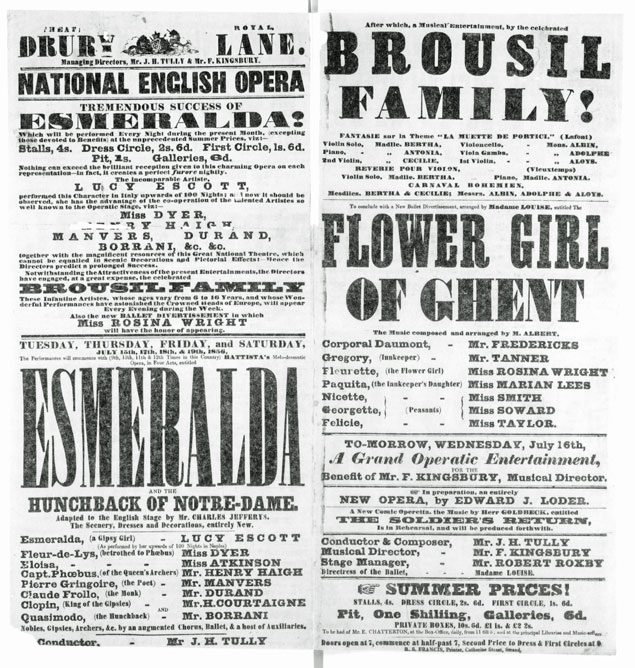
Playbill during their 1856 Drury Lane season -
British Library playbills
The repertoire included Il
Trovatore, Esmeralda [2], Maritana, Bohemian Girl, Cinderella, Fra Diavolo, Lucia di Lammermoor, Daughter of the
Regiment, La sonnambula, Der Freischutz, Norma, Lucrezia Borgia, Don Pasquale, The Beggar's Opera and The
Waterman. By the time the company reached Manchester on
August 11, they had already given over 100 performances [3]. There
they had a run of 24 nights before going on to Sheffield and Glasgow
followed by Edinburgh in the first week of October. Their visits took
place over consecutive weeks showing that they must have mastered the
logistics of touring, although it is not clear how many subsidiary
musicians and chorus as well as how much scenery the company might
also have taken with them.
There were few reviews but they received a
generally good one in Edinburgh, which was well into their itinerary,
so they were able to keep up reasonable standards. The attendance in Edinburgh was not good, which
The Era (Oct 5, 1856) put down to the company's
insistence of programming the old operas of The
Bohemian Girl and Maritana instead of doing more
performances of their English version of Verdi's Il
Trovatore. However, audiences must have been sufficiently
remunerative enough as they continued their run
in Edinburgh but at the Queen's Theatre rather than the Theatre Royal. They then went back to
Glasgow and on to Belfast, where they opened on October 23. There
they
had full houses, which, according to the Belfast News Letter
(Oct. 26, 1856) was something of a rarity at the time.
This was despite the chorus being "inefficient and the orchestra
at times unsteady" with them introducing "some startling
effects", "which were certainly not contemplated by the
composers". The performance seemed to have been kept on the
rails by Tully's piano accompaniment which "was steady as a
metronome". It was noted that "he did wonders with both chorus and
orchestra", which strongly suggests that they had been recruited locally.
They then went on to Dublin but were back in Belfast by the
end of the year.
In December 1856, Kingsbury had been
declared bankrupt and seems to have left the company by that time
possibly leaving Tully as sole manager, even though he was also
made bankrupt in early 1857. The tour continued in
the new year around several west country towns and cities. For
their stay in Cheltenham, the company included Lucy Escott,
Elizabeth Dyer, Miss Cronin, Henry Haigh, Charles Manvers,
Ainsley Cook, Mr Temple and Charles Durand. They offered Verdi's
Il Trovatore, Donizetti's Lucia di Lammermoor
and Charles Dibdin's The Waterman.[4] In
Exeter, in mid March, they offered Der Freischutz, La
Traviata, Bohemian Girl, Daughter of the Regiment, Beggar's
Opera and The Waterman, this despite "the many
obstacles that presented themselves to the ... company upon
their arrival", which, unfortunately, they did not elucidate. By May 3, 1857, they were claiming to have done 326
performances with Bath, Bristol and Cheltenham still to come [5]
before, on June 1, they began a nearly 3 month spell at the Surrey Theatre.
There, on June 8, they claimed to be giving the first performance of Verdi's
controversial La Traviata in English, although they had
advertised it for Exeter in the previous March. At the end of
August 1857, they were back in Manchester and then toured some
northern cities. However, on November 22, 1857, Mrs and
Mrs Haigh (Elizabeth Dyer) announced that that would be
accepting engagements after December 14, so clearly the company
was beginning to break up. .
In The Era (Dec. 6, 1857), Tully announced that
his current company would terminate on December 11 in Glasgow
after its 500th performance but that he would be reconstituting
it as soon as possible and asking singers to apply to join. This
suggests that there had been personnel problems rather than
because he had just been appointed music director and
composer at Drury Lane [6] and so needed to give up touring. The tour continued under the National English
Opera Company banner but with Escott as manager [7] and Edward Reyloff
as conductor.
Tully put together another company in July
1858 that included several of his former singers including the Haighs.
They performed in Portsmouth as the Grand English Opera Company
but, perhaps because other companies used that name [8], it appeared,
in August 1858, as the
New National English Opera Company
and toured almost until the end of the year. In
1859, Tully formed at least two companies, one for an abortive
season at Sadler's Wells and another at the Pavilion Theatre,
Whitechapel, but that seemed to be the limit of their activities. He also put together a company for the latter in early 1860.
In May 1860, a
Grand English Opera Company
with
Tully as musical director was advertised as appearing in Southampton
[9].
The Era (May 20, 1860) wrote that Mr Tully presided, with his
usual ability, at the piano forte", so either there was no orchestra
or it needed stiffening with Tully's piano playing. Rebecca Isaacs was
the prima donna. Leeds followed, where it went by the name of the
Metropolitan National English Opera Company and then Margate in August 1860 but no signs of
other performances have been found. In the 1860s, Tully did form ad
hoc companies for brief London stints but quite probably he was too taken up with
his Drury Lane duties to have had the time for any extensive touring.
|


